Und dann auf "Zum Home-Bildschirm [+]".

Stöbern
genialokal zum Startbildschirm hinzufügen
Installieren Sie die genialokal App auf Ihrem Startbildschirm für einen schnellen Zugriff und eine komfortable Nutzung.
Installieren Sie die genialokal App auf Ihrem Startbildschirm für einen schnellen Zugriff und eine komfortable Nutzung.


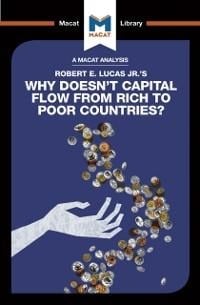
Robert Lucas is known among economists as one of the most influential macroeconomists of recent times - a reputation founded in no small part on the critical thinking skills displayed in his seminal 1990 paper 'Why Doesn't Capital Flow from Rich to Poor Countries?' Lucas's paper tackles a puzzle in economic theory that has since come to be known as the 'Lucas paradox,' and it deploys the author's brilliant problem solving skills to explain why such an apparent paradox in fact makes sense. Classical economic theory makes a simple prediction of how capital flows between countries: it should, it states, flow from rich to poor countries, because of the law of diminishing returns on capital. Since poor countries have so little capital invested in them, the returns on new investment should be proportionally far better than investment in rich countries. This should mean that investors seeking new opportunities will invest in poorer countries, making capital consistently flow from rich nations to poorer ones. But, problematically, this is not in fact the case. Having defined the problem, Lucas did what any good problem solver would: he looked critically at the criteria involved, and offered a series of possible solutions. Indeed, in just six pages, he puts forward four hypotheses to explain the paradox's existence. The popularity of his paper, and the influence it has had, are also greatly magnified by careful reasoning embodied in Lucas's marshalling of evidence and his explanations of the judgements he has made.
Pádraig Belton is completing his doctoral research in politics and international relations at the University of Oxford. A prolific financial, business and political journalist, his work has appeared in publications including the Irish Times, the Guardian, Telegraph, Independent, the Irish Independent, The Atlantic, the New Statesman, Prospect, the Times Literary Supplement, and Foreign Policy, as well as via the BBC.
Ways in to the Text Who was Robert E. Lucas Jr.? What does Why Doesn't Capital Flow from Rich to Poor Countries? Say? Why does Why Doesn't Capital Flow from Rich to Poor Countries? Matter? Section 1: Influences Module 1: The Author and the Historical Context Module 2: Academic Context Module 3: The Problem Module 4: The Author's Contribution Section 2: Ideas Module 5: Main Ideas Module 6: Secondary Ideas Module 7: Achievement Module 8: Place in the Author's Work Section 3: Impact Module 9: The First Responses Module 10: The Evolving Debate Module 11: Impact and Influence Today Module 12: Where Next? Glossary of Terms People Mentioned in the Text Works Cited
Dieses eBook wird im PDF-Format geliefert und ist mit einem Adobe Kopierschutz (DRM) versehen. Sie können dieses eBook mit allen Geräten lesen, die das PDF-Format und den Adobe Kopierschutz (DRM) unterstützen.
Zum Beispiel mit den folgenden Geräten:
• tolino Reader
Laden Sie das eBook direkt über den Reader-Shop auf dem tolino herunter oder übertragen Sie das eBook auf Ihren tolino mit einer kostenlosen Software wie beispielsweise Adobe Digital Editions.
• Sony Reader & andere eBook Reader
Laden Sie das eBook direkt über den Reader-Shop herunter oder übertragen Sie das eBook mit der kostenlosen Software Sony READER FOR PC/Mac oder Adobe Digital Editions auf ein Standard-Lesegeräte mit epub- und Adobe DRM-Unterstützung.
• Tablets & Smartphones
Möchten Sie dieses eBook auf Ihrem Smartphone oder Tablet lesen, finden Sie hier unsere kostenlose Lese-App für iPhone/iPad und Android Smartphone/Tablets.
• PC & Mac
Lesen Sie das eBook direkt nach dem Herunterladen mit einer kostenlosen Lesesoftware, beispielsweise Adobe Digital Editions, Sony READER FOR PC/Mac oder direkt über Ihre eBook-Bibliothek in Ihrem Konto unter „Meine eBooks“ - „online lesen“.
Schalten Sie das eBook mit Ihrer persönlichen Adobe ID auf bis zu sechs Geräten gleichzeitig frei.
Bitte beachten Sie, dass die Kindle-Geräte das Format nicht unterstützen und dieses eBook somit nicht auf Kindle-Geräten lesbar ist.