Und dann auf "Zum Home-Bildschirm [+]".

Stöbern
genialokal zum Startbildschirm hinzufügen
Installieren Sie die genialokal App auf Ihrem Startbildschirm für einen schnellen Zugriff und eine komfortable Nutzung.
Installieren Sie die genialokal App auf Ihrem Startbildschirm für einen schnellen Zugriff und eine komfortable Nutzung.
Ihr gewünschter Artikel ist in 0 Buchhandlungen vorrätig - wählen Sie hier eine Buchhandlung in Ihrer Nähe aus:


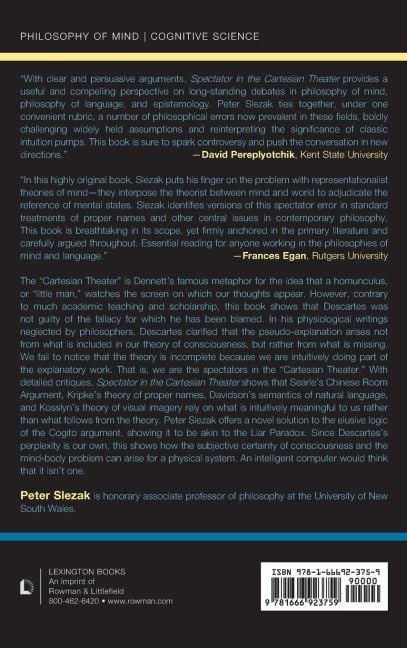
The "Cartesian Theater" is Dennett's famous metaphor for the idea that a homunculus or "little man" watches the screen on which our thoughts appear. However, contrary to much academic teaching and scholarship, Spectator in the Cartesian Theater: Where Theories of Mind Went Wrong since Descartes shows that Descartes was not guilty of this fallacy for which he has been blamed. In his physiological writings neglected by philosophers, Descartes explained that the pseudo-explanation arises not from what is included in our theory of consciousness, but rather from what is missing. We fail to notice that the theory is incomplete because we are intuitively doing part of the explanatory work. That is, we are the spectators in the Cartesian Theater.
With detailed critiques, Peter Slezak shows that Searle's Chinese Room Argument, Kripke's theory of proper names, Davidson's semantics of natural language and Kosslyn's theory of visual imagery rely on what is intuitively meaningful to us rather than what follows from the theory. Slezak offers a novel solution to the elusive logic of the Cogito argument, showing it to be akin to the Liar Paradox. Since Descartes' perplexity is our own, this shows how the subjective certainty of consciousness and the mind-body problem can arise for a physical system. An intelligent computer would think that it isn't one.
Peter Slezak is honorary associate professor of philosophy at the University of New South Wales.
Introduction: Illusions Chapter 1. Dangerous Meditations Chapter 2. Illusionism and The Phenomenological Fallacy Chapter 3. What It's Like: Conscious Experience Itself Chapter 4. Cogito, Ergo Sum: The Diagonal Deduction Chapter 5. The Mind's Eye: Visual Imagery Chapter 6. In the Chinese Room: Life without meaning Chapter 7. Meaning: Interpretation or Explanation? Chapter 8. Proper Names: The Omniscient Observer Chapter 9. The Theory of Ideas: Fodor's Guilty Passions Chapter 10. Descartes' Neurocomputational Philosophy Chapter 11. What is Knowledge? The Gettier Problem Chapter 12. Disjunctivism: The Argument from Illusion (Again) Chapter 13. Newcomb's Problem: Demons, Deceivers, and Liars Conclusion