Und dann auf "Zum Home-Bildschirm [+]".

Stöbern
genialokal zum Startbildschirm hinzufügen
Installieren Sie die genialokal App auf Ihrem Startbildschirm für einen schnellen Zugriff und eine komfortable Nutzung.
Installieren Sie die genialokal App auf Ihrem Startbildschirm für einen schnellen Zugriff und eine komfortable Nutzung.
Ihr gewünschter Artikel ist in 0 Buchhandlungen vorrätig - wählen Sie hier eine Buchhandlung in Ihrer Nähe aus:

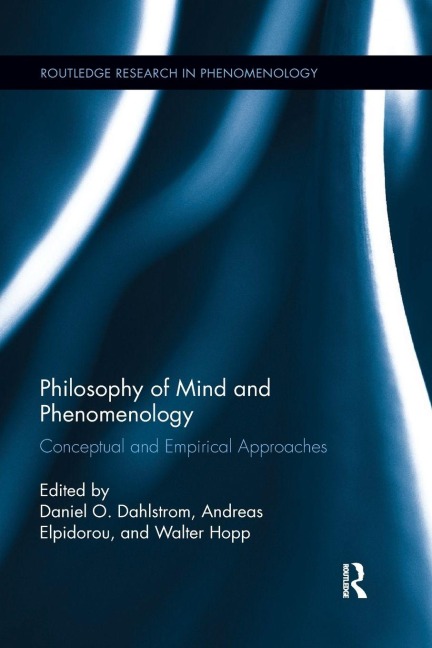
This volume identifies and develops how phenomenology and philosophy of mind interact in both conceptual and empirically-informed ways.
Daniel O. Dahlstrom is a Professor in the Department of Philosophy at Boston University, USA. Andreas Elpidorou is Visiting Assistant Professor of Philosophy, University of Louisville, USA. Walter Hopp is an Associate Professor in the Department of Philosophy at Boston University, USA.
Introduction Section I: Introspection and Phenomenal Consciousness 1. Cognitive Phenomenology David Woodruff Smith 2. For-me-ness: What It Is and What It Is Not Dan Zahavi and Uriah Kriegel Section II: Embodiment and Sociality 3. Lived Body, Intercorporeality, Intersubjectivity: The Body as a Phenomenological Theme Dermot Moran 4. The Body and Its Image in the Clinical Encounter Dorothée Legrand 5. Merleau-Ponty: Actions, Habits, and Skilled Expertise Komarine Romdenh-Romluc 6. The Minds of Others Shaun Gallagher Section III: Self-Awareness and Knowledge 7. Interoception and Self-Awareness: An Exploration in Interoceptive Phenomenology Daniel O. Dahlstrom 8. Knowing One's Own Desires Jonathan Webber 9. Phenomenal Conservatism and the Principle of All Principles Walter Hopp Section IV: Perception and Dreams 10. Hearing, Seeing, and Music in the Middle Dan Lloyd 11. Eyes Wide Shut: Sartre's Phenomenology of Dreaming Nicolas de Warren Section V: Affectivity 12. Defending a Heideggerian Account of Mood Lauren Freeman 13. The Significance of Boredom: A Sartrean Reading Andreas Elpidorou Section VI: Naturalism and Cognition 14. Prospects for a Naturalized Phenomenology Jeffrey Yoshimi 15. Bringing Philosophy Back: 4e Cognition and the Argument from Phenomenology Mark Rowlands