Und dann auf "Zum Home-Bildschirm [+]".

Stöbern
genialokal zum Startbildschirm hinzufügen
Installieren Sie die genialokal App auf Ihrem Startbildschirm für einen schnellen Zugriff und eine komfortable Nutzung.
Installieren Sie die genialokal App auf Ihrem Startbildschirm für einen schnellen Zugriff und eine komfortable Nutzung.
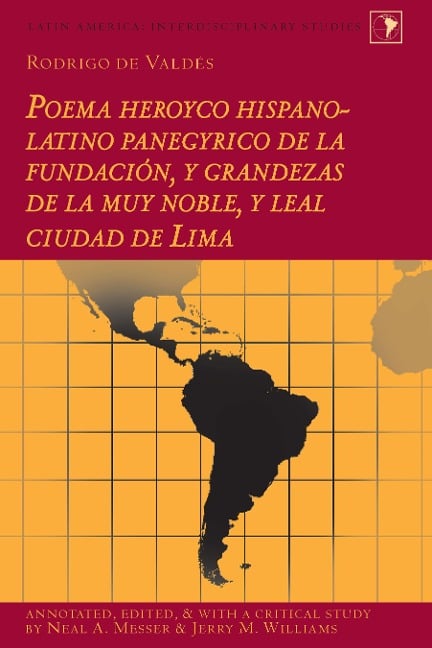

Poema heroyco hispano-latino (1687), a national chronicle or "epic poem," commemorates the founding and greatness of Lima, Peru. Its unique rhymed quatrains can be read in either Latin or Spanish with equal meaning, and its insightful marginal notes interpret the city's cultural history. Rodrigo de Valdés (1609-1682) underscores the decadence of peninsular Spanish letters in contrast to the compositions of New World writers. The poem is a tribute to the superiority, versatility, and interchangeability of Spanish and Latin as instruments of power that led to Spain's world dominance, and to Lima as the locus of marvels and a quasi biblical garden of delights. Lima has occupied without exception a privileged space within the colonial situation, as a metaphorical sovereign of new-world experiences and potentialities. Influenced by the spirit of Baroque sensibilities and Creole pride in his patria, Valdés bequeathed to Lima a staged panegyric that served as King Charles II's introduction to the bounty of his American colony. Valdés, acting as commentator, guides the reader through a journey that spans centuries of Peru's illustrious history. Working within the classical tradition of laus urbis or the praise of cities, Valdés depicts America as a paradise found with Lima at its center. In tracing the poem's relationship to the genre of classical panegyrics, Neal A. Messer and Jerry M. Williams argue its literary merits and elucidate how it enriches the colonial family of Latin American texts. Republished for the first time, this critical edition introduces Valdés to students and scholars of Ibero-American letters.
Neal A. Messer has published and lectured on colonial Latin American literature and history, and is currently preparing an edition of Andrés de León's Historia del huérfano (1621). He holds a Ph.D. in Hispanic studies from University of Kentucky. Jerry M. Williams, retired chairperson of the Department of Languages and Cultures at West Chester University, Pennsylvania, is the author of numerous books and essays on colonial historiography of the sixteenth and eighteenth centuries. He received a Ph.D. in Spanish from Yale University.
List of Illustrations - Foreword - Acknowledgments - List of Abbreviations - Introduction: A Lost Work Revived - A Puzzle Missing Pieces - Complexity by Design - Hispano-Latin Poetry: A Direct Link to Rome - Dual Language Authority - An Extension of Góngora - Education in a Poem - A Tribute to the City of Kings - Valdés and His Critics: A Poem Misunderstood - Poema heroyco's Front Matter: Honoring a Departed Author - Paragraph Synopses - Notes - Poema heroyco hispano-latino panegyrico de la fundación y grandezas de la muy noble y leal ciudad de Lima - Front Matter - Text - Notes and Latin Translations - Index of Latin Authors Quoted in Valdés' Commentary - Bibliography.
Dieses eBook wird im PDF-Format geliefert und ist mit einem Adobe Kopierschutz (DRM) versehen. Sie können dieses eBook mit allen Geräten lesen, die das PDF-Format und den Adobe Kopierschutz (DRM) unterstützen.
Zum Beispiel mit den folgenden Geräten:
• tolino Reader
Laden Sie das eBook direkt über den Reader-Shop auf dem tolino herunter oder übertragen Sie das eBook auf Ihren tolino mit einer kostenlosen Software wie beispielsweise Adobe Digital Editions.
• Sony Reader & andere eBook Reader
Laden Sie das eBook direkt über den Reader-Shop herunter oder übertragen Sie das eBook mit der kostenlosen Software Sony READER FOR PC/Mac oder Adobe Digital Editions auf ein Standard-Lesegeräte mit epub- und Adobe DRM-Unterstützung.
• Tablets & Smartphones
Möchten Sie dieses eBook auf Ihrem Smartphone oder Tablet lesen, finden Sie hier unsere kostenlose Lese-App für iPhone/iPad und Android Smartphone/Tablets.
• PC & Mac
Lesen Sie das eBook direkt nach dem Herunterladen mit einer kostenlosen Lesesoftware, beispielsweise Adobe Digital Editions, Sony READER FOR PC/Mac oder direkt über Ihre eBook-Bibliothek in Ihrem Konto unter „Meine eBooks“ - „online lesen“.
Schalten Sie das eBook mit Ihrer persönlichen Adobe ID auf bis zu sechs Geräten gleichzeitig frei.
Bitte beachten Sie, dass die Kindle-Geräte das Format nicht unterstützen und dieses eBook somit nicht auf Kindle-Geräten lesbar ist.