Und dann auf "Zum Home-Bildschirm [+]".

Stöbern
genialokal zum Startbildschirm hinzufügen
Installieren Sie die genialokal App auf Ihrem Startbildschirm für einen schnellen Zugriff und eine komfortable Nutzung.
Installieren Sie die genialokal App auf Ihrem Startbildschirm für einen schnellen Zugriff und eine komfortable Nutzung.
Ihr gewünschter Artikel ist in 0 Buchhandlungen vorrätig - wählen Sie hier eine Buchhandlung in Ihrer Nähe aus:

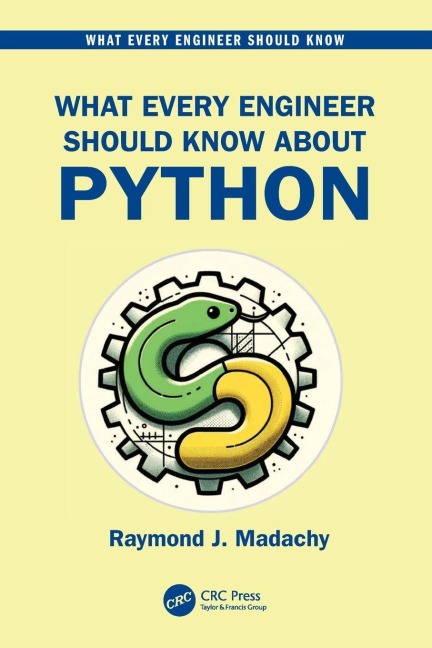
This book provides engineering students and practitioners with a simple and practical introduction to Python for technical programming and other empowering uses for engineering and scientific work, without computer science jargon.
Raymond Madachy, Ph.D., is a Professor in the Systems Engineering Department at the Naval Postgraduate School. He has over 30 years of experience working in industry, academia, and consulting in technical and management positions. He received his B.S. in Mechanical Engineering from the University of Dayton, an M.S in System Science from University of California, San Diego, and his Ph.D. in Industrial and Systems Engineering from the University of Southern California. His research interests include system cost modeling, affordability and tradespace analysis, modeling and simulation of systems and software engineering processes, integrating systems engineering and software engineering disciplines, and systems modeling tool environments for digital engineering. He recently created and is lead developer for the open-source Python Modeling Library (PyML) for system modeling. His books include Software Process Dynamics, Software Cost Estimation with COCOMO II, Software Cost Estimation Metrics Manual for Defense Systems, and What Every Engineer Should Know about Modeling and Simulation, and he is currently writing Systems Engineering Principles for Software Engineers.
i. Front Matter. 0. Introduction. 1. Language Overview. 2. General Purpose Scientific and Utility Libraries. 3. Engineering Analysis Examples. 4. Python Applications. 5. Processes and Tools. End Matter I. Appendix A: Keywords and Built-in Functions. End Matter II. References.