Und dann auf "Zum Home-Bildschirm [+]".

Stöbern
genialokal zum Startbildschirm hinzufügen
Installieren Sie die genialokal App auf Ihrem Startbildschirm für einen schnellen Zugriff und eine komfortable Nutzung.
Installieren Sie die genialokal App auf Ihrem Startbildschirm für einen schnellen Zugriff und eine komfortable Nutzung.
Ihr gewünschter Artikel ist in 0 Buchhandlungen vorrätig - wählen Sie hier eine Buchhandlung in Ihrer Nähe aus:

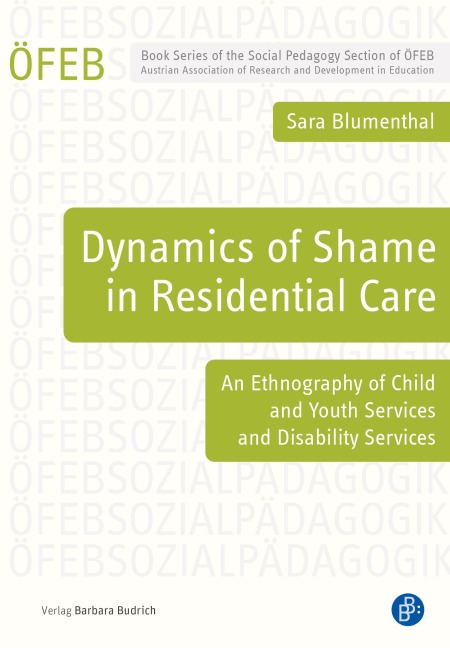
In this book, the author uses an ethnographic approach to examine shame dynamics in residential care for young people in Austria. The study explores shame dynamics in the context of pedagogical responses to violence from the perspective of young males, education-related shaming as a pedagogical sanction of girls by care workers, as well as suicidal behaviour as a cause of shame and guilt among care workers and young people in residential care. Drawing on grounded theory, the findings are theorised with reference to epistemic violence and to the role of shame in pedagogical tasks such as the upbringing of young people.
Sara Blumenthal is an assistant professor at the Research Unit for Social Pedagogy and Inclusion Research, Department of Educational Science, University of Klagenfurt, Austria.
Introduction 1 State of research on residential care for young people 1.1 An insight into the historical genesis of today's child and youth services in Austria 1.2 Perspectives on the history of violence in child and youth services in Austria 1.3 An insight into the historical genesis of care for children and young people funded by disability services 2 References to affect and shame theory 2.1 The concept of affect in this study 2.2 Social functions of shame: relationship regulation 2.3 Social functions of shame: incorporation of social orders 2.4 Social functions of shame: negotiating social conformity by confronting emotional norms 2.5 Hatred, anger, contempt, and aggression 2.6 Affects in the context of aggression and violence 3 Methods: Ethnographic research into shame and other affects in residential care 3.1 Participant observation 3.2 Semi-structured interviews 3.3 Data analysis and interpretation 3.4 Ethical issues 4 Shame dynamics in residential care of young people 4.1 Shame dynamics inbetween the emotional stress of care workers and their pedagogical scope of action 4.2 Shame dynamics in the context of the pedagogical handling of violence from the perspective of young males 4.3 Education-related shaming as a pedagogical sanction of girls by care workers 4.4 Suicidal behaviour as a cause of shame and guilt among care workers and young people in residential care 5 The social functions of shame with a focus on the pedagogical behaviour of care workers in residential care 5.1 Stigmatisation of young people in institutions by care workers as epistemic violence 5.2 Education-related shaming as an educational sanction for young people in the context of social orders 5.3 Conclusions on professionalisation processes in residential care Outlook - quo vadis residential care? Literature Index