Und dann auf "Zum Home-Bildschirm [+]".

Stöbern
genialokal zum Startbildschirm hinzufügen
Installieren Sie die genialokal App auf Ihrem Startbildschirm für einen schnellen Zugriff und eine komfortable Nutzung.
Installieren Sie die genialokal App auf Ihrem Startbildschirm für einen schnellen Zugriff und eine komfortable Nutzung.
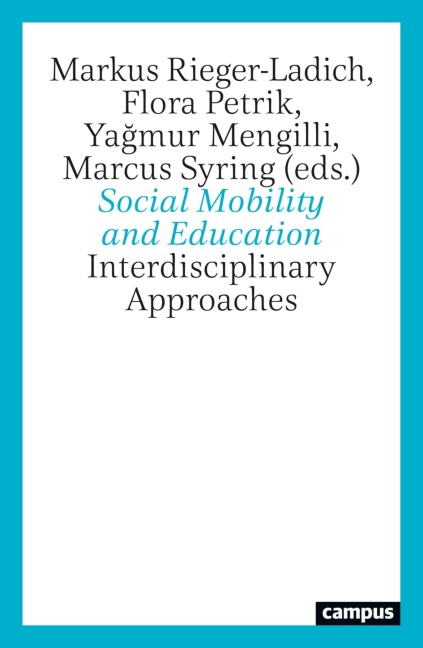

This edited volume explores the shifting meaning of educational mobility in a context where the traditional narrative of meritocratic success has lost much of its plausibility. Recent research shows that upwardly mobile individuals often experience their trajectories as deeply ambivalent: educational institutions do not simply open opportunities but also participate in processes of social closure. Schools and universities distribute chances, intervene in biographies, and regulate entries, transitions, and exits within educational pathways. While sociology of education has long shaped debates on mobility, literary studies, cultural studies, and history offer additional perspectives that illuminate overlooked tensions and unsettle taken-for-granted assumptions. By bringing these approaches into dialogue, the volume addresses the complexity and contradictions of educational mobility at conceptual, methodological, and empirical levels. It foregrounds the tensions that shape mobility: the relation between education and social ascent; the entanglement of mobility with class, gender, and migration; and the milieus and conflicts into which mobile individuals are incorporated.
creativecommons.org/licenses/by/4.0/
Prof. Dr. Markus Rieger-Ladich lehrt Allgemeine Erziehungswissenschaft an der Universität Tübingen und engagiert sich im Institut für Rechtsextremismusforschung (IRex). Er ist Mitglied des GRK »Doing Transitions« sowie des Netzwerks »Theoretische Forschung in der Erziehungswissenschaft«.
Markus Rieger-Ladich holds the Chair of Philosophy of Education at the University of Tübingen and is affiliated with the Institute for Research on Far Right Extremism. He is a member of the DFG Research Training Group »Doing Transitions« and the DFG Network »Theoretical Research in Educational Science.« Flora Petrik ist wissenschaftliche Mitarbeiterin am Institut für Erziehungswissenschaft der Universität Tübingen. Zu ihren Schwerpunkten zählen soziale Ungleichheit und Bildung (insbesondere Bourdieu'sche Perspektiven auf soziale Herkunft) sowie Wissenschaftstheorie und qualitative Sozialforschung.
Flora Petrik is a post-doctoral researcher at the University of Tübingen where she focuses on social inequality in education. Her work, rooted in a qualitative approach, centers around class and social mobility, Bourdieu's theory of practice as well as epistemological and methodological questions. Yagmur Mengilli ist Juniorprofessorin (mit Tenure Track) für Sozialpädagogik mit einer transnationalen Grundausrichtung auf die Schwerpunkte auf Jugend und Gender. Sie forscht und lehrt zu sozialpädagogischen Fragestellungen und jugendkulturellen Ausdrucksformen.
Yagmur Mengilli is a junior professor (tenure track) for social pedagogy with a transnational focus on youth and gender. Her research and teaching activities focus on social pedagogical issues and forms of expression in youth culture. Marcus Syring ist Professor für Erziehungswissenschaft mit dem Schwerpunkt Schulpädagogik. Er forscht und lehrt zu Fragen von Differenz und Heterogenität in Schule und Unterricht, Klassenführung und Bildungsungleichheit.
Marcus Syring is a professor of education with a focus on school pedagogy. He researches and teaches on issues of difference and heterogeneity in schools and teaching, classroom management, and educational inequality.