Und dann auf "Zum Home-Bildschirm [+]".

Stöbern
genialokal zum Startbildschirm hinzufügen
Installieren Sie die genialokal App auf Ihrem Startbildschirm für einen schnellen Zugriff und eine komfortable Nutzung.
Installieren Sie die genialokal App auf Ihrem Startbildschirm für einen schnellen Zugriff und eine komfortable Nutzung.


Ihr gewünschter Artikel ist in 0 Buchhandlungen vorrätig - wählen Sie hier eine Buchhandlung in Ihrer Nähe aus:

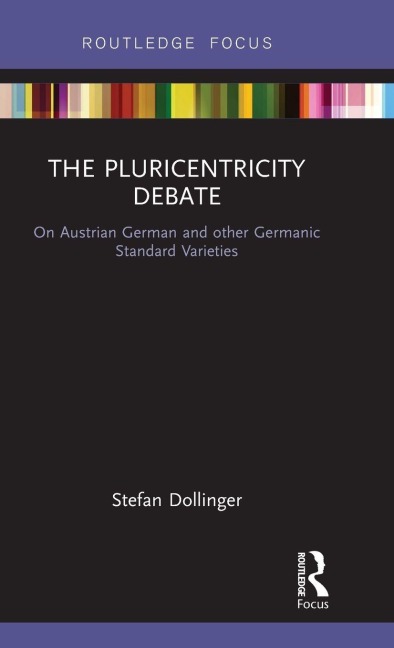
This book unpacks ongoing debates on pluricentricity, an idea implicit to the study of World Englishes which considers differing standards or local norms in a language's national varieties, with a focus on the emergent counter-perspective of "pluri-areality" as exemplified in the German language.
Stefan Dollinger is Associate Professor at UBC Vancouver, specializing in historical linguistics, sociolinguistics and linguistic border studies. He is the author of New-Dialect Formation in Canada (2008) and The Written Questionnaire in Social Dialectology (2015), and Chief Editor of the Dictionary of Canadianisms on Historical Principles - www.dchp.ca/dchp2 (2017).
Table of Contents List of tables List of illustrations Preface Acknowledgements Terminological Note 1 The problem 1.1 What is pluricentricity? 1.2 What is pluri-areality? 1.3 Pluricentricity in the world 1.4 Pluricentricity in the Germanic languages 1.5 An outline of the book 2 Standardizing German: concepts and background 2.1 Contiguous borders vs. sea borders 2.2 What's in a name? 2.3 The standardization of written German 2.4 Abstand, ausbau language and "roofing" 3 The international pluricentric model 3.1 English 3.2 Northern Germanic 3.3 Belgian Dutch (Flemish) and Dutch Dutch 3.4 Luxembourgish 4 The German "pluri-areal" model 4.1 Dialectological context 4.2 Pluricentric and monocentric models of German 4.3 The Upper Austrian - Bavarian border 4.4 A pluricentrist turned pluri-arealist 5 The case against pluricentricity 5.1 Pluricentricity and the Österreichisches Wörterbuch (ÖWB) 5.2 The charge of ideology vs. enregistering ideology 5.3 The pluri-arealist bias 5.4 Reinterpreting Auer (2005) 5.5 Pluricentricity: outdated in a borderless Europe vs. homo nationalis? 6 The case against "pluri-areality" 6.1 Demystifying pluri-areality = "geographical variation" 6.2 A-theoretical empiricism 6.3 The Axiom of Categoricity 6.4 Type vs. tokens and social salience 6.5 Formulae in a black box 7 The lynchpin: speaker attitudes 7.1 State Nation Austria vs. Nation State Germany 7.2 Linguistic insecurity 7.3 German mother-tongue language instruction 7.4 Language planning and pedagogy 8 Examples: trends, not categoricity 8.1 An undetected Austrianism: Anpatzen 'make disreputable' 8.2 An unlikely Austrianism: der Tormann 'goal tender' 8.3 An even unlikelier Austrianism: hudeln 8.4 An enregistered Austrianism: es geht sich (nicht) aus 8.5 A typology of Austrianisms 9 Safeguards in the Modelling of Standard Varieties 9.1 The Uniformitarian Principle: "vertical" and "horizontal" 9.2 Explicit and falsifiable theories 9.3 "The speaker is always right": pedagogical implications 9.4 The language political angle of "pluri-areality" 9.5 Considering political borders 10 Bibliography General Index