Und dann auf "Zum Home-Bildschirm [+]".

Stöbern
genialokal zum Startbildschirm hinzufügen
Installieren Sie die genialokal App auf Ihrem Startbildschirm für einen schnellen Zugriff und eine komfortable Nutzung.
Installieren Sie die genialokal App auf Ihrem Startbildschirm für einen schnellen Zugriff und eine komfortable Nutzung.


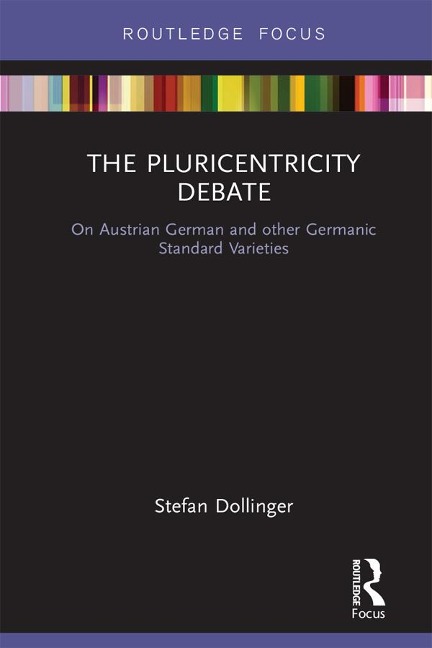
This book unpacks a 30-year debate about the pluricentricity of German. It examines the concept of pluricentricity, an idea implicit to the study of World Englishes, which expressly allows for national standard varieties, and the notion of "pluri-areality," which seeks to challenge the former. Looking at the debate from three angles - methodological, theoretical, and epistemological - the volume draws on data from German and English, with additional perspectives from Dutch, Luxembourgish, Swedish, Danish and Norwegian, to establish if and to what degree "pluri-areality" and pluricentricity model various sociolinguistic situations adequately. Dollinger argues that "pluri-areality" is synonymous with "geographical variation" and, as such, no match for pluricentricity. Instead, "pluri-areality" presupposes an atheoretical, supposedly "neutral", data-driven linguistics that violates basic science-theoretical principles. Three fail-safes are suggested - the uniformitarian hypothesis, Popper's theory of falsification and speaker attitudes - to avoid philological incompatibilities and terminological clutter. This book is of particular interest to scholars in sociolinguistics, World Englishes, Germanic languages and linguists more generally.
Stefan Dollinger is Associate Professor at UBC Vancouver, specializing in historical linguistics, sociolinguistics and linguistic border studies. He is the author of New-Dialect Formation in Canada (2008) and The Written Questionnaire in Social Dialectology (2015), and Chief Editor of the Dictionary of Canadianisms on Historical Principles - www.dchp.ca/dchp2 (2017).
Table of Contents List of tables List of illustrations Preface Acknowledgements Terminological Note 1 The problem 1.1 What is pluricentricity? 1.2 What is pluri-areality? 1.3 Pluricentricity in the world 1.4 Pluricentricity in the Germanic languages 1.5 An outline of the book 2 Standardizing German: concepts and background 2.1 Contiguous borders vs. sea borders 2.2 What's in a name? 2.3 The standardization of written German 2.4 Abstand, ausbau language and "roofing" 3 The international pluricentric model 3.1 English 3.2 Northern Germanic 3.3 Belgian Dutch (Flemish) and Dutch Dutch 3.4 Luxembourgish 4 The German "pluri-areal" model 4.1 Dialectological context 4.2 Pluricentric and monocentric models of German 4.3 The Upper Austrian - Bavarian border 4.4 A pluricentrist turned pluri-arealist 5 The case against pluricentricity 5.1 Pluricentricity and the Österreichisches Wörterbuch (ÖWB) 5.2 The charge of ideology vs. enregistering ideology 5.3 The pluri-arealist bias 5.4 Reinterpreting Auer (2005) 5.5 Pluricentricity: outdated in a borderless Europe vs. homo nationalis? 6 The case against "pluri-areality" 6.1 Demystifying pluri-areality = "geographical variation" 6.2 A-theoretical empiricism 6.3 The Axiom of Categoricity 6.4 Type vs. tokens and social salience 6.5 Formulae in a black box 7 The lynchpin: speaker attitudes 7.1 State Nation Austria vs. Nation State Germany 7.2 Linguistic insecurity 7.3 German mother-tongue language instruction 7.4 Language planning and pedagogy 8 Examples: trends, not categoricity 8.1 An undetected Austrianism: Anpatzen 'make disreputable' 8.2 An unlikely Austrianism: der Tormann 'goal tender' 8.3 An even unlikelier Austrianism: hudeln 8.4 An enregistered Austrianism: es geht sich (nicht) aus 8.5 A typology of Austrianisms 9 Safeguards in the Modelling of Standard Varieties 9.1 The Uniformitarian Principle: "vertical" and "horizontal" 9.2 Explicit and falsifiable theories 9.3 "The speaker is always right": pedagogical implications 9.4 The language political angle of "pluri-areality" 9.5 Considering political borders 10 Bibliography General Index
Dieses eBook wird im PDF-Format geliefert und ist mit einem Adobe Kopierschutz (DRM) versehen. Sie können dieses eBook mit allen Geräten lesen, die das PDF-Format und den Adobe Kopierschutz (DRM) unterstützen.
Zum Beispiel mit den folgenden Geräten:
• tolino Reader
Laden Sie das eBook direkt über den Reader-Shop auf dem tolino herunter oder übertragen Sie das eBook auf Ihren tolino mit einer kostenlosen Software wie beispielsweise Adobe Digital Editions.
• Sony Reader & andere eBook Reader
Laden Sie das eBook direkt über den Reader-Shop herunter oder übertragen Sie das eBook mit der kostenlosen Software Sony READER FOR PC/Mac oder Adobe Digital Editions auf ein Standard-Lesegeräte mit epub- und Adobe DRM-Unterstützung.
• Tablets & Smartphones
Möchten Sie dieses eBook auf Ihrem Smartphone oder Tablet lesen, finden Sie hier unsere kostenlose Lese-App für iPhone/iPad und Android Smartphone/Tablets.
• PC & Mac
Lesen Sie das eBook direkt nach dem Herunterladen mit einer kostenlosen Lesesoftware, beispielsweise Adobe Digital Editions, Sony READER FOR PC/Mac oder direkt über Ihre eBook-Bibliothek in Ihrem Konto unter „Meine eBooks“ - „online lesen“.
Schalten Sie das eBook mit Ihrer persönlichen Adobe ID auf bis zu sechs Geräten gleichzeitig frei.
Bitte beachten Sie, dass die Kindle-Geräte das Format nicht unterstützen und dieses eBook somit nicht auf Kindle-Geräten lesbar ist.