Und dann auf "Zum Home-Bildschirm [+]".

Stöbern
genialokal zum Startbildschirm hinzufügen
Installieren Sie die genialokal App auf Ihrem Startbildschirm für einen schnellen Zugriff und eine komfortable Nutzung.
Installieren Sie die genialokal App auf Ihrem Startbildschirm für einen schnellen Zugriff und eine komfortable Nutzung.
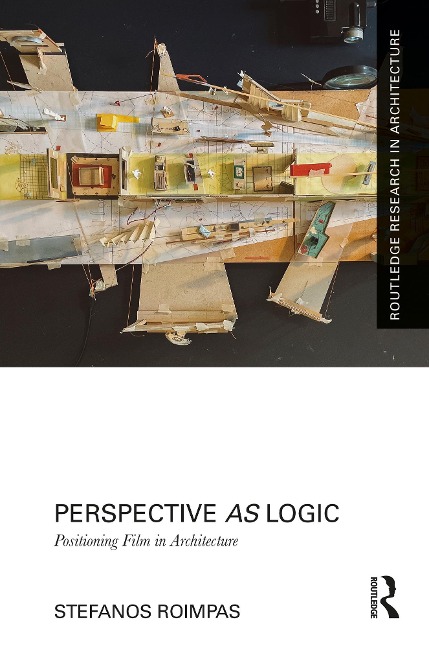
Perspective as Logic offers an architectural examination of the filmic screen as an ontologically unique element in the discipline's repertoire. The book determines the screen's conditions of possibility by critically asking not what a screen means, but how it can mean anything of architectural significance. Based on this shift of enquiry towards the question of meaning, it introduces Jacques Lacan and Alain Badiou in an unprecedented way to architecture-since they exemplify an analogous shift of perspective towards the question of the subject and the question of being accordingly. The book begins by positing perspective projection as being a logical mapping of space instead of a matter of sight (Alberti & Lacan). Secondly, it discusses the very nature of architecture's view and relation to the topological notion of outside between immediacy and mediation (Diller and Scofidio, The Slow House). It examines the limitation of pictorial illusion and the productive negativity in the suspension of architecture's signified equivalent to language's production of undecidable propositions (Eisenman & Badiou). In addition, the book outlines the difference between the point of view and the vanishing point by introducing two different conceptions of infinity (Michael Webb, Temple Island). Finally, a series of design experiments playfully shows how the screen exemplifies architecture's self-reflexive capacity where material and immaterial components are part of the spatial conception to which they refer and produce. This book will be particularly appealing to scholars of architectural theory, especially those interested in the domains of philosophy, psychoanalysis and the linguistic turn of architecture.
Stefanos Roimpas (Athens, 1989) is an architect who recently completed his PhD thesis entitled Screen: The Intersectional Element of Architecture (2022) at the University of Cambridge with the supervision of Prof François Penz. His diploma project at École Spéciale d'Architecture-Paris (ESA) entitled The Lens City with the supervision of Sir Peter Cook was shortlisted for the RIBA Silver Medal (2013). He has previously worked for Office for Metropolitan Architecture (OMA) in Rotterdam and co-curated the Cyprus Pavilion, Anatomy of the Wallpaper, at the 14th Venice Biennale (2014).
List of Figures. Acknowledgements. Introduction. 1.Positioning the Screen: Logic of Perspective. 2.Problematising the Screen: Duality of Representation. 3.Analysing the Screen: Vision and Mediation. 4.Questioning the Screen: Architectural Limits of Representation. 5.Demonstrating the Screen: Undoing the Showing. Conclusion. Index.
Dieses eBook wird im PDF-Format geliefert und ist mit einem Adobe Kopierschutz (DRM) versehen. Sie können dieses eBook mit allen Geräten lesen, die das PDF-Format und den Adobe Kopierschutz (DRM) unterstützen.
Zum Beispiel mit den folgenden Geräten:
• tolino Reader
Laden Sie das eBook direkt über den Reader-Shop auf dem tolino herunter oder übertragen Sie das eBook auf Ihren tolino mit einer kostenlosen Software wie beispielsweise Adobe Digital Editions.
• Sony Reader & andere eBook Reader
Laden Sie das eBook direkt über den Reader-Shop herunter oder übertragen Sie das eBook mit der kostenlosen Software Sony READER FOR PC/Mac oder Adobe Digital Editions auf ein Standard-Lesegeräte mit epub- und Adobe DRM-Unterstützung.
• Tablets & Smartphones
Möchten Sie dieses eBook auf Ihrem Smartphone oder Tablet lesen, finden Sie hier unsere kostenlose Lese-App für iPhone/iPad und Android Smartphone/Tablets.
• PC & Mac
Lesen Sie das eBook direkt nach dem Herunterladen mit einer kostenlosen Lesesoftware, beispielsweise Adobe Digital Editions, Sony READER FOR PC/Mac oder direkt über Ihre eBook-Bibliothek in Ihrem Konto unter „Meine eBooks“ - „online lesen“.
Schalten Sie das eBook mit Ihrer persönlichen Adobe ID auf bis zu sechs Geräten gleichzeitig frei.
Bitte beachten Sie, dass die Kindle-Geräte das Format nicht unterstützen und dieses eBook somit nicht auf Kindle-Geräten lesbar ist.