Und dann auf "Zum Home-Bildschirm [+]".

Stöbern
genialokal zum Startbildschirm hinzufügen
Installieren Sie die genialokal App auf Ihrem Startbildschirm für einen schnellen Zugriff und eine komfortable Nutzung.
Installieren Sie die genialokal App auf Ihrem Startbildschirm für einen schnellen Zugriff und eine komfortable Nutzung.
Ihr gewünschter Artikel ist in 0 Buchhandlungen vorrätig - wählen Sie hier eine Buchhandlung in Ihrer Nähe aus:

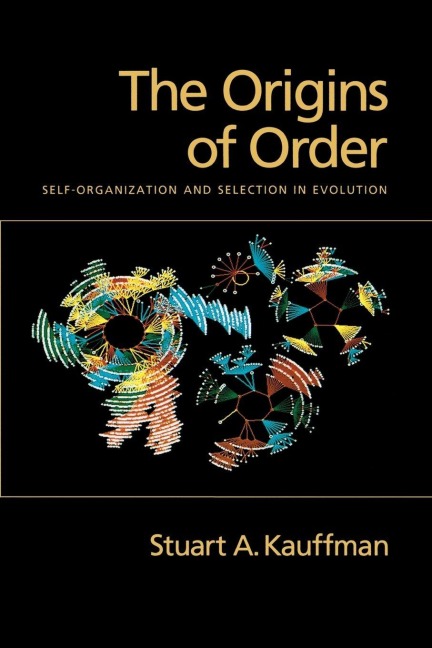
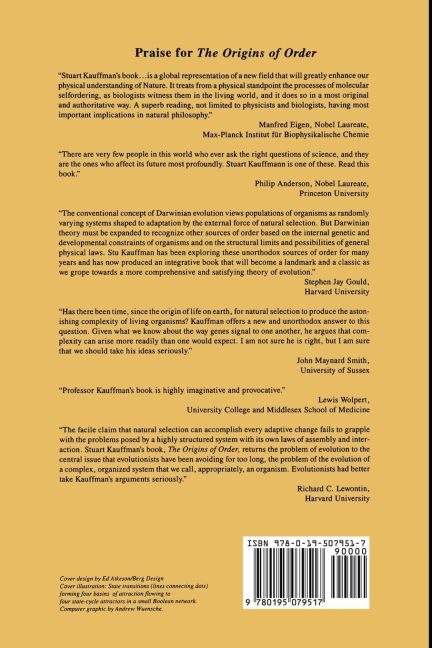
Kauffman here presents a brilliant new paradigm for evolutionary biology, one that extends the basic concepts of Darwinian evolution to accommodate recent findings and perspectives from the fields of biology, physics, chemistry, and mathematics. The book drives to the heart of the exciting debate on the origins of life and maintenance of order in complex biological systems. It explores the concept of self-organization into evolutionary theory--the extent to which selection itself can yield systems able to adapt more successfull. The approaches investigated here may prove to be the new center around which biological science itself may evolove. The work is written for all those interested in the cutting edge of research in the life sciences, including students and researchers in the fields of physics, biophysics, biochemistry, molecular biology, cell and developmental biophysics, biochemistry, molecular biology, cell and developmental biology, ecology, mathematics, philosophy, computer science, and social science. 273 illustration.
Stuart Kauffman, M.D., is a MacArthur Fellow, and a philosopher, biologist, evolutionary theorist, and one of the founders of the discipline known as complexity.
1: Conceptual outline of current evolutionary theory
Part I: Adaptation on the edge of chaos
2: The structure of rugged fitness landscapes
3: Biological implications of rugged fitness landscapes
4: The structure of adaptive landscapes underlying protein evolution
5: Self organization and adaptation in complex systems
6: Coevolving complex systems
Part II: The crystallization of life
7: The origins of life: a new view
8: The origin of a connected metabolism
9: Autocatalytic polynucleotide systems: hypercycles, spin glasses and coding
10: Random grammars
Part III: Order and ontogeny
11: The architecture of genetic regulatory circuits and its evolution
12: Differentiation: the dynamical behaviors of genetic regulatory networks
13: Selection for gene expression in cell type
14: Morphology, maps and the spatial ordering of integrated tissues