Und dann auf "Zum Home-Bildschirm [+]".

Stöbern
genialokal zum Startbildschirm hinzufügen
Installieren Sie die genialokal App auf Ihrem Startbildschirm für einen schnellen Zugriff und eine komfortable Nutzung.
Installieren Sie die genialokal App auf Ihrem Startbildschirm für einen schnellen Zugriff und eine komfortable Nutzung.
Ihr gewünschter Artikel ist in 0 Buchhandlungen vorrätig - wählen Sie hier eine Buchhandlung in Ihrer Nähe aus:

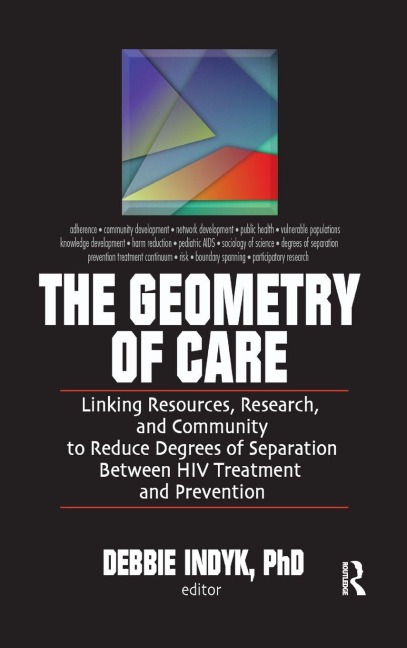
An effective strategy to deal with the AIDS epidemic is to have a wide range of scientists, clinicians, front-line workers, and clients distribute theory, care, and resource knowledge geometrically through all levels. The Geometry of Care: Linking Resources, Research, and Community to Reduce Degrees of Separation Between HIV Treatment and Prevention shows how to link bottom-up and top-down approaches to advance care, services, resources, training, theory, and policy analysis. Leading authorities draw upon behavioral and organizational theory to discuss the development of the frameworks necessary to effectively disseminate knowledge to benefit those needing care and to protect the community from further risk.
Debbie Indyk
Chapter 1 Overview of Issue, Debbie Indyk; Part 1 SYSTEM- AND PROGRAM-LEVEL GEOMETRY; Chapter 2 The Rationale of Interorganizational Linkages to Connect Multiple Sites of Expertise, Knowledge Production, and Know ledge Transfer: An Example from HIV/AIDS Services for the Inner City, David A. Rier, PhD, Debbie Indyk, PhD; Chapter 3 Wiring the HIV/AIDS System: Building Interorganizational Infrastructure to Link People, Sites, and Networks, Debbie Indyk, PhD, David A. Rier, PhD; Chapter 4 Collecting Data Along the Continuum of Prevention and Care: A Continuous Quality Improvement Approach, Leonard Indyk, PhD, Debbie Indyk, PhD; Chapter 5 A Community-Based Organization's Integration of HIV and Substance Abuse Treatment Services for Ex-Offenders, Danielle Strauss, MPH; Chapter 6 Culture, Community Networks, and HIV/AIDS Outreach Opportunities in a South Indian Siddha Organization, Kaylan Bahan, Scott Ikeda, Deeangelee Pooran, Nils Hennig, MD, PhD, Debbie Indyk, PhD, Henry Sacks, MD, PhD, George Carter; Chapter 7 Requisites, Benefits, and Challenges of Sustainable HIV/AIDS System-Building: Where Theory Meets Practice, Debbie Indyk, PhD, David A. Rier, PhD; Part 2 PATIENT-LEVEL GEOMETRY: ADHERENCE AND UNCERTAINTY-THE CHALLENGE OF PRACTICING CHANGE WHILE CHANGING PRACTICE; Chapter 8 The Shifting Locus of Risk-Reduction: The Critical Role of HIV Infected Individuals, Debbie Indyk, PhD, Sarit A. Golub, PhD; Chapter 9 Flexible Rigidity: Supporting HIV Treatment Adherence in a Rapidly-Changing Treatment Environment, David A. Rier, PhD, Debbie Indyk, PhD; Chapter 10 Shaping Garments of Care: Tools for Maximizing Adherence Potential, Ann Boyer, MD, Debbie Indyk, PhD; Chapter 11 Reframing HIV Adherence as Part of the Experience of Illness, Sarit A. Golub, PhD, Debbie Indyk, PhD, Milton L. Wainberg, MD; Chapter 12 Pediatric HIV Adherence: An Ever-Evolving Challenge, Jocelyn Childs, LCSW, Nancy Cincotta, LCSW; Chapter 13 Patient-Provider Relationships, HIV, and Adherence: Requisites for a Part nership, Arlyn Apollo, MD, MPH, Sarit A. Golub, PhD, Milton L. Wainberg, MD, Debbie Indyk, PhD; Chapter 14 HIV-Infected Individuals as Part ners in Prevention: A Redefinition of the Part ner Notification Process, Sarit A. Golub, PhD, Debbie Indyk, PhD; Chapter 15 The STARK Study: A Cross-Sectional Study of Adherence to Short-Term Drug Regimens in Urban Kenya, Ann E. Ellis, BSE, Rebecca P. Gogel, AB, Benjamin R. Roman, BA, James B. Watson, MPH (candidate), Debbie Indyk, PhD, Gary Rosenberg, PhD;