Und dann auf "Zum Home-Bildschirm [+]".

Stöbern
genialokal zum Startbildschirm hinzufügen
Installieren Sie die genialokal App auf Ihrem Startbildschirm für einen schnellen Zugriff und eine komfortable Nutzung.
Installieren Sie die genialokal App auf Ihrem Startbildschirm für einen schnellen Zugriff und eine komfortable Nutzung.
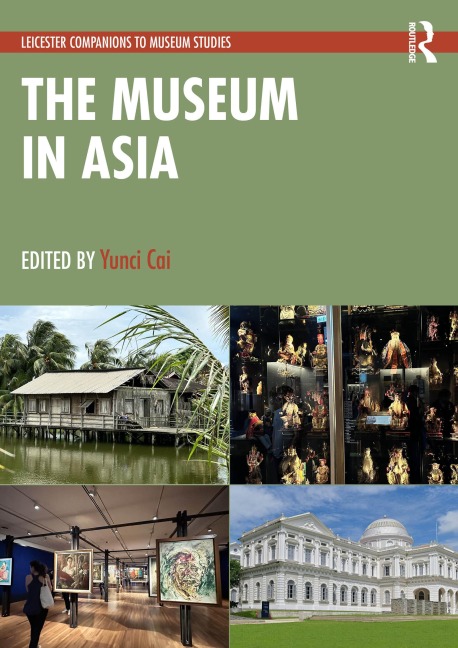
The Museum in Asia advances an understanding of the flourishing museum landscape in the region by offering a variety of conceptual tools and frameworks through which museum development can be analysed and understood. Informed by the key theoretical tenets of critical museology and heritage studies, this volume seeks to deconstruct the idea of museology and the museum phenomenon in East, South and Southeast Asia to identify common themes and trends unique to Asia. Drawing on case studies from ten different countries in Asia, including China and India, it proffers a set of analytical tools to think through how we can understand and conceptualise the study of museums and museology in Asia. Contributions to this edited volume are drawn from both Asian and Western academic contexts, thus offering both 'inside' and 'outside' perspectives on the museum phenomenon in Asia. The Museum in Asia is the first academic book to explore the museum phenomenon in Asia from theoretical perspectives informed by critical museology and heritage studies, making it an essential text for the teaching of courses relating to museum studies, cultural heritage studies or Asian studies. Academics, students and professionals who are interested in learning more about the theory behind the museum phenomenon in Asia will find this book to be a useful resource.
Yunci Cai is Associate Professor of Museum and Heritage Studies at the University of Leicester, United Kingdom. She has research interests in cultural politics and museologies in and out of Asia. Her monograph Staging Indigenous Heritage: Instrumentalisation, Brokerage and Representation in Malaysia (Routledge 2020) explores the cultural politics of four Indigenous cultural villages in Malaysia.
List of figures; Series Preface; Preface; Acknowledgements; List of Contributors; 1. A Manifesto for Museums in Asia; Section A: Reconsidering Knowledge Structures - 2. Numinous Objects and Their (Re)Contextualisation in Local Museologies; 3. Religion on Display: A Comparative Study of the Museum of World Religions and Exhibition Spaces in Temples in Taiwan; 4. Tracing the Lineage of Linear Exhibition Narratives in Chinese Museology; Section B: Rethinking Colonialism - 5. Defining, Designating and Ruling the Other in the Spaces of the Raffles Museum, Singapore, 1823 - 1960; 6. 'Unity in Diversity': Museums and Representation in Myanmar; 7. Swapping Time between Contemporary Ainu and Kaitaku Settler Colonial History; Section C: Localising Museums -- 8. Transforming Chemde Museum: Monastic Curating and Co-Curating in a Tibetan Buddhist Monastery in Ladakh; 9. Community-based Museums in Thailand and their Indigenous Curatorial Practices; 10. Curating the Dead: A Case Study of Localising Strategies in a Private Museum in Vietnam; 11. Vaacha: Preservation and Erasure in an Indigenous Museum; Section D: Negotiating Politics - 12. The Impact of India's Partition on Museums of the Punjab; 13. Exhibition Diplomacy: The Chinese Experience; 14. Jianchuan Museum Complex: Ethics and Politics in China's Private Museum Practice; 15. Rethinking Heritage Diplomacy on the Maritime Silk Road; 16. Museums as Sites of Indigenous Revitalisation: Dialogues between National Museums, Indigenous Artisans, and Indigenous Communities in Taiwan; Section E: Embracing Contemporaneity - 17. Intersections between Private Lives, Public Housing, and National Narratives: Community Museums in Hong Kong and Singapore; 18. A Systematic View on Digital Museum Practices with Activity Theory: Exploring the Contradictions That Museum Practitioners Experience in the Republic of Korea; 19. From Digitisation to Digital Repatriation: A Case Study of International Dunhuang Project; 20. Post-disaster Practices in Japanese Museums after the 2011 Great East Japan Earthquake and Tsunami; Index.
Dieses eBook wird im PDF-Format geliefert und ist mit einem Adobe Kopierschutz (DRM) versehen. Sie können dieses eBook mit allen Geräten lesen, die das PDF-Format und den Adobe Kopierschutz (DRM) unterstützen.
Zum Beispiel mit den folgenden Geräten:
• tolino Reader
Laden Sie das eBook direkt über den Reader-Shop auf dem tolino herunter oder übertragen Sie das eBook auf Ihren tolino mit einer kostenlosen Software wie beispielsweise Adobe Digital Editions.
• Sony Reader & andere eBook Reader
Laden Sie das eBook direkt über den Reader-Shop herunter oder übertragen Sie das eBook mit der kostenlosen Software Sony READER FOR PC/Mac oder Adobe Digital Editions auf ein Standard-Lesegeräte mit epub- und Adobe DRM-Unterstützung.
• Tablets & Smartphones
Möchten Sie dieses eBook auf Ihrem Smartphone oder Tablet lesen, finden Sie hier unsere kostenlose Lese-App für iPhone/iPad und Android Smartphone/Tablets.
• PC & Mac
Lesen Sie das eBook direkt nach dem Herunterladen mit einer kostenlosen Lesesoftware, beispielsweise Adobe Digital Editions, Sony READER FOR PC/Mac oder direkt über Ihre eBook-Bibliothek in Ihrem Konto unter „Meine eBooks“ - „online lesen“.
Schalten Sie das eBook mit Ihrer persönlichen Adobe ID auf bis zu sechs Geräten gleichzeitig frei.
Bitte beachten Sie, dass die Kindle-Geräte das Format nicht unterstützen und dieses eBook somit nicht auf Kindle-Geräten lesbar ist.