Und dann auf "Zum Home-Bildschirm [+]".

Stöbern
genialokal zum Startbildschirm hinzufügen
Installieren Sie die genialokal App auf Ihrem Startbildschirm für einen schnellen Zugriff und eine komfortable Nutzung.
Installieren Sie die genialokal App auf Ihrem Startbildschirm für einen schnellen Zugriff und eine komfortable Nutzung.


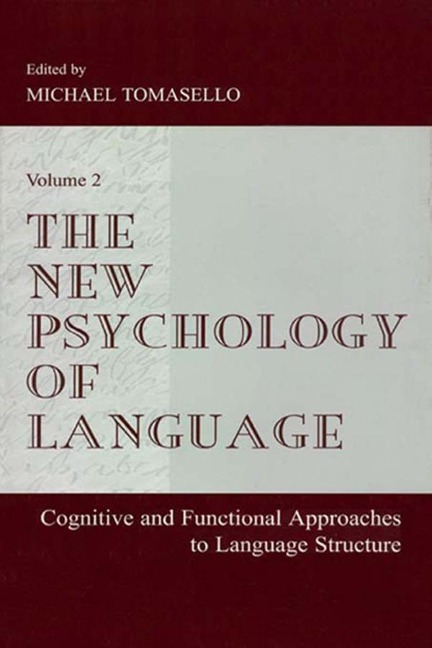
From the point of view of psychology and cognitive science, much of modern linguistics is too formal and mathematical to be of much use. The newly emerging approaches to language termed, "Functional and Cognitive Linguistics," however, are much less formally oriented. Instead, functional and cognitive approaches to language structure are typically couched in terms already familiar to cognitive scientists: perception, attention, conceptualization, meaning, symbols, categories, schemas, perspectives, discourse context, social interaction, and communicative goals. The account of human linguistic competence emerging from this new paradigm should be extremely useful to scientists studying how human beings (not formal devices) comprehend, produce, and acquire natural languages. The current volume brings together 10 of the most important linguists in cognitive and functional linguistics whose work is often not easily available to those outside the field. In original contributions, each of these scholars focuses on an important aspect of human linguistic competence, with a special eye to readers who are not professional linguists. Of special importance to all of the contributions are the cognitive and social interactional processes that constitute human linguistic communication. The book is of special interest to psychologists, cognitive scientists, psycholinguists, and developmental psycholinguists, in addition to linguists taking a more psychological approach to language.
Edited by Tomasello, Michael
Contents: Introduction: Some Surprises for Psychologists. L. Talmy, Concept Structuring Systems in Language. J.W. Du Bois, Discourse and Grammar. S. Kemmer, Human Cognition and the Elaboration of Events: Some Universal Conceptual Categories. C.E. Ford, B.A. Fox, S.A. Thompson, Social Interaction and Grammar. J. Bybee, Cognitive Processes in Grammaticalization. K. van Hoek, Pronouns and Point of View: Cognitive Principles of Coreference. B. Comrie, On Explaining Language Universals. M. Haspelmath, The Geometry of Grammatical Meaning: Semantic Maps and Cross-Linguistic Comparison. C.J. Fillmore, P. Kay, M.C. O'Connor, Regularity and Idiomaticity in Grammatical Constructions: The Case of Let Alone.
Dieses eBook wird im PDF-Format geliefert und ist mit einem Adobe Kopierschutz (DRM) versehen. Sie können dieses eBook mit allen Geräten lesen, die das PDF-Format und den Adobe Kopierschutz (DRM) unterstützen.
Zum Beispiel mit den folgenden Geräten:
• tolino Reader
Laden Sie das eBook direkt über den Reader-Shop auf dem tolino herunter oder übertragen Sie das eBook auf Ihren tolino mit einer kostenlosen Software wie beispielsweise Adobe Digital Editions.
• Sony Reader & andere eBook Reader
Laden Sie das eBook direkt über den Reader-Shop herunter oder übertragen Sie das eBook mit der kostenlosen Software Sony READER FOR PC/Mac oder Adobe Digital Editions auf ein Standard-Lesegeräte mit epub- und Adobe DRM-Unterstützung.
• Tablets & Smartphones
Möchten Sie dieses eBook auf Ihrem Smartphone oder Tablet lesen, finden Sie hier unsere kostenlose Lese-App für iPhone/iPad und Android Smartphone/Tablets.
• PC & Mac
Lesen Sie das eBook direkt nach dem Herunterladen mit einer kostenlosen Lesesoftware, beispielsweise Adobe Digital Editions, Sony READER FOR PC/Mac oder direkt über Ihre eBook-Bibliothek in Ihrem Konto unter „Meine eBooks“ - „online lesen“.
Schalten Sie das eBook mit Ihrer persönlichen Adobe ID auf bis zu sechs Geräten gleichzeitig frei.
Bitte beachten Sie, dass die Kindle-Geräte das Format nicht unterstützen und dieses eBook somit nicht auf Kindle-Geräten lesbar ist.