Und dann auf "Zum Home-Bildschirm [+]".

Stöbern
genialokal zum Startbildschirm hinzufügen
Installieren Sie die genialokal App auf Ihrem Startbildschirm für einen schnellen Zugriff und eine komfortable Nutzung.
Installieren Sie die genialokal App auf Ihrem Startbildschirm für einen schnellen Zugriff und eine komfortable Nutzung.
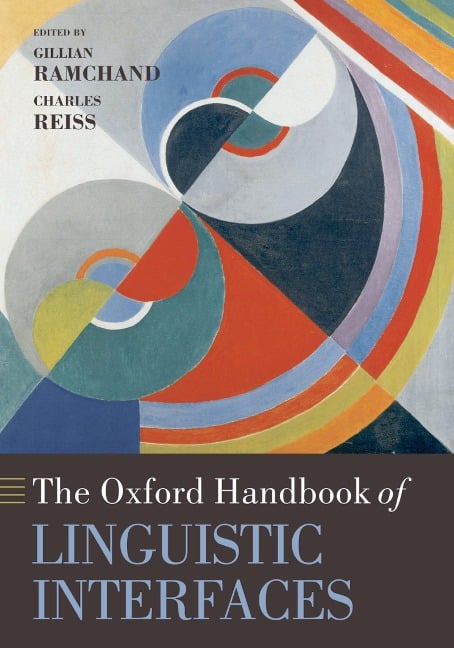
This state-of-the-art guide to some of the most exciting work in current linguistics explores how the core components of the language faculty interact. It examines how these interactions are reflected in linguistic and cognitive theory, considers what they reveal about the operations of language within the mind, and looks at their reflections in expression and communication. Leading international scholars present cutting-edge accounts of developments in the interfaces between phonetics, phonology, morphology, syntax, semantics, and pragmatics. They bring to bear a rich variety of methods and theoretical perspectives, focus on a broad array of issues and problems, and illustrate their arguments from a wide range of the world's languages.
After the editors' introduction to its structure, scope, and content, the book is divided into four parts. The first, Sound, is concerned with the interfaces between phonetics and phonology, phonology and morphology, and phonology and syntax. Part II, Structure, considers the interactions of syntax with morphology, semantics, and the lexicon, and explores the status of the word and its representional status in the mind. Part III, Meaning, revisits the syntax-semantics interface from the perspective of compositionality, and looks at issues concerned with intonation, discourse, and context. The authors in the final part of the book, General Architectural Concerns, examine work on Universal Grammar, the overall model of language, and linguistic and associated theories of language and cognition.
All scholars and advanced students of language will value this book, whether they are in linguistics, cognitive science, philosophy, artificial intelligence, computational science, or informatics.
Gillian Ramchand was born in Scotland, and grew up in Britain and the Caribbean. After receiving her PhD in Linguistics from Stanford University, she worked as Lecturer in General Linguistics at Oxford University for ten years, and is now Professor of Linguistics at University of Tromsø. She is interested in issues at the syntax-semantics interface, especially in the areas of aspect and argument structure, and has worked on both the Bengali and Scottish Gaelic languages. ; Charles Reiss is Associate Professor of Linguistics at Concordia University in Montréal. He is interested in phonology, language acquisition, cognitive science and historical linguistics. His 1995 Harvard PhD dissertation A Theory of Assimilation, with special reference to Old Icelandic Phonology combined insights from all these domains, and he continues to publish journal articles and book chapters in this interdisciplinary vein.
- 1: Gillian Ramchand and Charles Reiss: Introduction - Part I Sound - 2: James Scobbie: Interface and Overlap in Phonetics and Phonology - 3: Charles Reiss: Modularity in the SOund Domain - 4: Mark Hale and Madelyn Kissock: The Phonetics-Phonology Interface and the Acquisition of Perseverant Underspecification - 5: Orhan Orgun and Andrew Dolbey: Phonology-Morphology Interaction in a COnstraint-based Framework - 6: Gorka Elordieta: Segmental Phonology and Syntactic Structure - Part II Structure - 7: Sara Rosen: Structured Events, Structured Discourse - 8: Marit Julien: On the Relation Between Morphology and Syntax - 9: Peter Svenious: 1...3-2 - 10: David Embick and Ralf Noyer: Distributed Morphology and the Syntax/Morphology Interface - 11: Peter Ackema and Ad Neeleman: Morphology does not equal Syntax - 12: Edwin Williams: Dumping Lexicalism - 13: Thomas Stewart and Gregory Stump: Paradigm Function Morphology and the Morphology-Syntax - Part III Meaning - 14: James Higginbotham: Some Consequences of Compositionality - 15: Daniel Büring: Semantics, Intonation and Information Structure - 16: Christopher Potts: Conventional Implicatures: A Distinguished Class of Meanings - 17: David Beaver and Henk Zeevat: Accommodation - Part IV Architecture - 18: Cedric Boeckx and Juan Uriagereka: Minimalism - 19: Mark Steedman: The Computation - 20: Jonas Kuhn: Constraint Based Grammar - The Authors - Language Index - Subject and Name Index
Dieses eBook wird im PDF-Format geliefert und ist mit einem Adobe Kopierschutz (DRM) versehen. Sie können dieses eBook mit allen Geräten lesen, die das PDF-Format und den Adobe Kopierschutz (DRM) unterstützen.
Zum Beispiel mit den folgenden Geräten:
• tolino Reader
Laden Sie das eBook direkt über den Reader-Shop auf dem tolino herunter oder übertragen Sie das eBook auf Ihren tolino mit einer kostenlosen Software wie beispielsweise Adobe Digital Editions.
• Sony Reader & andere eBook Reader
Laden Sie das eBook direkt über den Reader-Shop herunter oder übertragen Sie das eBook mit der kostenlosen Software Sony READER FOR PC/Mac oder Adobe Digital Editions auf ein Standard-Lesegeräte mit epub- und Adobe DRM-Unterstützung.
• Tablets & Smartphones
Möchten Sie dieses eBook auf Ihrem Smartphone oder Tablet lesen, finden Sie hier unsere kostenlose Lese-App für iPhone/iPad und Android Smartphone/Tablets.
• PC & Mac
Lesen Sie das eBook direkt nach dem Herunterladen mit einer kostenlosen Lesesoftware, beispielsweise Adobe Digital Editions, Sony READER FOR PC/Mac oder direkt über Ihre eBook-Bibliothek in Ihrem Konto unter „Meine eBooks“ - „online lesen“.
Schalten Sie das eBook mit Ihrer persönlichen Adobe ID auf bis zu sechs Geräten gleichzeitig frei.
Bitte beachten Sie, dass die Kindle-Geräte das Format nicht unterstützen und dieses eBook somit nicht auf Kindle-Geräten lesbar ist.