Und dann auf "Zum Home-Bildschirm [+]".

Stöbern
genialokal zum Startbildschirm hinzufügen
Installieren Sie die genialokal App auf Ihrem Startbildschirm für einen schnellen Zugriff und eine komfortable Nutzung.
Installieren Sie die genialokal App auf Ihrem Startbildschirm für einen schnellen Zugriff und eine komfortable Nutzung.
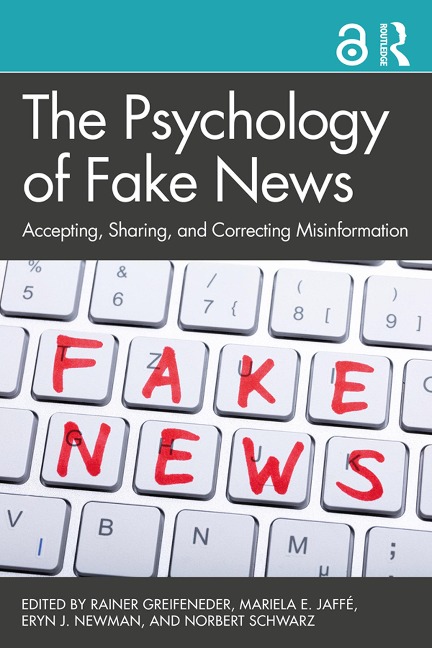
This volume examines the phenomenon of fake news by bringing together leading experts from different fields within psychology and related areas, and explores what has become a prominent feature of public discourse since the first Brexit referendum and the 2016 US election campaign. Dealing with misinformation is important in many areas of daily life, including politics, the marketplace, health communication, journalism, education, and science. In a general climate where facts and misinformation blur, and are intentionally blurred, this book asks what determines whether people accept and share (mis)information, and what can be done to counter misinformation? All three of these aspects need to be understood in the context of online social networks, which have fundamentally changed the way information is produced, consumed, and transmitted. The contributions within this volume summarize the most up-to-date empirical findings, theories, and applications and discuss cutting-edge ideas and future directions of interventions to counter fake news. Also providing guidance on how to handle misinformation in an age of "alternative facts", this is a fascinating and vital reading for students and academics in psychology, communication, and political science and for professionals including policy makers and journalists.
Rainer Greifeneder is Professor of Social Psychology at the University of Basel, Switzerland. His research focuses on the impact of feelings on judgment, individuals' experiences and perceptions of being socially excluded, and the way individuals construe truth. Mariela E. Jaffé is a Postdoctoral Researcher in Social Psychology at the University of Basel, Switzerland. Her research interests focus on the construal of truth, individuals' preferences regarding diversity, and the use of decision-making aids. Eryn J. Newman is a Lecturer at the Australian National University. Her research focuses on how people come to believe and remember things are true and how tangential information or "pseudo-evidence" can bias people's assessments of information they encounter. Norbert Schwarz is Provost Professor of Psychology and Marketing and Co-director of the Mind & Society Center at the University of Southern California. His research addresses the context sensitive and embodied nature of judgment and decision making and its implications for public opinion, consumer behavior, and social science research.
01. What is new and true about fake news? Greifeneder, R., Jaffé, M. E., Newman, E., & Schwarz, N. 02. How Bad is the Fake News Problem? The Role of Baseline Information in Public Perceptions Lyons, B., Merola, V., & Reifler, J. 03. Truth and the Dynamics of News Diffusion on Twitter Ackland, R. & Gwynn, K. 04. Retracted Articles - The Scientific Version of Fake News Bar-Ilan, J. & Halevi, G. 05. When (Fake) News Feels True: Intuitions of Truth and the Acceptance and Correction of Misinformation Schwarz, N. & Jalbert, M. 06. Truthiness: How Non-Probative Photos Shape Belief Newman, E. J. & Zhang, L. 07. Can that be True or is it just Fake News? New Perspectives on the Negativity Bias in Judgments of Truth Jaffé, M. E. & Greifeneder, R. 08. False Beliefs: Byproducts of an Adaptive Knowledge Base? Marsh, E. J. & Stanley, M. 09. Psychological Inoculation against Fake News van der Linden, S. & Roozenbeek, J. 10. Your fake news, our facts: Identity-based motivation shapes what we believe, share, and accept Oyserman, D. & Dawson, A. 11. Conspiracy Beliefs: Knowledge, Ego-Defense, and Social Integration in the Processing of Fake News Albaraccin, D. 12. Fake News Attributions as a Source of Nonspecific Structure Axt, J. R., Landau, M. J., & Kay, A. C.
Dieses eBook wird im PDF-Format geliefert und ist mit einem Adobe Kopierschutz (DRM) versehen. Sie können dieses eBook mit allen Geräten lesen, die das PDF-Format und den Adobe Kopierschutz (DRM) unterstützen.
Zum Beispiel mit den folgenden Geräten:
• tolino Reader
Laden Sie das eBook direkt über den Reader-Shop auf dem tolino herunter oder übertragen Sie das eBook auf Ihren tolino mit einer kostenlosen Software wie beispielsweise Adobe Digital Editions.
• Sony Reader & andere eBook Reader
Laden Sie das eBook direkt über den Reader-Shop herunter oder übertragen Sie das eBook mit der kostenlosen Software Sony READER FOR PC/Mac oder Adobe Digital Editions auf ein Standard-Lesegeräte mit epub- und Adobe DRM-Unterstützung.
• Tablets & Smartphones
Möchten Sie dieses eBook auf Ihrem Smartphone oder Tablet lesen, finden Sie hier unsere kostenlose Lese-App für iPhone/iPad und Android Smartphone/Tablets.
• PC & Mac
Lesen Sie das eBook direkt nach dem Herunterladen mit einer kostenlosen Lesesoftware, beispielsweise Adobe Digital Editions, Sony READER FOR PC/Mac oder direkt über Ihre eBook-Bibliothek in Ihrem Konto unter „Meine eBooks“ - „online lesen“.
Schalten Sie das eBook mit Ihrer persönlichen Adobe ID auf bis zu sechs Geräten gleichzeitig frei.
Bitte beachten Sie, dass die Kindle-Geräte das Format nicht unterstützen und dieses eBook somit nicht auf Kindle-Geräten lesbar ist.