Und dann auf "Zum Home-Bildschirm [+]".

Stöbern
genialokal zum Startbildschirm hinzufügen
Installieren Sie die genialokal App auf Ihrem Startbildschirm für einen schnellen Zugriff und eine komfortable Nutzung.
Installieren Sie die genialokal App auf Ihrem Startbildschirm für einen schnellen Zugriff und eine komfortable Nutzung.
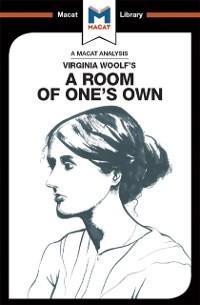
A Room of One's Own is a very clear example of how creative thinkers connect and present things in novel ways. Based on the text of a talk given by Virginia Woolf at an all-female Cambridge college, Room considers the subject of 'women and fiction.' Woolf's approach is to ask why, in the early 20th century, literary history presented so few examples of canonically 'great' women writers. The common prejudices of the time suggested this was caused by (and proof of) women's creative and intellectual inferiority to men. Woolf argued instead that it was to do with a very simple fact: across the centuries, male-dominated society had systematically prevented women from having the educational opportunities, private spaces and economic independence to produce great art. At a time when 'art' was commonly considered to be a province of the mind that had no relation to economic circumstances, this was a novel proposal. More novel, though, was Woolf's manner of arguing and proving her contentions: through a fictional account of the limits placed on even the most privileged women in everyday existence. An impressive early example of cultural materialism, A Room of One's Own is an exemplary encapsulation of creative thinking.
Dr Tim Smith-Laing took his DPhil at Merton College, Oxford, and has held positions at Jesus College, Oxford, and Sciences Politiques in Paris. Dr. Fiona Robinson holds a PhD in early twentieth-century English literature from Yale University.
Ways In to the Text Who was Virginia Woolf? What does A Room of One's Own Say? Why does A Room of One's Own Matter? Section 1: Influences Module 1: The Author and the Historical Context Module 2: Academic Context Module 3: The Problem Module 4: The Author's Contribution Section 2: Ideas Module 5: Main Ideas Module 6: Secondary Ideas Module 7: Achievement Module 8: Place in the Author's Work Section 3: Impact Module 9: The First Responses Module 10: The Evolving Debate Module 11: Impact and Influence Today Module 12: Where Next? Glossary of Terms People Mentioned in the Text Works Cited
Dieses eBook wird im PDF-Format geliefert und ist mit einem Adobe Kopierschutz (DRM) versehen. Sie können dieses eBook mit allen Geräten lesen, die das PDF-Format und den Adobe Kopierschutz (DRM) unterstützen.
Zum Beispiel mit den folgenden Geräten:
• tolino Reader
Laden Sie das eBook direkt über den Reader-Shop auf dem tolino herunter oder übertragen Sie das eBook auf Ihren tolino mit einer kostenlosen Software wie beispielsweise Adobe Digital Editions.
• Sony Reader & andere eBook Reader
Laden Sie das eBook direkt über den Reader-Shop herunter oder übertragen Sie das eBook mit der kostenlosen Software Sony READER FOR PC/Mac oder Adobe Digital Editions auf ein Standard-Lesegeräte mit epub- und Adobe DRM-Unterstützung.
• Tablets & Smartphones
Möchten Sie dieses eBook auf Ihrem Smartphone oder Tablet lesen, finden Sie hier unsere kostenlose Lese-App für iPhone/iPad und Android Smartphone/Tablets.
• PC & Mac
Lesen Sie das eBook direkt nach dem Herunterladen mit einer kostenlosen Lesesoftware, beispielsweise Adobe Digital Editions, Sony READER FOR PC/Mac oder direkt über Ihre eBook-Bibliothek in Ihrem Konto unter „Meine eBooks“ - „online lesen“.
Schalten Sie das eBook mit Ihrer persönlichen Adobe ID auf bis zu sechs Geräten gleichzeitig frei.
Bitte beachten Sie, dass die Kindle-Geräte das Format nicht unterstützen und dieses eBook somit nicht auf Kindle-Geräten lesbar ist.