Und dann auf "Zum Home-Bildschirm [+]".

Stöbern
genialokal zum Startbildschirm hinzufügen
Installieren Sie die genialokal App auf Ihrem Startbildschirm für einen schnellen Zugriff und eine komfortable Nutzung.
Installieren Sie die genialokal App auf Ihrem Startbildschirm für einen schnellen Zugriff und eine komfortable Nutzung.
Ihr gewünschter Artikel ist in 0 Buchhandlungen vorrätig - wählen Sie hier eine Buchhandlung in Ihrer Nähe aus:

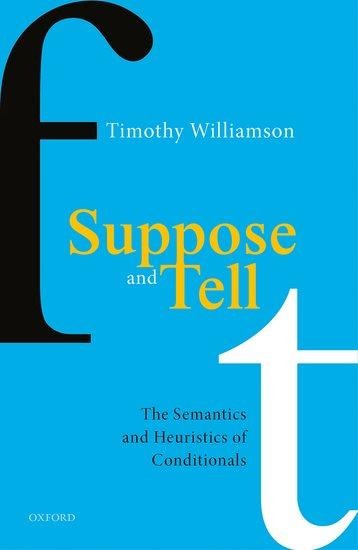
What does 'if' mean? Timothy Williamson presents a controversial new approach to understanding conditional thinking, which is central to human cognitive life. He argues that in using 'if' we rely on psychological heuristics, fast and frugal methods which can lead us to trust faulty data and prematurely reject simple theories.
Timothy Williamson is Wykeham Professor of Logic at the University of Oxford and Whitney Griswold Visiting Professor at Yale University. He has also taught at MIT, Princeton, Edinburgh, Trinity College Dublin, Chinese University of Hong Kong, and elsewhere. He works on logic, philosophy of language, epistemology, metaphysics, and metaphilosophy. His books include Doing Philosophy, Tetralogue, Modal Logic as Metaphysics, and The Philosophy of Philosophy. He is a Fellow of the British Academy, Foreign Honorary Member of the American Academy of Arts and Sciences, and Member of the Academia Europaea.
- Preface
- Part I: If
- 1: The Value of Conditionals
- 2: The Suppositional Rule
- 3: Consequences of the Suppositional Rule
- 4: Heuristics within Heuristics
- 5: Conditional Testimony
- 6: The Role of Conditional Propositionals
- 7: More Challenges
- 8: Interactions between Plain Conditionals and Quantifiers
- Part II: Would If
- 9: Conditionals and Abduction
- 10: The Interaction of 'If' and 'Would': Semantics and Logic
- 11: The Interaction of 'If' and 'Would': Heuristics
- 12: Is 'Would' Hyperintensional?
- 13: More on the Interaction of 'Would' with Context
- 14: Thought Experiments and 'Would'
- 15: Worlds and Meaning
- 16: Conclusion: Semantics, Heuristics, Pragmatics