Und dann auf "Zum Home-Bildschirm [+]".

Stöbern
genialokal zum Startbildschirm hinzufügen
Installieren Sie die genialokal App auf Ihrem Startbildschirm für einen schnellen Zugriff und eine komfortable Nutzung.
Installieren Sie die genialokal App auf Ihrem Startbildschirm für einen schnellen Zugriff und eine komfortable Nutzung.
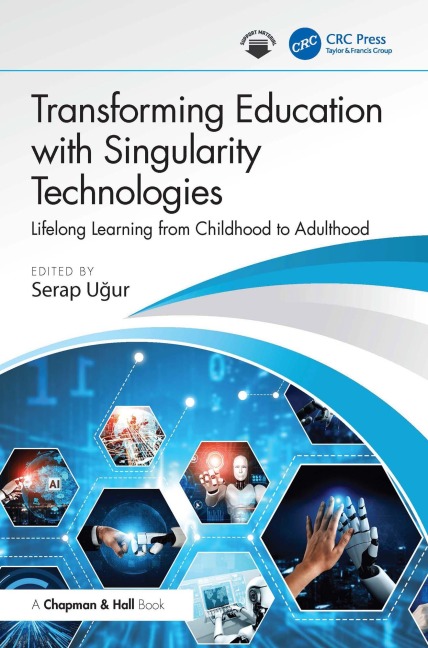
This book presents a transformative vision of education in the era of technological singularity, where Artificial Intelligence (AI) and immersive technologies redefine how we learn and teach. Bringing together a global team of experts, the chapters explore the potential of technological singularity to create more equitable and accessible learning experiences for learners of all ages. By fostering a lifelong learning mindset, this book paves the way for a more informed and empowered future. Through studies on the current state and future trajectories of educational systems, this book explores how these technologies can reshape learning structures. It addresses a wide range of themes, including the evolution of existing educational frameworks and the possibilities that arise as we engage with AI and immersive technologies. This book will serve as a valuable resource for educators, researchers, and professionals seeking to understand the transformative power of emerging technologies in education and to navigate the exciting challenges and opportunities ahead.
Serap Ugur is internationally recognized for her expertise in Transhumanism and Technological Singularity. She is an expert in technologies such as e-learning, gamification, VR and Metaverse, human-computer interaction, brain-computer interface, AI, Artificial General Intelligence (AGI), and Artificial Super Intelligence (ASI). In 2021, she was the only woman from Türkiye selected in the "Futurist" category of Career Beacon magazine's "Elite 50 Exemplary Women" special issue. She is the Deputy Director at the Social Media and Digital Security Education Application and Research Centre (SODIGEM), and a member of the Board of Directors of the Turkish Informatics Association (Eskisehir), Oxford University-Artificial Intelligence in Education, the United States Distance Education Association (USDLA), and European Distance Education Network (EDEN). Ugur has participated in EU, The Scientific and Technological Research Council of Türkiye (Türkiye Bilimsel ve Teknolojik Arastirma Kurumu, TÜBITAK), and university-supported Scientific Research Project (Bilimsel Arastirma Projesi, BAP) projects and has served as a referee and board member for Social Sciences Citation Index (SSCI), Emerging Sources Citation Index (ESCI), and TRDizin journals. She is also the editor of the academic journal Digital Security and Media (DISEM).
Part I: Philosophical and Conceptual Grounds. 1. Extropy, Transhumanism Affirmation, and Human+AI. 2. Quantum Information and Agentic AI in Higher Education: A Global Roadmap for 2035. 3. Technological Singularity and the Reconstruction of Meaning in Communication Studies. Part II: The Evolution of Learning and New Technologies. 4. Artificial Intelligence and the Evolution of Learning. 5. Artificial Intelligence-Supported Educational Metaverse: The Best of Both Worlds?. 6. Immersive Learning: A New Approach in Education. 7. The Transformative Role of Wearable Technologies in Education. 8. The Use of Body-Integrated Technologies for Educational Purposes. Part III: Artificial Intelligence and Learning Processes. 9. AI-Powered Chatbots for Education Using RAGs: A Study on Embedding Efficiency, LLM Performance, and Context Integrity. 10. Characteristic Changes in Online Learners in the Age of Artificial Intelligence: A Literature Review. 11. The Role of Artificial Intelligence in Examining Emotional Learning Analytics in Online Learning Environments. 12. Innovative Approaches to Cloud-Based Standardization and Advanced Techniques for Next-Gen Online Evaluation. 13. Use of Synthetic Content in Open and Distance Learning. Part IV: Lifelong Learning, Micro-Credentials, and Inclusion. 14. Lifelong Learning: AI, Microcredentials, and Ethical Futures. 15. Two Sides of the Same Coin: Artificial Intelligence and Inclusive Education. 16. The AI Educational Revolution: A Case Study from Argentina. 17. AI Literacy for All. Part V: Ethics, Risks, and Future Perspectives. 18. The Impact of Generative Artificial Intelligence Technologies on Education. 19. Opportunities and Threats in Education: Generative Artificial Intelligence Perspectives. 20. Ethical Editorial Framework in the Age of Generative AI.
Dieses eBook wird im PDF-Format geliefert und ist mit einem Adobe Kopierschutz (DRM) versehen. Sie können dieses eBook mit allen Geräten lesen, die das PDF-Format und den Adobe Kopierschutz (DRM) unterstützen.
Zum Beispiel mit den folgenden Geräten:
• tolino Reader
Laden Sie das eBook direkt über den Reader-Shop auf dem tolino herunter oder übertragen Sie das eBook auf Ihren tolino mit einer kostenlosen Software wie beispielsweise Adobe Digital Editions.
• Sony Reader & andere eBook Reader
Laden Sie das eBook direkt über den Reader-Shop herunter oder übertragen Sie das eBook mit der kostenlosen Software Sony READER FOR PC/Mac oder Adobe Digital Editions auf ein Standard-Lesegeräte mit epub- und Adobe DRM-Unterstützung.
• Tablets & Smartphones
Möchten Sie dieses eBook auf Ihrem Smartphone oder Tablet lesen, finden Sie hier unsere kostenlose Lese-App für iPhone/iPad und Android Smartphone/Tablets.
• PC & Mac
Lesen Sie das eBook direkt nach dem Herunterladen mit einer kostenlosen Lesesoftware, beispielsweise Adobe Digital Editions, Sony READER FOR PC/Mac oder direkt über Ihre eBook-Bibliothek in Ihrem Konto unter „Meine eBooks“ - „online lesen“.
Schalten Sie das eBook mit Ihrer persönlichen Adobe ID auf bis zu sechs Geräten gleichzeitig frei.
Bitte beachten Sie, dass die Kindle-Geräte das Format nicht unterstützen und dieses eBook somit nicht auf Kindle-Geräten lesbar ist.