Und dann auf "Zum Home-Bildschirm [+]".

Stöbern
genialokal zum Startbildschirm hinzufügen
Installieren Sie die genialokal App auf Ihrem Startbildschirm für einen schnellen Zugriff und eine komfortable Nutzung.
Installieren Sie die genialokal App auf Ihrem Startbildschirm für einen schnellen Zugriff und eine komfortable Nutzung.


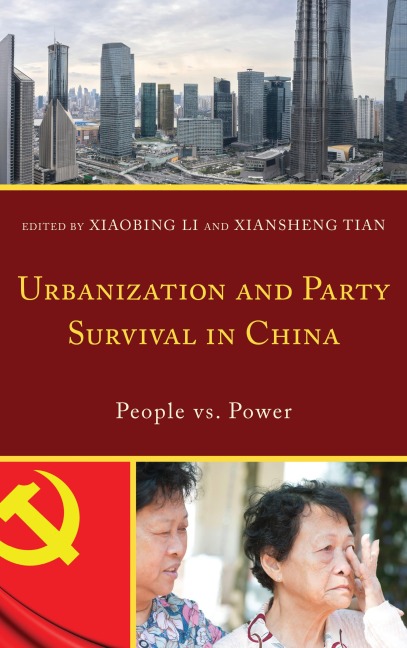
While the Chinese urban movement has successfully transferred surplus labor from the countryside to urban industries that urgently require free and cheap labor, numerous problems have arisen as a result of the unprecedented huge-scale process. Such conditions such as overcrowding, substandard housing, lack of social services, corruption, and abuse of power have often reached crisis stage. American college students often ask: How does the government control the largest urban population in the world? Why do newly developed, highly commercialized cities continue to support the Chinese Communist Party (CCP) rather than challenging the old regime? What happens when urban residents have problems with a party-controlled government?
This book, collects essays from the best scholars in their fields and examines urban issues, including identifying residents' concerns, analyzing policy problems, and providing some answers to these pivotal questions. They address this important topic from a Chinese-American perspective through a cooperative interdisciplinary research effort among Chinese-American scholars interested in the subject. Their scholarship makes a significant contribution through multi-faceted components from different fields such as economics, political science, criminal justice, law, anthropology, sociology, and education. The authors introduce and explore the theory and practice of policy patterns, political systems, and social institutions by identifying key issues in Chinese government and society contained within the larger framework of the international sphere.
Originally from Beijing, Shanghai, Xi'an, Tianjin, and other cities in China, these authors have received training and advanced degrees from American universities and colleges, thus bringing uncommon perspective and conclusions by focusing on urban studies specific to China. Their endeavors move beyond the existing scholarship and seek to spark new debates and proposed solutions while reflecting on established schools of history, religion, linguistics, and gender studies. Crucial to this volume is the assessment of historical and empirical data found in these essays that place major events in the context of Chinese tradition, its culture, and national security. Using comprehensive coverage to create a broad and solid foundation of knowledge, this collection presents a better understanding of the current Chinese metropolitan climate and includes legitimate issues with city policy implementation.
Xiaobing Li is professor and chair of the Department of History and Geography at the University of Central Oklahoma.
Xiansheng Tian is professor of history at the Metropolitan State University of Denver.
Introduction: China's Urbanization and CCP Transformation, Xiaobing Li and Xiansheng Tian
Note on Transliteration
Abbreviations
Part I: Manufacturing, Market, and Migrants
Chapter 1: Economic Globalization and China's Urbanization in the Post-Mao Era, Yunqiu Zhang
Chapter 2: Characteristics of Xi'an's Emerging Private Consumer Market, Linda Wang
Chapter 3: Half Realized Dreams: Consumption of Domestic Sojourners in Urban China, Xiaofen Chen
Part II: Demographic Changes and Urban Problems
Chapter 4: Urban Chinese Elderly: Demographic Characteristics and Their Impact on
Socioeconomic Status, Jianjun Ji and Changyong Yu
Chapter 5: Marco Signs of Emerging Real Estate Speculation Urban China, Guoqiang Shen
Chapter 6: New Rural Construction and Township Establishment, Xiaoxiao Li
Chapter 7: The Spatial Study of Catholic Market in Urban China, Zhaohui Hong and Jianfeng Jin
Part III: Social Crises and Political Control
Chapter 8: Cry for Help: An Analytical Study of the Cases at the Maple Women's Counseling Center in Beijing, Yi Sun
Chapter 9: Urban Air Pollution vs. Economic Sustainability, Jingyi Song
Chapter 10: Demolition or Preservation? China's Dilemma in Urban Heritage Protection 239, Patrick Fuliang Shan
Chapter 11: Ghost Town in China: A Comparison with the Shrink City in the West, Kun Zhao
Part IV: Continuing Struggle and CCP Survival
Chapter 12: Power vs. Law: Legal Reform and Party Control, Qiang Fang
Chapter 13: Maternal and Children Healthcare in Ethnic Minority Towns of Xinjiang, Dongyu Yang
Chapter 14: Modern Public Hygiene Movements in Guangzhou, Guangqiu Xu
Chapter 15: Pension Reform in Urban Areas, Ting Jiang
Conclusion: New Political Culture and Emerging Social Groups, Xiaobing Li and Xiansheng Tian
Dieses eBook wird im PDF-Format geliefert und ist mit einem Adobe Kopierschutz (DRM) versehen. Sie können dieses eBook mit allen Geräten lesen, die das PDF-Format und den Adobe Kopierschutz (DRM) unterstützen.
Zum Beispiel mit den folgenden Geräten:
• tolino Reader
Laden Sie das eBook direkt über den Reader-Shop auf dem tolino herunter oder übertragen Sie das eBook auf Ihren tolino mit einer kostenlosen Software wie beispielsweise Adobe Digital Editions.
• Sony Reader & andere eBook Reader
Laden Sie das eBook direkt über den Reader-Shop herunter oder übertragen Sie das eBook mit der kostenlosen Software Sony READER FOR PC/Mac oder Adobe Digital Editions auf ein Standard-Lesegeräte mit epub- und Adobe DRM-Unterstützung.
• Tablets & Smartphones
Möchten Sie dieses eBook auf Ihrem Smartphone oder Tablet lesen, finden Sie hier unsere kostenlose Lese-App für iPhone/iPad und Android Smartphone/Tablets.
• PC & Mac
Lesen Sie das eBook direkt nach dem Herunterladen mit einer kostenlosen Lesesoftware, beispielsweise Adobe Digital Editions, Sony READER FOR PC/Mac oder direkt über Ihre eBook-Bibliothek in Ihrem Konto unter „Meine eBooks“ - „online lesen“.
Schalten Sie das eBook mit Ihrer persönlichen Adobe ID auf bis zu sechs Geräten gleichzeitig frei.
Bitte beachten Sie, dass die Kindle-Geräte das Format nicht unterstützen und dieses eBook somit nicht auf Kindle-Geräten lesbar ist.