Und dann auf "Zum Home-Bildschirm [+]".

Stöbern
genialokal zum Startbildschirm hinzufügen
Installieren Sie die genialokal App auf Ihrem Startbildschirm für einen schnellen Zugriff und eine komfortable Nutzung.
Installieren Sie die genialokal App auf Ihrem Startbildschirm für einen schnellen Zugriff und eine komfortable Nutzung.
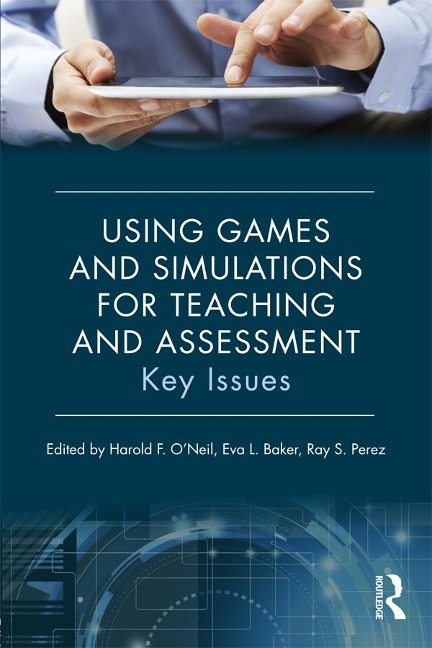
Using Games and Simulations for Teaching and Assessment: Key Issues comprises a multidisciplinary investigation into the issues that arise when using games and simulations for educational purposes. Using both theoretical and empirical analyses, this collection examines cognitive, motivational, and psychometric issues with a focus on STEM content. Unlike other research-based volumes that focus solely on game design or the theoretical basis behind gaming, this book unites previously disparate communities of researchers-from civilian to military contexts as well as multiple disciplines-to critically explore current problems and illustrate how instructionally effective games and simulations should be planned and evaluated. While computer-based simulations and games have the potential to improve the quality of education and training, Using Games and Simulations for Teaching and Assessment: Key Issues shows how the science of learning should underlie the use of such technologies. Through a wide-ranging yet detailed examination, chapter authors provide suggestions for designing and developing games, simulations, and intelligent tutoring systems that are scientifically-based, outcomes-driven, and cost-conscious.
Harold F. O'Neil is Professor of Education Psychology and Technology at the University of Southern California and Project Director at the National Center for Research on Evaluation, Standards, and Student Testing (CRESST). Eva L. Baker is Distinguished Research Professor at the Graduate School of Education and Information Studies, University of California, Los Angeles. She is also co-director of CRESST. Ray S. Perez is Program Officer at the Office of Naval Research (ONR), where he manages a cognitive science of learning research program.
List of Contributors Preface by Harold F. O'Neil, Eva L. Baker, and Ray S. Perez Section 1: Theory/Framework/Context Chapter 1: A Framework to Create Effective Learning Games and Simulations by Eva L. Baker and Girlie C. Delacruz Chapter 2: Computational Issues in Modeling User Behavior in Serious Games by Markus R. Iseli and Rajesh Jha Chapter 3: A Framework for Validating 21st Century Assessment Tools by Roy Stripling, John J. Lee, and Joseph V. Cohn Chapter 4: Intelligent Tutoring Systems, Serious Games, and the Generalized Intelligent by Arthur C. Graesser, Xiangen Hu, Benjamin D. Nye, and Robert A. Sottilare Section 2: Assessment Chapter 5: Using Crowdsourcing as a Formative Evaluation Technique for Game Icons by Ayesha Madni, Gregory K. W. K. Chung, Eva L. Baker, and Noelle C. Griffin Chapter 6: Lessons Learned From Intelligent Tutoring Research for Simulation by Ray S. Perez, Anna Skinner, and Paul Chatelier Chapter 7: Measuring Learning in Simulations and Games by Allen Munro Chapter 8: The Role of Neurobiology in Teaching and Assessing Games by Ray S. Perez, Jason Ralph, and James Niehaus Section 3: Cognitive/Motivational Issues Chapter 9: Role of Metacognition in STEM Games and Simulations by Richard E. Mayer Chapter 10: The Role of Motivation, Affect, and Engagement in Simulation/Game Environments: A Proposed Model by Robert Rueda, Harold F. O'Neil, and Elena Son Chapter 11: Can Games Facilitate Access to College? By Zoë B. Corwin, Robert W. Danielson, Gisele Ragusa, and William G. Tierney Section 4: Psychometric Issues Chapter 12: Inference in Game-Based Assessment by Kristen E. DiCerbo, Robert J. Mislevy, and John T. Behrens Chapter 13: On the Role of Multilevel Item Response Models in Multisite Evaluation Studies for Serious Games by Li Cai, Kilchan Choi, and Megan Kuhfeld Index
Dieses eBook wird im PDF-Format geliefert und ist mit einem Adobe Kopierschutz (DRM) versehen. Sie können dieses eBook mit allen Geräten lesen, die das PDF-Format und den Adobe Kopierschutz (DRM) unterstützen.
Zum Beispiel mit den folgenden Geräten:
• tolino Reader
Laden Sie das eBook direkt über den Reader-Shop auf dem tolino herunter oder übertragen Sie das eBook auf Ihren tolino mit einer kostenlosen Software wie beispielsweise Adobe Digital Editions.
• Sony Reader & andere eBook Reader
Laden Sie das eBook direkt über den Reader-Shop herunter oder übertragen Sie das eBook mit der kostenlosen Software Sony READER FOR PC/Mac oder Adobe Digital Editions auf ein Standard-Lesegeräte mit epub- und Adobe DRM-Unterstützung.
• Tablets & Smartphones
Möchten Sie dieses eBook auf Ihrem Smartphone oder Tablet lesen, finden Sie hier unsere kostenlose Lese-App für iPhone/iPad und Android Smartphone/Tablets.
• PC & Mac
Lesen Sie das eBook direkt nach dem Herunterladen mit einer kostenlosen Lesesoftware, beispielsweise Adobe Digital Editions, Sony READER FOR PC/Mac oder direkt über Ihre eBook-Bibliothek in Ihrem Konto unter „Meine eBooks“ - „online lesen“.
Schalten Sie das eBook mit Ihrer persönlichen Adobe ID auf bis zu sechs Geräten gleichzeitig frei.
Bitte beachten Sie, dass die Kindle-Geräte das Format nicht unterstützen und dieses eBook somit nicht auf Kindle-Geräten lesbar ist.