Und dann auf "Zum Home-Bildschirm [+]".

Stöbern
genialokal zum Startbildschirm hinzufügen
Installieren Sie die genialokal App auf Ihrem Startbildschirm für einen schnellen Zugriff und eine komfortable Nutzung.
Installieren Sie die genialokal App auf Ihrem Startbildschirm für einen schnellen Zugriff und eine komfortable Nutzung.


Ihr gewünschter Artikel ist in 0 Buchhandlungen vorrätig - wählen Sie hier eine Buchhandlung in Ihrer Nähe aus:

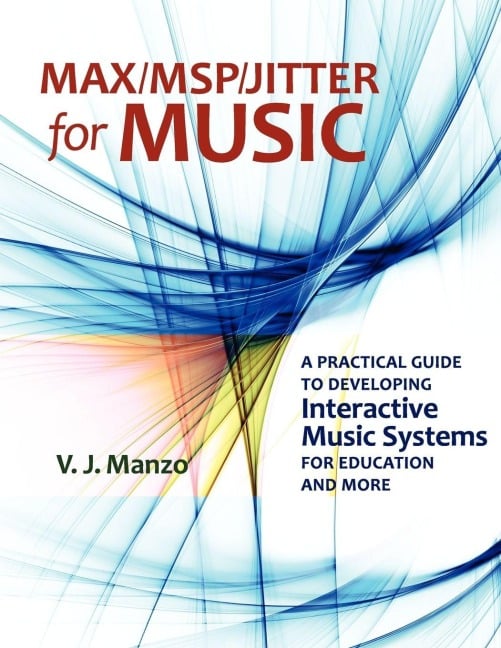
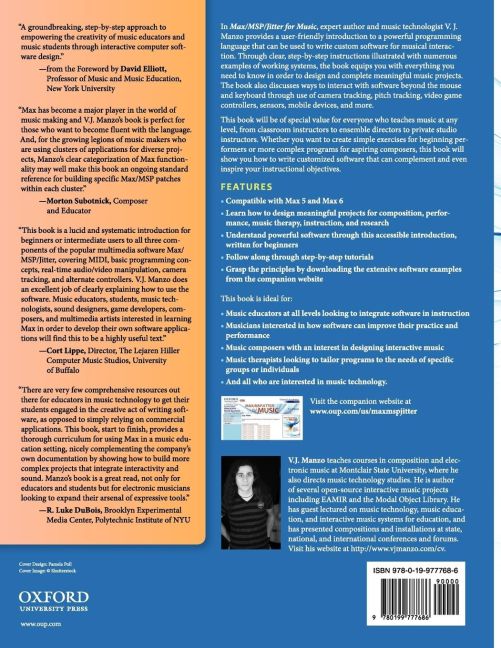
A practical guide for readers of all levels of programming ability, Max/MSP/Jitter for Music teaches all of the necessary skills for writing custom software for musical interaction using the programming language Max/MSP/Jitter. In step-by-step instructions, expert author VJ Manzo guides readers through all of the essential concepts and steps for designing and completing projects.
Manzo's applications are remarkably broad; from complex programs which explore relationships between modes for veteran composers to basic exercise for beginners that helps improve finger dexterity, the range of possibilities this book opens up will impress both new and experienced users of music technologies. With clear, hands-on examples, Manzo teaches readers to write effective, customized software which supplements and complement their instructional and musical objectives. The book also discusses ways to interact with the software beyond the mouse and keyboard through use of camera tracking, pitch tracking, video game controllers, sensors, mobile devices, and more. Chapter review sections remind readers of key commands and important concepts, buildling a solid foundation in understanding Max and its structure, while connecting it to music making and learning concepts.
Extensively illustrated throughout and packed with practical tips, this book will be invaluable for musicians and teachers looking to supplement their lessons with interactive instructional tools, develop adaptive instruments to aid in composition and performance activities, and create measurement tools with which to conduct research.
V.J. Manzo is Director of Music Technology at Montclair State University where he teaches courses in composition and electronic music. He is the author of several open-source interactive music projects including EAMIR and the Modal Object Library. He has guest lectured on music technology, music education, and interactive music systems for education, and has presented compositions and installations at numerous conferences. For more information, visit the author's website at www.vjmanzo.com/cv.
Foreword by David Elliott
Preface
Acknowledgments
Chapter 1: Introduction to Programming
Chapter 2: Generating Music
Chapter 3: Math and Music
Chapter 4: Scales and Chords
Chapter 5: Interactive Ear-training
Chapter 6: Data Structures
Chapter 7: Control Interfaces
Chapter 8: Control Interfaces Continued
Chapter 9: Tools for Music Theory Concepts
Chapter 10: Working with Time
Chapter 11: Building Standalone Applications
Chapter 12: Working with Audio
Chapter 13: Audio Playback and Pitch Tracking
Chapter 14: Audio Buffers
Chapter 15: Audio Effects and Processing
Chapter 16: Working with Live Video
Chapter 17: Working with Video Files
Chapter 18: Video Research Instrument
Chapter 19: Informal Music Learning Instruments
Chapter 20: Compositions and Perception Tools
Index