Und dann auf "Zum Home-Bildschirm [+]".

Stöbern
genialokal zum Startbildschirm hinzufügen
Installieren Sie die genialokal App auf Ihrem Startbildschirm für einen schnellen Zugriff und eine komfortable Nutzung.
Installieren Sie die genialokal App auf Ihrem Startbildschirm für einen schnellen Zugriff und eine komfortable Nutzung.
Ihr gewünschter Artikel ist in 0 Buchhandlungen vorrätig - wählen Sie hier eine Buchhandlung in Ihrer Nähe aus:

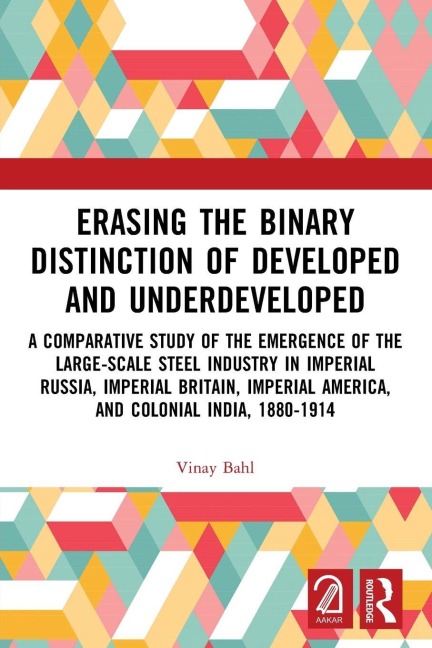

Through a sample comparative historical study focusing on the question of the emergence of the large-scale steel industry (1880-1914) of four chosen countries it is shown how the yardstick of parity can be applied without the categorization of societies as either developed or underdeveloped.
Vinay Bahl, presently a non-affiliated research scholar, taught historical sociology in the United States for many years. She received her Ph.D. degree in Sociology from Binghamton University, New York and M. Phil degree in Modern Indian History from Jawaharlal Nehru University, New Delhi, India. She was an invited guest scholar of the College de France, Paris, for one academic year. She was also an Associate Fellow at the International Institute for Asian Studies in Amsterdam.
Preface and Acknowledgments INTRODUCTION SECTION I - Defining and Explaining the Problem 1 - Spurious and Misleading Binary Distinction SECTION II - A Possible Alternative Perspective 2 - Erasing the Binary Distinction SECTION III - Applying the Alternative Perspective 3 - Interaction and Conjunction of International Historical Forces, 1800-1913 4 - The Emergence of the Large-Scale Steel Industry in Imperial Russia, 1880-1914 5 - The (Non)Emergence of the Large-Scale Steel Industry in Imperial Britain, 1880-1914 6 - The Emergence of the Large-Scale Steel Industry in Post-Colonial Imperial US, 1880-1914 7 - The Emergence of the Large-Scale Steel Industry in India Under British Colonial Rule, 1880-191 SUMMARY AND OBSERVATIONS Bibliography About the Author Abstract