Und dann auf "Zum Home-Bildschirm [+]".

Stöbern
genialokal zum Startbildschirm hinzufügen
Installieren Sie die genialokal App auf Ihrem Startbildschirm für einen schnellen Zugriff und eine komfortable Nutzung.
Installieren Sie die genialokal App auf Ihrem Startbildschirm für einen schnellen Zugriff und eine komfortable Nutzung.
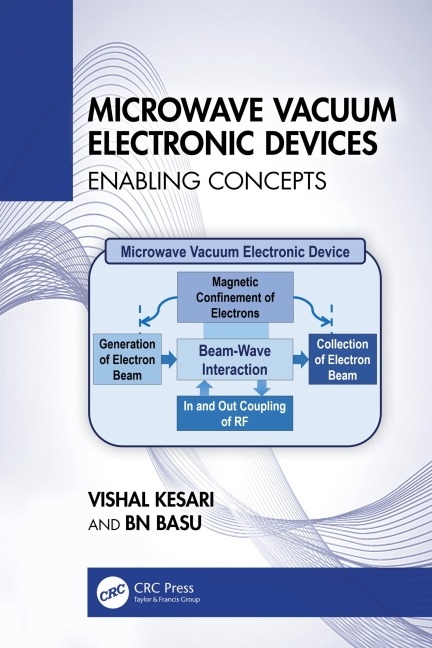
Microwave Vacuum Electronic Devices: Enabling Concepts covers vacuum electronic devices (VEDs) operating in the microwave to terahertz frequency regime. The book aims to equip students, teachers, scientists, and engineers with an understanding of the concepts and physical principles underpinning VEDs. VEDs have manifold applications in technologies used in defense, civilian, medical, scientific, and industrial sectors. The authors build confidence among the readers seeking to design and develop VEDs in these sectors by presenting enabling concepts and step-by-step guides to the mathematical formulations used in VEDs in the microwave, millimeter-wave, and terahertz frequency range. Chapters covering important physical principles, including space-charge waves, cyclotron waves, and electron bunching (both relativistic and non-relativistic), are followed by discussions of techniques for improving the performance of VEDs. The book will be a useful reference for advanced undergraduates, postgraduates, and industry professionals seeking to understand and develop their own VEDs. Key Features: - Discusses practical concepts that enable readers to develop independent thinking in the design and development of VEDs. - Provides detailed mathematical steps that make the design and development of VEDs easier to understand. - Presents end-of-chapter questions and hints throughout to aid teaching and learning.
Vishal Kesari received an MSc (Physics) degree from Veer Bahadur Singh Purvanchal University, India, and a PhD (Electronics Engineering) degree from the Institute of Technology, Banaras Hindu University (IT-BHU) (now known as the Indian Institute of Technology (IIT-BHU)), India, in 2001 and 2006, respectively. Currently, he is a senior scientist at Microwave Tube Research and Development Centre (MTRDC), Defence Research and Development Organisation (DRDO), Bengaluru, India. Dr. Kesari is the recipient of many prestigious awards. He is internationally acclaimed for authoring/co-authoring journal papers and books. BN Basu received BTech, MTech, and PhD degrees from the Institute of Radiophysics and Electronics, Calcutta University, in 1965, 1966, and 1976, respectively. He is superannuated as Professor and Head of the Electronics Engineering Department and Coordinator of the Centre of Research in Microwave Tubes at the Institute of Technology, Banaras Hindu University (BHU), now known as the Indian Institute of Technology-BHU. Currently, he holds the position of Distinguished Adjunct Professor at the Supreme Knowledge Foundation Group of Institutions (SKFGI) in Mankundu, West Bengal, India. Professor Basu is the recipient of many prestigious awards, including the John Robinson Pierce Award of the IEEE Electron Devices Society, USA (2023) for Excellence in Vacuum Electronics. He is well known for authoring/co-authoring journal papers and books.
1 Introduction 2 Space-Charge Waves and Cyclotron Waves 3 Non-Relativistic Bunching of Electrons 4 Cyclotron Resonance Maser and Weibel Instabilities and Relativistic Bunching of Electrons in Gyro-Devices 5 Induced Current on Electrodes due to Electron Beam Flow 6 Kinetic or Potential Energy Transfer from the Bunches of Electrons to Electromagnetic Waves 7 Space-Charge-Limiting Current 8 Electromagnetic Wave Propagation through Helix Slow-Wave Interaction Structure of a Traveling-Wave Tube 9 Analysis of Fast-wave Interaction Structures 10 Beam-Present Dispersion Relation of Helix Slow-Wave Structure and Interpretation thereof for the Gain Equation of a Helix-Traveling-Wave Tube 11 Broadbanding a Helix-Traveling-Wave Tube 12 Beam-present Dispersion Relations of Fast-Wave Interaction Structures and Interpretation Therefrom Gain Equation 13 Techniques for Widening the Bandwidth of Disc-Loaded Gyro-Traveling-Wave Tube 14 Start-Oscillation Condition of a Vacuum Electronic Device 15 Performance Improvement of Vacuum Electronic Devices by Plasma Assistance 16 Performance Improvement of Vacuum Electronic Devices by Metamaterial Assistance 17 Exploration of Vacuum Electronic Devices into Terahertz Regime 18 Summary Index
Dieses eBook wird im PDF-Format geliefert und ist mit einem Adobe Kopierschutz (DRM) versehen. Sie können dieses eBook mit allen Geräten lesen, die das PDF-Format und den Adobe Kopierschutz (DRM) unterstützen.
Zum Beispiel mit den folgenden Geräten:
• tolino Reader
Laden Sie das eBook direkt über den Reader-Shop auf dem tolino herunter oder übertragen Sie das eBook auf Ihren tolino mit einer kostenlosen Software wie beispielsweise Adobe Digital Editions.
• Sony Reader & andere eBook Reader
Laden Sie das eBook direkt über den Reader-Shop herunter oder übertragen Sie das eBook mit der kostenlosen Software Sony READER FOR PC/Mac oder Adobe Digital Editions auf ein Standard-Lesegeräte mit epub- und Adobe DRM-Unterstützung.
• Tablets & Smartphones
Möchten Sie dieses eBook auf Ihrem Smartphone oder Tablet lesen, finden Sie hier unsere kostenlose Lese-App für iPhone/iPad und Android Smartphone/Tablets.
• PC & Mac
Lesen Sie das eBook direkt nach dem Herunterladen mit einer kostenlosen Lesesoftware, beispielsweise Adobe Digital Editions, Sony READER FOR PC/Mac oder direkt über Ihre eBook-Bibliothek in Ihrem Konto unter „Meine eBooks“ - „online lesen“.
Schalten Sie das eBook mit Ihrer persönlichen Adobe ID auf bis zu sechs Geräten gleichzeitig frei.
Bitte beachten Sie, dass die Kindle-Geräte das Format nicht unterstützen und dieses eBook somit nicht auf Kindle-Geräten lesbar ist.