Und dann auf "Zum Home-Bildschirm [+]".

Stöbern
genialokal zum Startbildschirm hinzufügen
Installieren Sie die genialokal App auf Ihrem Startbildschirm für einen schnellen Zugriff und eine komfortable Nutzung.
Installieren Sie die genialokal App auf Ihrem Startbildschirm für einen schnellen Zugriff und eine komfortable Nutzung.
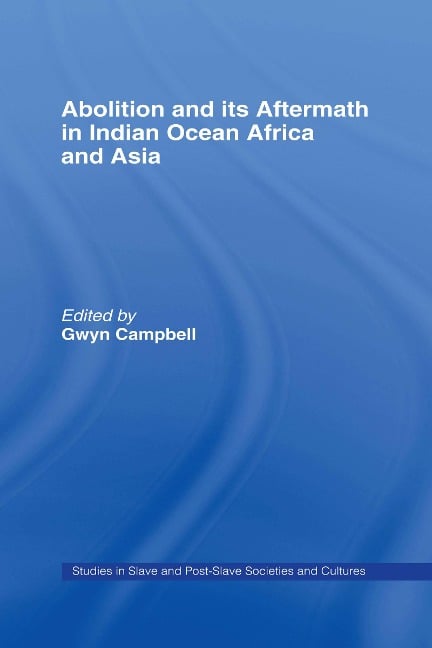
This important collection of essays examines the history and impact of the abolition of the slave trade and slavery in the Indian Ocean World, a region stretching from Southern and Eastern Africa to the Middle East, India, Southeast Asia and the Far East. Slavery studies have traditionally concentrated on the Atlantic slave trade and slavery in the Americas. In comparison, the Indian Ocean World slave trade has been little explored, although it started some 3,500 years before the Atlantic slave trade and persists to the present day. This volume, which follows a collection of essays The Structure of Slavery in Indian Ocean Africa and Asia (Frank Cass, 2004), examines the various abolitionist impulses, indigenous and European, in the Indian Ocean World during the nineteenth and twentieth centuries. It assesses their efficacy within a context of a growing demand for labour resulting from an expanding international economy and European colonisation. The essays show that in applying definitions of slavery derived from the American model, European agents in the region failed to detect or deliberately ignored other forms of slavery, and as a result the abolitionist impulse was only partly successful with the slave trade still continuing today in many parts of the Indian Ocean World.
Gwyn Campbell is a History Professor at McGill University. He initiated the series of Avignon conferences on Slavery and Forced Labour and has published widely on slavery, the slave trade and other aspects of forced labour including The Structure of Slavery in Indian Ocean Africa and Asia (Frank Cass, 2004).
1. Introduction Gwyn Campbell 2. Indian Ocean Slavery and its Demise in the Cape Colony Nigel Worden 3. The Bel Ombre Rebellion: Indian convicts in Mauritius, 1815-53 Clare Anderson 4. Abolition and its Aftermath in Madagascar, 1877-1949 Gwyn Campbell 5. Abolition and its Impact on the Benadir Coast Omar Eno 6. Slavery and the Slave Trade in Saudi Arabia and the Persian Gulf States, 1920s-1960s Suzanne Miers 7. The "Shari'a and the Anti-Slave Trade "Farman" of 1848 in Iran Behnaz Mirzai 8. The Slave Trade and its Fallout in the Persian Gulf Abdul Sheriff, Advisor, Zanzibar Museums 9. Abolition by Denial? Slavery in South Asia after 1843 Indrani Chatterjee 10. Plantation Labour in the Brahmapura Valley: Regional enclaves in a colonial context, 1881-1921 Keya Dasgupta 11. Colonialism, Nationalism and the Meaning of Slavery: The genealogy of "an insult to the American government and to the Filipino people" Michael Salman 12. Islamic Attitudes towards the Abolition of the Slave Trade and Slavery in the Indian Ocean, c1800-c1940 W.G. Clarence Smith 13. The Emancipation of Slaves in the Indian Ocean Martin Klein
Dieses eBook wird im PDF-Format geliefert und ist mit einem Adobe Kopierschutz (DRM) versehen. Sie können dieses eBook mit allen Geräten lesen, die das PDF-Format und den Adobe Kopierschutz (DRM) unterstützen.
Zum Beispiel mit den folgenden Geräten:
• tolino Reader
Laden Sie das eBook direkt über den Reader-Shop auf dem tolino herunter oder übertragen Sie das eBook auf Ihren tolino mit einer kostenlosen Software wie beispielsweise Adobe Digital Editions.
• Sony Reader & andere eBook Reader
Laden Sie das eBook direkt über den Reader-Shop herunter oder übertragen Sie das eBook mit der kostenlosen Software Sony READER FOR PC/Mac oder Adobe Digital Editions auf ein Standard-Lesegeräte mit epub- und Adobe DRM-Unterstützung.
• Tablets & Smartphones
Möchten Sie dieses eBook auf Ihrem Smartphone oder Tablet lesen, finden Sie hier unsere kostenlose Lese-App für iPhone/iPad und Android Smartphone/Tablets.
• PC & Mac
Lesen Sie das eBook direkt nach dem Herunterladen mit einer kostenlosen Lesesoftware, beispielsweise Adobe Digital Editions, Sony READER FOR PC/Mac oder direkt über Ihre eBook-Bibliothek in Ihrem Konto unter „Meine eBooks“ - „online lesen“.
Schalten Sie das eBook mit Ihrer persönlichen Adobe ID auf bis zu sechs Geräten gleichzeitig frei.
Bitte beachten Sie, dass die Kindle-Geräte das Format nicht unterstützen und dieses eBook somit nicht auf Kindle-Geräten lesbar ist.