Und dann auf "Zum Home-Bildschirm [+]".

Stöbern
genialokal zum Startbildschirm hinzufügen
Installieren Sie die genialokal App auf Ihrem Startbildschirm für einen schnellen Zugriff und eine komfortable Nutzung.
Installieren Sie die genialokal App auf Ihrem Startbildschirm für einen schnellen Zugriff und eine komfortable Nutzung.
Ihr gewünschter Artikel ist in 0 Buchhandlungen vorrätig - wählen Sie hier eine Buchhandlung in Ihrer Nähe aus:

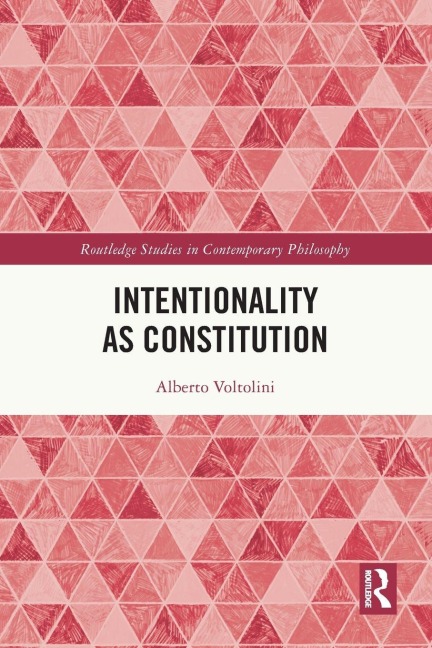
This book develops a novel theory of intentionality. It argues that intentionality is an internal essential relation of constitution between an intentional state and an object or between such a state and a possible state of affairs as subsisting.
Alberto Voltolini (PhD Scuola Normale Superiore, Pisa 1989) is a philosopher of language and mind whose works have focused mainly on intentionality, depiction and fiction, perception, and Wittgenstein. He is currently a Professor of Philosophy of Mind at the University of Turin (Italy). He has received scholarships at the Universities of Geneva and Sussex. He has been a visiting professor at the Universities of California, Riverside (1998), Australian National University, Canberra (2007), Barcelona (2010), London (2015), Auckland (2007, 2018), and Antwerp (2019). He has been a member of the Steering Committee of the European Society for Analytic Philosophy (2002-2008), of the Board of the European Society for Philosophy and Psychology (2009-2012), and of the International Society for Fiction and Fictionality Studies. He is presently President of the Italian Society for Analytic Philosophy. His publications include How Ficta Follow Fiction (2006), as well as the "Fictional Entities" and the "Fiction" entries (with F. Kroon) of the Stanford Encyclopaedia of Philosophy, A Syncretistic Theory of Depiction (2015) and Down But Not Out (2022).
Introduction: The Structure of Intentionality 1. What Intentionality Metaphysically Is Not - I 2. What Intentionality Metaphysically Is Not - II 3. The Core Theory 4. How the Core Theory Fits the Adequacy Conditions 5. The Extended Theory and How It Fits the Adequacy Conditions 6. Intentionality and Its Role in the World 7. Intentionality and the Mark of the Mental Conclusion