Und dann auf "Zum Home-Bildschirm [+]".

Stöbern
genialokal zum Startbildschirm hinzufügen
Installieren Sie die genialokal App auf Ihrem Startbildschirm für einen schnellen Zugriff und eine komfortable Nutzung.
Installieren Sie die genialokal App auf Ihrem Startbildschirm für einen schnellen Zugriff und eine komfortable Nutzung.
Ihr gewünschter Artikel ist in 0 Buchhandlungen vorrätig - wählen Sie hier eine Buchhandlung in Ihrer Nähe aus:

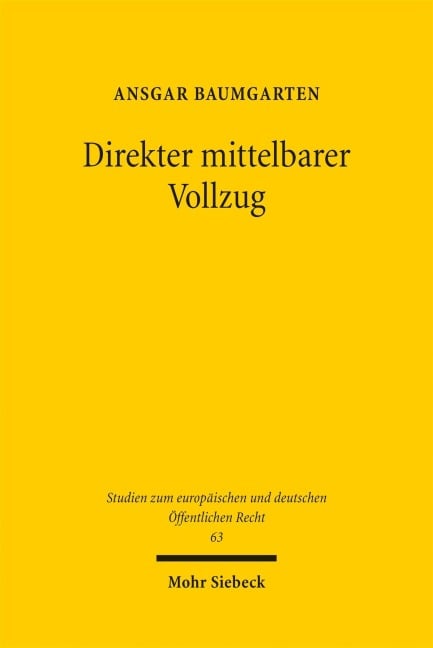
Ansgar Baumgarten develops the concept of "direct indirect implementation" as a new category of European administrative execution. This form of implementation describes situations in which EU authorities apply national implementation law in order to indirectly enforce EU law. For the first time, this mechanism enables the EU to apply national law that transposes directives or specifies options contained in regulations. In doing so, it closes an existing gap and ensures the uniform and effective enforcement of the underlying EU law. It marks a new stage in the Europeanization of administrative execution and strengthens the primacy and practical effectiveness of EU law. Article 291 TFEU does not limit the delegation of executive powers. Under the principle of subsidiarity, the EU may also act in the field of implementation insofar as enforcement deficits in the member states endanger the uniform application of EU law. The principle of democracy remains safeguarded, since administrative action rests on a dual democratic foundation-both at the EU and the member state level. Looking ahead, direct indirect implementation provides a tool for enhancing the effectiveness of EU administrative enforcement, for example in the areas of European migration and cybersecurity law. It links national lawmaking with EU-level enforcement and thereby expands the EU's capacity to act - also in the interests of the member states.
Born in 1993; 2015 First State Examination in Law in Berlin (Humboldt University of Berlin); 2016 Maîtrise en droit (Université Panthéon-Assas); 2017 LL.M. (King's College London); Research Associate at the Chair of Public Law, in particular Environmental Law and European Law, at Freie Universität Berlin; Legal clerkship at the Berlin Court of Appeal (Kammergericht); Lawyer and lecturer at the German-Polish Law School of Humboldt University of Berlin and the University of Wroc-aw.
Einleitung
A. Rechtspolitischer Kontext
B. Untersuchungsgegenstand: Vollzug nationalen Rechts durch Unionsbehörden
C. Ziel und Gang der Untersuchung
1. Kapitel Grundlagen und systematische Einordnung der Vollzugsform
A. Bezugnahmen auf nationales Recht in der Unionsrechtsordnung
B. Einführung der Vollzugsform in der SSM-VO und der EBA-VO
C. Systematische und methodische Grundlagen der Vollzugsform
D. Sekundärrechtliche Ausgestaltung des direkten mittelbaren Vollzugs
E. Sinn und Zweck des direkten mittelbaren Vollzugs
F. Resümee
2. Kapitel Primärrechtliche Anforderungen an die Vollzugsform
A. Grundlagen
B. Verwaltungsprärogative der Mitgliedstaaten, Art. 291 AEUV
C. Grundsatz der begrenzten Einzelermächtigung, Art. 5 Abs. 2 S. 1 EUV
D. Subsidiaritäts- und Verhältnismäßigkeitsprinzip, Art. 5 Abs. 3 und 4 EUV
E. Demokratieprinzip, Art. 10 Abs. 1 EUV
F. Institutionelles Gleichgewicht
G. Resümee
3. Kapitel Sekundärrechtliche Operationalisierung der Vollzugsform
A. Verwaltungsebene
B. Rechtsschutzebene
C. Resümee
4. Kapitel Perspektiven der Vollzugsform
A. Konzeptionelle Überlegungen
B. Potenzielle Einsatzmöglichkeiten de lege ferenda
C. Resümee
Schlussbetrachtung und Ausblick