Und dann auf "Zum Home-Bildschirm [+]".

Stöbern
genialokal zum Startbildschirm hinzufügen
Installieren Sie die genialokal App auf Ihrem Startbildschirm für einen schnellen Zugriff und eine komfortable Nutzung.
Installieren Sie die genialokal App auf Ihrem Startbildschirm für einen schnellen Zugriff und eine komfortable Nutzung.


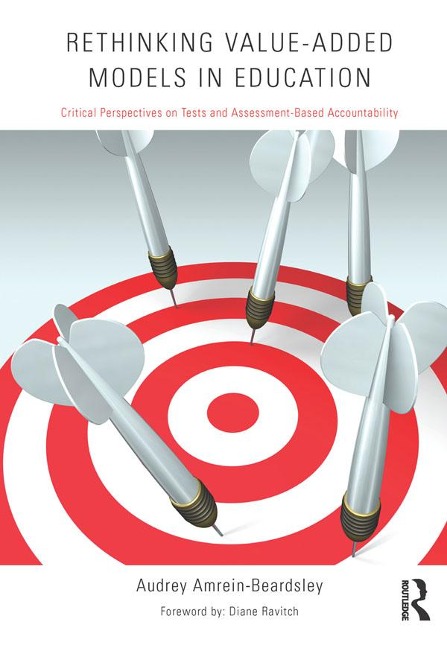
Since passage of the of No Child Left Behind Act in 2001, academic researchers, econometricians, and statisticians have been exploring various analytical methods of documenting students' academic progress over time. Known as value-added models (VAMs), these methods are meant to measure the value a teacher or school adds to student learning from one year to the next. To date, however, there is very little evidence to support the trustworthiness of these models. What is becoming increasingly evident, yet often ignored mainly by policymakers, is that VAMs are 1) unreliable, 2) invalid, 3) nontransparent, 4) unfair, 5) fraught with measurement errors and 6) being inappropriately used to make consequential decisions regarding such things as teacher pay, retention, and termination. Unfortunately, their unintended consequences are not fully recognized at this point either. Given such, the timeliness of this well-researched and thoughtful book cannot be overstated. This book sheds important light on the debate surrounding VAMs and thereby offers states and practitioners a highly important resource from which they can move forward in more research-based ways.
Audrey Amrein-Beardsley, Ph.D., is currently an Associate Professor in Mary Lou Fulton Teachers College at Arizona State University. She is one of the top Edu-Scholars in the nation, honored for being an academic who is contributing substantially to public debates about the nation's educational system. She is also creator and host of the blog: VAMboozled! (vamboozled.com).
Section I: Introduction Chapter 1: Socially Engineering the Road to Utopia Chapter 2: Value-Added Models (VAMs) and the Human Factor Chapter 3: A VAMoramic View of the Nation Section II: Highly Questionable Yet Often Unquestioned Assumptions Chapter 4: Assumptions Used as Rationales and Justifications Chapter 5: Test-Based, Statistical, and Methodological Assumptions Section III: Nontraditional Concerns about Traditional Methodological Notions Chapter 6: Reliability and Validity Chapter 7: Bias and the Random Assignment of Students into Classrooms Section IV: Alternatives, Solutions, and Conclusions Chapter 8: Alternatives, Solutions, and Conclusions
Dieses eBook wird im PDF-Format geliefert und ist mit einem Adobe Kopierschutz (DRM) versehen. Sie können dieses eBook mit allen Geräten lesen, die das PDF-Format und den Adobe Kopierschutz (DRM) unterstützen.
Zum Beispiel mit den folgenden Geräten:
• tolino Reader
Laden Sie das eBook direkt über den Reader-Shop auf dem tolino herunter oder übertragen Sie das eBook auf Ihren tolino mit einer kostenlosen Software wie beispielsweise Adobe Digital Editions.
• Sony Reader & andere eBook Reader
Laden Sie das eBook direkt über den Reader-Shop herunter oder übertragen Sie das eBook mit der kostenlosen Software Sony READER FOR PC/Mac oder Adobe Digital Editions auf ein Standard-Lesegeräte mit epub- und Adobe DRM-Unterstützung.
• Tablets & Smartphones
Möchten Sie dieses eBook auf Ihrem Smartphone oder Tablet lesen, finden Sie hier unsere kostenlose Lese-App für iPhone/iPad und Android Smartphone/Tablets.
• PC & Mac
Lesen Sie das eBook direkt nach dem Herunterladen mit einer kostenlosen Lesesoftware, beispielsweise Adobe Digital Editions, Sony READER FOR PC/Mac oder direkt über Ihre eBook-Bibliothek in Ihrem Konto unter „Meine eBooks“ - „online lesen“.
Schalten Sie das eBook mit Ihrer persönlichen Adobe ID auf bis zu sechs Geräten gleichzeitig frei.
Bitte beachten Sie, dass die Kindle-Geräte das Format nicht unterstützen und dieses eBook somit nicht auf Kindle-Geräten lesbar ist.