Und dann auf "Zum Home-Bildschirm [+]".

Stöbern
genialokal zum Startbildschirm hinzufügen
Installieren Sie die genialokal App auf Ihrem Startbildschirm für einen schnellen Zugriff und eine komfortable Nutzung.
Installieren Sie die genialokal App auf Ihrem Startbildschirm für einen schnellen Zugriff und eine komfortable Nutzung.
Ihr gewünschter Artikel ist in 0 Buchhandlungen vorrätig - wählen Sie hier eine Buchhandlung in Ihrer Nähe aus:

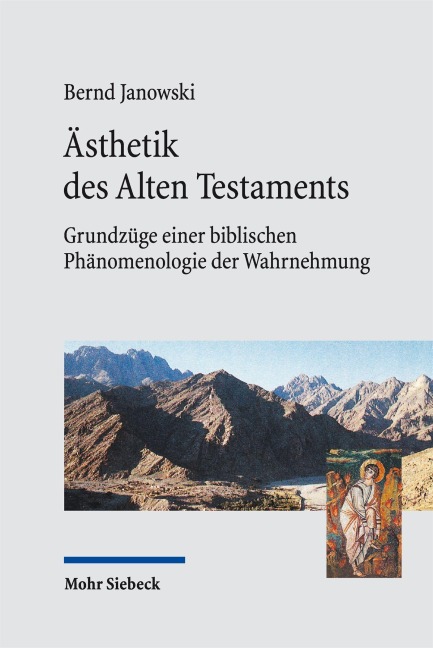
How did people in ancient Israel perceive God, the world, and themselves? And what significance does Old Testament aesthetics have for us today? In this book, the term "aesthetics" is understood in its original sense of aisthesis , "perception." Following an introduction to the history of the concept and of research, the subject is developed comprehensively on the basis of fundamental concepts (beauty, glory, etc.), sensorimotor aspects (sense perceptions, colors, sounds), emotional dimensions (feelings, empathy), and cognitive aspects (recollection, memory), as well as the central thematic fields of experience of the world, perception of God, and self-perception. The distinctive character of Old Testament aesthetics lies in resonant relationships to God and to the world, whereby the world does not remain silent for the perceiving self but "responds" to it in manifold ways - as succinctly expressed in the metaphor of the "listening heart" (1 Kgs 3:9) and in the motif of the visibility of the invisible (Exod 3:1-6). The present study is divided into four main parts and ten subsections, supplemented by two appendices containing selected texts on Old Testament aesthetics from Gen 1 to Eccl 12, as well as 150 textual and visual sources on ancient aesthetics from Egypt, Mesopotamia, Northern Syria/Palestine, Greece, Rome, ancient Judaism, the New Testament, early Christianity, and the Qur'an.
Born 1943; Study of Protestant Theology, Egyptology, and Assyriology in Tübingen; 1980 PhD; 1984 Habilitation; Member of the Heidelberg Academy of Sciences and Humanities; Professor Emeritus of Old Testament Theology in Tübingen.
I. "Ästhetik des Alten Testaments". Einführung (Begriffs- und Ideengeschichte, Forschungsgeschichte)
II. Bausteine der alttestamentlichen Ästhetik (Grundbegriffe und Grundmotive, Aktivitäten und Eigenschaften, Denkformen und Sprachformen)
III. Hauptthemen der alttestamentlichen Ästhetik
1. Formen der Welterfahrung (Raumerfahrungen/-konzepte, Zeiterfahrungen/-konzepte, Erfahrungen von Ordnung und Chaos)
2. Formen der Gotteswahrnehmung (Sehen Gottes, Anthropomorphe und Theriomorphe Gottesbilder)
3. Literarische Ästhetik (Poetik der Erzählliteratur, der Prophetie, der Weisheitsliteratur, der Psalmen)
IV. Gottes, Welt- und Selbstwahrnehmung. Resümee (Methodenfragen, Zentrale Themenfelder, Schlussbemerkungen)
Anhänge (Texte zur alttestamentlichen Ästhetik, Quellen zur Ästhetik der Antike)