Und dann auf "Zum Home-Bildschirm [+]".

Stöbern
genialokal zum Startbildschirm hinzufügen
Installieren Sie die genialokal App auf Ihrem Startbildschirm für einen schnellen Zugriff und eine komfortable Nutzung.
Installieren Sie die genialokal App auf Ihrem Startbildschirm für einen schnellen Zugriff und eine komfortable Nutzung.
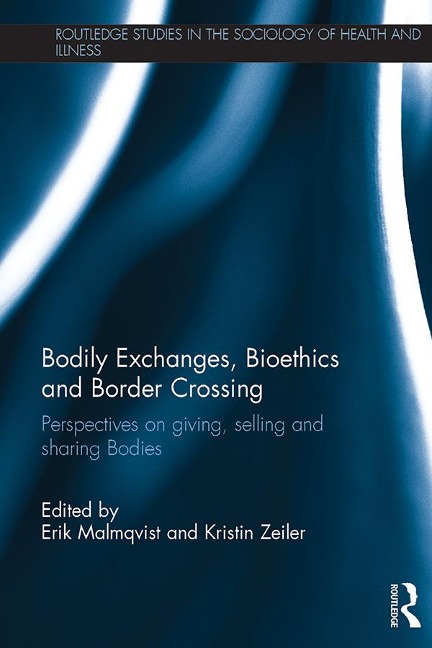
Medical therapy, research and technology enable us to make our bodies, or parts of them, available to others in an increasing number of ways. This is the case in organ, tissue, egg and sperm donation as well as in surrogate motherhood and clinical research. Bringing together leading scholars working on the ethical, social and cultural aspects of such bodily exchanges, this cutting-edge book develops new ways of understanding them. Bodily Exchanges, Bioethics and Border Crossing both probes the established giving and selling frameworks for conceptualising bodily exchanges in medicine, and seeks to develop and examine another, less familiar framework: that of sharing. A framework of sharing can capture practices that involve giving up and giving away part of one's body, such as organ and tissue donation, and practices that do not, such as surrogacy and research participation. Sharing also recognizes the multiple relationalities that these exchanges can involve and invites inquiry into the context in which they occur. In addition, the book explores the multiple forms of border crossing that bodily exchanges in medicine involve, from the physical boundaries of the body to relational borders - as can happen in surrogacy - to national borders and the range of ethical issues that these various border-crossings can give rise to. Engaging with anthropology, sociology, philosophy, and feminist and postcolonical perspectives, this is an original and timely contribution to contemporary bioethics in a time of increasing globalization. It will be of use to students and researchers from a range of humanities and social science backgrounds as well as medical and other healthcare professionals with an interest in bioethics.
Erik Malmqvist, PhD, is Lecturer in Philosophy of Medicine and Medical Ethics at the Department of Thematic Studies: Technology and Social Change, Linköping University, Sweden. His research interests include ethical issues in organ and tissue transplantation, biomedical research, assisted reproduction and vaccination. Currently his research focuses on the ethics of international clinical research and of commodifying the human body. His publications have appeared in journals such as The Lancet, Bioethics, Hastings Center Report, Journal of Medical Ethics and Journal of Applied Philosophy. Kristin Zeiler, PhD, is Senior Lecturer and Docent at the Department of Thematic Studies: Technology and Social Change, Linköping University, Sweden, and Pro Futura Scientia Fellow at the Swedish Collegium for Advanced Study, Uppsala University, Sweden. Zeiler examines ethical, social and cultural aspects of biotechnological interventions and explores how medical treatment, the use of new technology and experience of pain and illness can form our ways of engaging with others and the world, and inform our self-understandings. Her research areas include medical humanities, bioethics, philosophy of medicine and feminist theory, and among her publications is the edited volume (with L.F. Käll) Feminist Phenomenology and Medicine (2014). Zeiler's articles have appeared in journals such as Bioethics, Feminist Theory and Medicine, Health Care and Philosophy.
1. Introduction: Bodily Exchanges, Bioethics and Border Crossing 2. The Lived Body and Personal Identity: The Ontology of Exiled Body Parts 3. Putting the Gift Relationship to Test: The Peculiar Case of Research on Discarded Human Tissue 4. "I Wouldn't Put Them on eBay!" Discourses on Money, Markets and Meanings amongst IVF Patients Volunteering for a UK "Egg Sharing for Research" Scheme 5. Sharing Organs for Transplantation: Altruism as Kagandahang Loob 6. Sharing Amidst Scarcity: The Commons as Innovative Transgression in Xeno- and Allo- Transplant Science 7. Sharing the Embodied Experience of Pregnancy: The Case of Surrogate Motherhood 8. Relational Ontology and Ethics in Online Organ Solicitation: The Problem of Sharing One's Body when Being Touched Online 9. The Transplant Imaginary and Its Postcolonial Hauntings 10. Managing Hope and Spiritual Distress: The Centrality of the Doctor-Patient Relationship in Combatting Stem Cell Travel 11. International Clinical Research and the Problem of Benefiting from Injustice 12. The Ethics of Transactions in an Unjust World 13. Concluding Reflections: Bodily Exchanges as Sharing
Dieses eBook wird im PDF-Format geliefert und ist mit einem Adobe Kopierschutz (DRM) versehen. Sie können dieses eBook mit allen Geräten lesen, die das PDF-Format und den Adobe Kopierschutz (DRM) unterstützen.
Zum Beispiel mit den folgenden Geräten:
• tolino Reader
Laden Sie das eBook direkt über den Reader-Shop auf dem tolino herunter oder übertragen Sie das eBook auf Ihren tolino mit einer kostenlosen Software wie beispielsweise Adobe Digital Editions.
• Sony Reader & andere eBook Reader
Laden Sie das eBook direkt über den Reader-Shop herunter oder übertragen Sie das eBook mit der kostenlosen Software Sony READER FOR PC/Mac oder Adobe Digital Editions auf ein Standard-Lesegeräte mit epub- und Adobe DRM-Unterstützung.
• Tablets & Smartphones
Möchten Sie dieses eBook auf Ihrem Smartphone oder Tablet lesen, finden Sie hier unsere kostenlose Lese-App für iPhone/iPad und Android Smartphone/Tablets.
• PC & Mac
Lesen Sie das eBook direkt nach dem Herunterladen mit einer kostenlosen Lesesoftware, beispielsweise Adobe Digital Editions, Sony READER FOR PC/Mac oder direkt über Ihre eBook-Bibliothek in Ihrem Konto unter „Meine eBooks“ - „online lesen“.
Schalten Sie das eBook mit Ihrer persönlichen Adobe ID auf bis zu sechs Geräten gleichzeitig frei.
Bitte beachten Sie, dass die Kindle-Geräte das Format nicht unterstützen und dieses eBook somit nicht auf Kindle-Geräten lesbar ist.