Und dann auf "Zum Home-Bildschirm [+]".

Stöbern
genialokal zum Startbildschirm hinzufügen
Installieren Sie die genialokal App auf Ihrem Startbildschirm für einen schnellen Zugriff und eine komfortable Nutzung.
Installieren Sie die genialokal App auf Ihrem Startbildschirm für einen schnellen Zugriff und eine komfortable Nutzung.
Ihr gewünschter Artikel ist in 0 Buchhandlungen vorrätig - wählen Sie hier eine Buchhandlung in Ihrer Nähe aus:

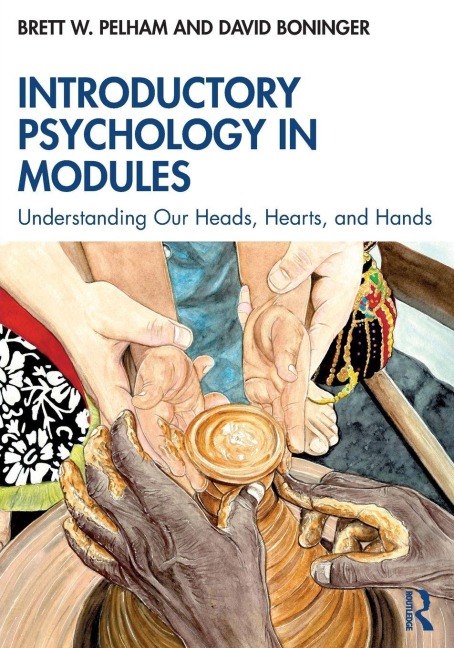
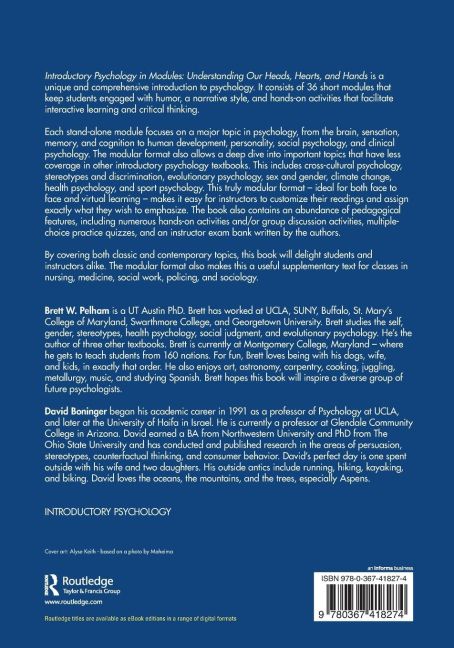
Introductory Psychology in Modules: Understanding Our Heads, Hearts, and Hands is a unique and comprehensive introduction to psychology. It consists of 36 short modules that keep students engaged with humor, a narrative style, and hands-on activities that facilitate interactive learning and critical thinking.
Brett W. Pelham is a UT Austin PhD. Brett has worked at UCLA, SUNY, Buffalo, St. Mary's College of Maryland, Swarthmore College, and Georgetown University. Brett studies the self, gender, stereotypes, health psychology, social judgment, and evolutionary psychology. He's the author of three other textbooks. Brett is currently at Montgomery College, Maryland - where he gets to teach students from 160 nations. For fun, Brett loves being with his dogs, wife, and kids, in exactly that order. He also enjoys art, astronomy, carpentry, cooking, juggling, metallurgy, music, and studying Spanish. Brett hopes this book will inspire a diverse group of future psychologists. David Boninger began his academic career in 1991 as a professor of Psychology at UCLA, and later at the University of Haifa in Israel. He is currently a professor at Glendale Community College in Arizona. David earned a BA from Northwestern University and PhD from The Ohio State University and has conducted and published research in the areas of persuasion, stereotypes, counterfactual thinking, and consumer behavior. David's perfect day is one spent outside with his wife and two daughters. His outside antics include running, hiking, kayaking, and biking. David loves the oceans, the mountains, and the trees, especially Aspens.
I. History of and Methods in Psychology: 1) Psychology and the Four Ways of Knowing 2) Seven Windows on the History of Psychology 3) Doing Good Science: Internal Validity in Psychological Research 4) Doing Relevant Science: External Validity and Archival Research II. The Brain: 5) Six Important Features of the Human Brain 6) The Structure and Function of Key Brain Regions III. Genetics & Evolution: 7) Genetics - Our Biological Origins 8) Evolutionary Psychology: How the Past Informs the Present IV. Sensation & Perception: 9) How the World Gets Inside You: Sensation and Perception 10) Four Windows on Human Perception V. Learning: 11) Classical Conditioning: Learning by Association 12) Operant Conditioning: Learning the Consequences of Our Behavior VI. Motivation, Emotion, and More: 13) Motivation: The Psychology of Wants and Needs 14) Emotions: Are You Feeling It? 15) Sex, Gender, and Sexuality VII. Memory and Cognition: 16) Memory: Making the Past the Present 17) Consciousness (or the Lack Thereof) 18) Exploring the "Snap" in Snap Judgment: Judgment and Decision Making 19) Look Who's Talking: Language and Reasoning 20) Intelligence and the Insularity of Genius VIII. Lifespan Human Development: 21) Human Prenatal Development and Birth 22) Critical and Sensitive Periods in Human Development 23) Cognitive Development: Going from the Concrete to the Abstract 24) Psychosocial Development: Navigating Challenges Across the Lifespan 25) Adult Development: Getting There - and then Hanging in There IX. Social, Personality, and Cultural Psychology: 26) Social Psychology: The Power of the Situation 27) Stereotypes and Social Perception 28) Six Lenses on Human Aggression 29) Is there an "I" in Altruism? Human Prosocial Behavior 30) Personality: Our Uniqueness and Why it Matters 31) Culture: How Psychology Varies with Geography X. Clinical Psychology: 32) Everybody Hurts: Understanding Psychological Disorders 33) Getting Well: Treatment of Psychological Disorders XI. Applied Psychology: 34) Health Psychology: How the Psychological Becomes the Physical 35) Mind Games, in a Good Way: Sport Psychology 36) Saving the Planet: Psychology and Climate Change