Und dann auf "Zum Home-Bildschirm [+]".

Stöbern
genialokal zum Startbildschirm hinzufügen
Installieren Sie die genialokal App auf Ihrem Startbildschirm für einen schnellen Zugriff und eine komfortable Nutzung.
Installieren Sie die genialokal App auf Ihrem Startbildschirm für einen schnellen Zugriff und eine komfortable Nutzung.
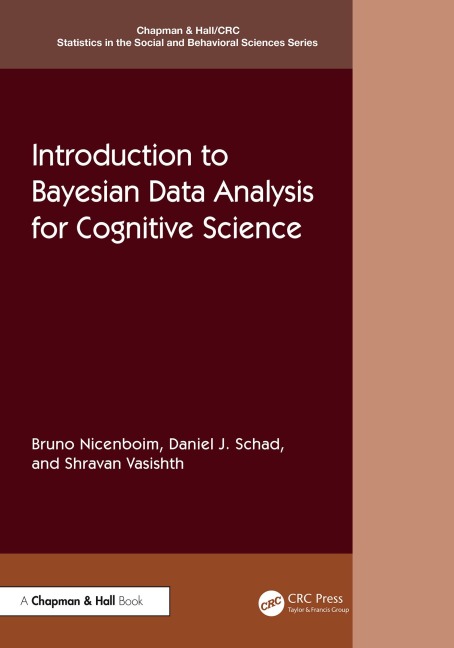
This book introduces Bayesian data analysis and Bayesian cognitive modeling to students and researchers in cognitive science (e.g., linguistics, psycholinguistics, psychology, computer science), with a particular focus on modeling data from planned experiments. The book relies on the probabilistic programming language Stan and the R package brms, which is a front-end to Stan. The book only assumes that the reader is familiar with the statistical programming language R, and has basic high school exposure to pre-calculus mathematics; some of the important mathematical constructs needed for the book are introduced in the first chapter. Through this book, the reader will be able to develop a practical ability to apply Bayesian modeling within their own field. The book begins with an informal introduction to foundational topics such as probability theory, and univariate and bi-/multivariate discrete and continuous random variables. Then, the application of Bayes' rule for statistical inference is introduced with several simple analytical examples that require no computing software; the main insight here is that the posterior distribution of a parameter is a compromise between the prior and the likelihood functions. The book then gradually builds up the regression framework using the brms package in R, ultimately leading to hierarchical regression modeling (aka the linear mixed model). Along the way, there is detailed discussion about the topic of prior selection, and developing a well-defined workflow. Later chapters introduce the Stan programming language, and cover advanced topics using practical examples: contrast coding, model comparison using Bayes factors and cross-validation, hierarchical models and reparameterization, defining custom distributions, measurement error models and meta-analysis, and finally, some examples of cognitive models: multinomial processing trees, finite mixture models, and accumulator models. Additional chapters, appendices, and exercises are provided as online materials and can be accessed here: https://github.com/bnicenboim/bayescogsci.
Bruno Nicenboim is assistant professor in the department of Cognitive Science and Artificial Intelligence at Tilburg University in the Netherlands, working within the area of computational psycholinguistics. Daniel J. Schad is a cognitive psychologist and is professor of Quantitative Methods at the HMU Health and Medical University in Potsdam, Germany. Shravan Vasishth is professor of psycholinguistics at the department of Linguistics at the University of Potsdam, Germany; he is a chartered statistician (Royal Statistical Society, UK).
Preface About the Authors I Foundational ideas 1 Introduction 2 Introduction to Bayesian data analysis II Regression models with brms 3 Computational Bayesian data analysis 4 Bayesian regression models 5 Bayesian hierarchical models 6 Contrast coding 7 Contrast coding with two predictor variables III Advanced models with Stan 8 Introduction to the probabilistic programming language Stan 9 Hierarchical models and reparameterization 10 Custom distributions in Stan IV Evidence synthesis and measurements with error 11 Meta-analysis and measurement error models V Model comparison 12 Introduction to model comparison 13 Bayes factors 14 Cross-validation VI Cognitive modeling with Stan 15 Introduction to cognitive modeling 16 Multinomial processing trees 17 Mixture models 18 A simple accumulator model to account for choice response time 19 In closing References
Dieses eBook wird im PDF-Format geliefert und ist mit einem Adobe Kopierschutz (DRM) versehen. Sie können dieses eBook mit allen Geräten lesen, die das PDF-Format und den Adobe Kopierschutz (DRM) unterstützen.
Zum Beispiel mit den folgenden Geräten:
• tolino Reader
Laden Sie das eBook direkt über den Reader-Shop auf dem tolino herunter oder übertragen Sie das eBook auf Ihren tolino mit einer kostenlosen Software wie beispielsweise Adobe Digital Editions.
• Sony Reader & andere eBook Reader
Laden Sie das eBook direkt über den Reader-Shop herunter oder übertragen Sie das eBook mit der kostenlosen Software Sony READER FOR PC/Mac oder Adobe Digital Editions auf ein Standard-Lesegeräte mit epub- und Adobe DRM-Unterstützung.
• Tablets & Smartphones
Möchten Sie dieses eBook auf Ihrem Smartphone oder Tablet lesen, finden Sie hier unsere kostenlose Lese-App für iPhone/iPad und Android Smartphone/Tablets.
• PC & Mac
Lesen Sie das eBook direkt nach dem Herunterladen mit einer kostenlosen Lesesoftware, beispielsweise Adobe Digital Editions, Sony READER FOR PC/Mac oder direkt über Ihre eBook-Bibliothek in Ihrem Konto unter „Meine eBooks“ - „online lesen“.
Schalten Sie das eBook mit Ihrer persönlichen Adobe ID auf bis zu sechs Geräten gleichzeitig frei.
Bitte beachten Sie, dass die Kindle-Geräte das Format nicht unterstützen und dieses eBook somit nicht auf Kindle-Geräten lesbar ist.