Und dann auf "Zum Home-Bildschirm [+]".

Stöbern
genialokal zum Startbildschirm hinzufügen
Installieren Sie die genialokal App auf Ihrem Startbildschirm für einen schnellen Zugriff und eine komfortable Nutzung.
Installieren Sie die genialokal App auf Ihrem Startbildschirm für einen schnellen Zugriff und eine komfortable Nutzung.


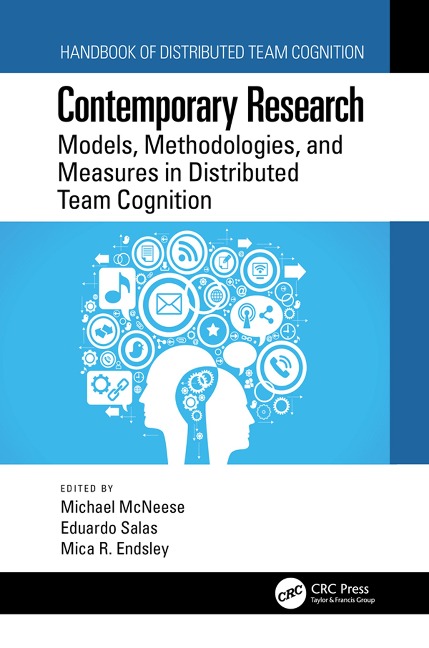
The objective of Contemporary Research: Models, Methodologies, and Measures in Distributed Team Cognition is to advance knowledge in terms of real-world interactions among information, people, and technologies through explorations and discovery embedded within the research topics covered. Each chapter provides insight, comprehension, and differing yet cogent perspectives to topics relevant within distributed team cognition. Experts present their use of models and frameworks, different approaches to studying distributed team cognition, and new types of measures and indications of successful outcomes. The research topics presented span the continuum of interdisciplinary philosophies, ideas, and concepts that underline research investigation. Features - Articulates distributed team cognition principles/constructs within studies, models, methods, and measures - Utilizes experimental studies and models as cases to explore new analytical techniques and tools - Provides team situation awareness measurement, mental model assessment, conceptual recurrence analysis, quantitative model evaluation, and unobtrusive measures - Transforms analytical output from tools/models as a basis for design in collaborative technologies - Generates an interdisciplinary approach using multiple methods of inquiry
Michael D. McNeese is a Professor (Emeritus) and was the Director of the MINDS Group (Multidisciplinary Initiatives in Naturalistic Decision Systems) at the College of Information Sciences and Technology, The Pennsylvania State University, University Park, PA. Previously, he was the Senior Associate Dean and Professor in Charge at Penn State. He has worked on multiple research projects involving team cognition, artificial intelligence, human factors engineering, crisis management and response, situation awareness, and interactive simulations over the last 35 years. He was a Senior Scientist and Director of Collaborative Design Technology at the USAF Research Laboratory prior to moving to Penn State. Dr. McNeese earned a PhD in cognitive science at Vanderbilt University and an MA in experimental-cognitive psychology at the University of Dayton, was a visiting professor at The Ohio State University, Department of Integrated Systems Engineering. Eduardo Salas is the Allyn R. and Gladys M. Cline Chair Professor and Chair of the Department of Psychological Sciences at Rice University. He is a past president of the Society for Industrial and Organizational Psychology (SIOP) and the Human Factors and Ergonomics Society (HFES), and a fellow of the American Psychological Association (APA), Association for Psychological Science, and HFES. He is also the recipient of the 2012 Society for Human Resource Management Losey Lifetime Achievement Award, the 2012 Joseph E. McGrath Award for Lifetime Achievement for his work on teams and team training, and the 2016 APA Award for Outstanding Lifetime Contributions to Psychology. He earned a PhD (1984) in industrial/organizational psychology at Old Dominion University. Mica R. Endsley is the President of SA Technologies, a cognitive engineering firm specializing in the development of operator interfaces for advanced systems, including the next generation of systems for military, aviation, air traffic control, medicine, and power grid operations. Previously she served as Chief Scientist of the U.S. Air Force and was the chief scientific adviser to the Chief of Staff and Secretary of the Air Force. She has also been a visiting associate professor at MIT and an associate professor of industrial engineering at Texas Tech University. She earned a PhD in industrial and systems engineering at the University of Southern California. She is a past president and fellow of the Human Factors and Ergonomics Society and a fellow of the International Ergonomics Association.
1. Situation Awareness in Teams: Models and Measures 2. Studying Team Cognition in the C3Fire Microworld 3. The Dynamical Systems Approach to Team Cognition: Theory, Models, and Measures 4. Distributed Cognition in Self-Organizing Teams 5. Unobtrusive Measurement of Team Cognition: A Review and Event-Based Approach to Measurement Design 6. A Method for Rigorously Assessing Causal Mental Models to Support Distributed Team Cognition 7. Quantitative Modeling of Dynamic Human-Agent Cognition 8. Fuzzy Cognitive Maps for Modeling Human Factors in Systems 9. Understanding Human-Machine Teaming through Interdependence Analysis 10. Using Conceptual Recurrence Analysis to Decompose Team Conversations
Dieses eBook wird im PDF-Format geliefert und ist mit einem Adobe Kopierschutz (DRM) versehen. Sie können dieses eBook mit allen Geräten lesen, die das PDF-Format und den Adobe Kopierschutz (DRM) unterstützen.
Zum Beispiel mit den folgenden Geräten:
• tolino Reader
Laden Sie das eBook direkt über den Reader-Shop auf dem tolino herunter oder übertragen Sie das eBook auf Ihren tolino mit einer kostenlosen Software wie beispielsweise Adobe Digital Editions.
• Sony Reader & andere eBook Reader
Laden Sie das eBook direkt über den Reader-Shop herunter oder übertragen Sie das eBook mit der kostenlosen Software Sony READER FOR PC/Mac oder Adobe Digital Editions auf ein Standard-Lesegeräte mit epub- und Adobe DRM-Unterstützung.
• Tablets & Smartphones
Möchten Sie dieses eBook auf Ihrem Smartphone oder Tablet lesen, finden Sie hier unsere kostenlose Lese-App für iPhone/iPad und Android Smartphone/Tablets.
• PC & Mac
Lesen Sie das eBook direkt nach dem Herunterladen mit einer kostenlosen Lesesoftware, beispielsweise Adobe Digital Editions, Sony READER FOR PC/Mac oder direkt über Ihre eBook-Bibliothek in Ihrem Konto unter „Meine eBooks“ - „online lesen“.
Schalten Sie das eBook mit Ihrer persönlichen Adobe ID auf bis zu sechs Geräten gleichzeitig frei.
Bitte beachten Sie, dass die Kindle-Geräte das Format nicht unterstützen und dieses eBook somit nicht auf Kindle-Geräten lesbar ist.