Und dann auf "Zum Home-Bildschirm [+]".

Stöbern
genialokal zum Startbildschirm hinzufügen
Installieren Sie die genialokal App auf Ihrem Startbildschirm für einen schnellen Zugriff und eine komfortable Nutzung.
Installieren Sie die genialokal App auf Ihrem Startbildschirm für einen schnellen Zugriff und eine komfortable Nutzung.
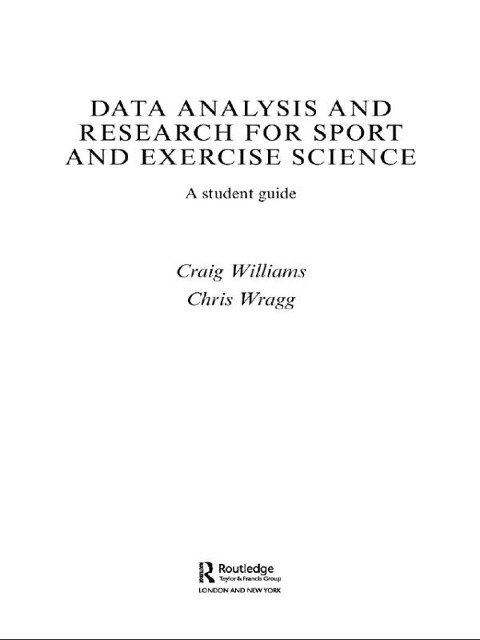
Data Analysis and Research for Sport and Exercise Science is tailored to suit undergraduate sports and exercise science students seeking a clear understanding of data and statistics to support their scientific research. The text is divided into three main areas: Research and Design, Data Analysis and the Interpretation of Findings. Topics covered in the book include: * introduction to the scientific research method * the literature review * developing your research question and experimental design * using statistical analysis to interpret results * presentation of your data * discussing your results and drawing conclusions. Both authors have supervised many student dissertations and have an excellent understanding of the concerns and pitfalls facing those new to this field.
Craig Williams is programme director and senior lecturer in sport and exercise science at the University of Exeter. Chris Wragg is a lecturer in sport and exercise science at the University of Brighton.
1. Learning outcomes 1.1 Introduction 1.2 The history of science 1.2.1 Logic and deductive reasoning 1.2.2 Inductivism 1.2.3 Reductionism 1.2.4 Hypothesis testing 1.3 Summery and criticism of the scientific method 1.4 The foundations and development of exercise and sport sciences, Summary 2. Learning outcomes 2.1 Introduction 2.2 Why is a literature review so important? 2.2.1 The purpose of a review of literature 2.2.2 Planning and preparation 2.2.3 Define the research area 2.2.4 State the specific purpose of the search 2.2.5 Select database(s) and descriptors 2.2.6 Plan 2.2.7 Conduct 2.3 How to write the review, Common problems faced by students, Common mistakes, Summary 3. Learning outcomes 3.1 Introduction 3.1.1 Common mistakes 3.1.2 The research question and experimental design 3.2 Validity 3.3 Internal validity 3.3.1 Threats to internal validity 3.4 External validity 3.5 Validity of measurement 3.5.1 Logical validity 3.5.2 Criterion validity 3.5.3 Construct validity 3.5.4 Ecological validity 3.6 Reliability 3.6.1 Sources of variability 3.6.1.1 Technician error 3.6.1.2 Equipment error 3.6.1.3 Learning effect 3.6.1.4 Biological variance 3.6.2 Terminology 3.6.2.1 Reproducibility 3.6.2.3 Constancy 3.7 Types of experimental design 3.7.1 Single subject study 3.7.2 Longitudinal study 3.7.3 True experimental 3.7.4 Quasi-experimental 3.7.5 Causal-comparative 3.7.6 Correlational 3.8 Selecting the appropriate experimental design, Summary 4. Learning outcomes 4.1 Introduction 4.2 Different types of averages; a quick reminder 4.3 Normal distribution 4.3.1 Skewness 4.3.2 Multimodal data 4.3.3 Variance 4.4 Measures of variance 4.4.1 Range 4.4.2 Standard deviation 4.4.3 Coefficient of variation 4.5 Standard Deviation and the normal distribution, Summary 5. Learning outcomes 5.1 Introduction 5.2 Type I and Type II Errors 5.3 Statistical power 5.4 One-tailed and Two-tailed tests of difference 5.5 Measuring differences between independent samples 5.5.1 Independent samples t tests 5.5.2 Dependent samples (repeated measures) t tests 5.6 Testing differences between more than two samples 5.6.1 Simple one way analysis of variance (ANOVA) 5.6.2 One way repeated measures analysis of variance (ANOVA) 5.7 Post hoc testing 5.8 Factorial analysis of variance 5.9 Common mistakes, Summary 6. Learning outcomes 6.1 Introduction 6.2 Scatter plots 6.3 Correlations 6.3.1 Sample size and statistical significance 6.3.2 Size of a correlation coefficient 6.3.3 Understanding correlations 6.4 Bivariate regression 6.5 Multiple regression 6.6 Common mistakes, Summary 7. Learning outcomes 7.1 Introduction 7.2 Ordinal scales 7.3 Non-parametric statistical tests 7.3.1 Tests of difference for independent samples 7.3.2 Tests of difference for dependent samples (repeated measures) 7.3.3 Relationship testing 7.4 Chi-squares 7.5 Common mistakes, Summary 8. Learning outcomes 8.1 Introduction 8.2 Guidelines for text 8.3 Guidelines for tables 8.4 Guidelines for figures 8.5 Presentations 8.5.1 Oral presentations 8.5.2 Poster presentations 8.7 Common mistakes, Summary 9. Learning outcomes 9.1 Introduction 9.2 Generic information related to the interpretation of data 9.3 Difference testing 9.3.1 Interpreting effects 9.3.2 How significant is significant? 9.3.3 Practical versus statistical significance 9.3.4 Summary 9.4 Correlation studies 9.4.1 Cause and effect? 9.4.2 The size of the correlation 9.4.3 The range of the data 9.4.4 Statistical versus practical significance 9.4.5 Common mistakes 9.5 Regression analyses 9.5.1 Prediction or cause and effect? 9.5.2 The prediction model 9.5.3 Summary 10. Learning outcomes 10.1 Introduction 10.2 Discussion and conclusion 10.2.1 Key points 10.3 Reasoning and conclusions 10.3.1 Multiple reasons and intermediate conclusions 10.4 Common mistakes, Summary
Dieses eBook wird im PDF-Format geliefert und ist mit einem Adobe Kopierschutz (DRM) versehen. Sie können dieses eBook mit allen Geräten lesen, die das PDF-Format und den Adobe Kopierschutz (DRM) unterstützen.
Zum Beispiel mit den folgenden Geräten:
• tolino Reader
Laden Sie das eBook direkt über den Reader-Shop auf dem tolino herunter oder übertragen Sie das eBook auf Ihren tolino mit einer kostenlosen Software wie beispielsweise Adobe Digital Editions.
• Sony Reader & andere eBook Reader
Laden Sie das eBook direkt über den Reader-Shop herunter oder übertragen Sie das eBook mit der kostenlosen Software Sony READER FOR PC/Mac oder Adobe Digital Editions auf ein Standard-Lesegeräte mit epub- und Adobe DRM-Unterstützung.
• Tablets & Smartphones
Möchten Sie dieses eBook auf Ihrem Smartphone oder Tablet lesen, finden Sie hier unsere kostenlose Lese-App für iPhone/iPad und Android Smartphone/Tablets.
• PC & Mac
Lesen Sie das eBook direkt nach dem Herunterladen mit einer kostenlosen Lesesoftware, beispielsweise Adobe Digital Editions, Sony READER FOR PC/Mac oder direkt über Ihre eBook-Bibliothek in Ihrem Konto unter „Meine eBooks“ - „online lesen“.
Schalten Sie das eBook mit Ihrer persönlichen Adobe ID auf bis zu sechs Geräten gleichzeitig frei.
Bitte beachten Sie, dass die Kindle-Geräte das Format nicht unterstützen und dieses eBook somit nicht auf Kindle-Geräten lesbar ist.