Und dann auf "Zum Home-Bildschirm [+]".

Stöbern
genialokal zum Startbildschirm hinzufügen
Installieren Sie die genialokal App auf Ihrem Startbildschirm für einen schnellen Zugriff und eine komfortable Nutzung.
Installieren Sie die genialokal App auf Ihrem Startbildschirm für einen schnellen Zugriff und eine komfortable Nutzung.
Ihr gewünschter Artikel ist in 0 Buchhandlungen vorrätig - wählen Sie hier eine Buchhandlung in Ihrer Nähe aus:

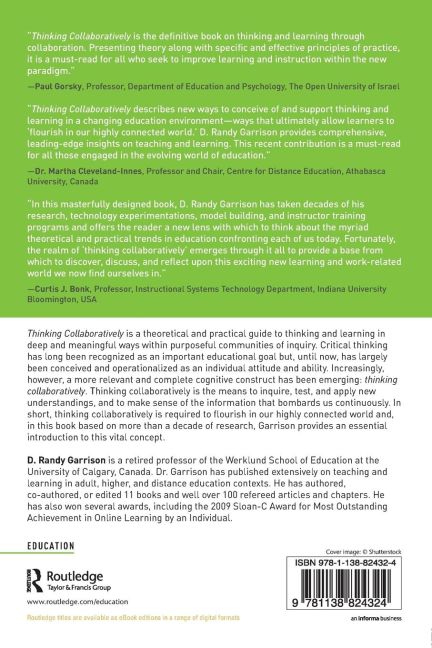
Thinking Collaboratively is a theoretical and practical guide to thinking and learning in deep and meaningful ways within purposeful communities of inquiry. Critical thinking has long been recognized as an important educational goal but, until now, has largely been conceived and operationalized as an individual attitude and ability. Increasingly, however, a more relevant and complete cognitive construct has been emerging: thinking collaboratively. Thinking collaboratively is the means to inquire, test, and apply new understandings, and to make sense of the information that bombards us continuously. In short, thinking collaboratively is required to flourish in our highly connected world and, in this book based on more than a decade of research, Garrison provides an essential introduction to this vital concept.
D. Randy Garrison is a retired professor of the Werklund School of Education at the University of Calgary, Canada. Dr. Garrison has published extensively on teaching and learning in adult, higher, and distance education contexts. He has authored, co-authored, or edited eleven books and well over 100 refereed articles and chapters. He has also won several awards including the 2009 Sloan-C Award for Most Outstanding Achievement in Online Learning by an Individual.
Preface Chapter 1: Introduction Foundational Constructs Technology Critical thinking The Community of Inquiry Summary Chapter 2: Thinking and Learning Critical and Reflective Thinking Collaborative Constructivism Community and Collaboration Collaboration and Competition Metacognition and Regulation Summary Chapter 3: Technology and Thinking Technological Innovations Technology Enhanced Approaches Summary Chapter 4: A New Era Distance Education Campus-Based Education Online Learning Summary Chapter 5: The Community of Inquiry Communities of Inquiry Inquiry Deep Approaches to Learning The Community of Inquiry Framework Metacognition Summary Chapter 6: Community of Inquiry Research A Coherent Framework Social Presence Cognitive presence Teaching Presence Shared Metacognition Summary Chapter 7: Principles of Practice Principles Design Facilitation Direction Assessment Summary Chapter 8: Leading Collaboratively Collaboration and Bureaucracy Initiating and Sustaining Change Faculty Development Summary Chapter 9: Conclusion Appendix A: Community of Inquiry Survey Instrument Appendix B: Shared Metacognition Survey Instrument References Index