Und dann auf "Zum Home-Bildschirm [+]".

Stöbern
genialokal zum Startbildschirm hinzufügen
Installieren Sie die genialokal App auf Ihrem Startbildschirm für einen schnellen Zugriff und eine komfortable Nutzung.
Installieren Sie die genialokal App auf Ihrem Startbildschirm für einen schnellen Zugriff und eine komfortable Nutzung.
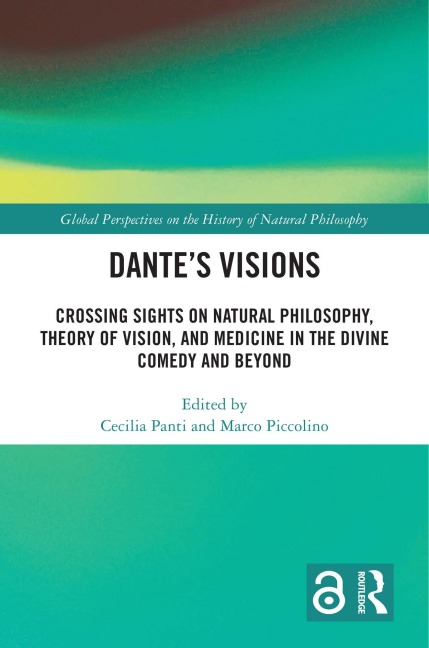
Dante's Visions: Crossing Sights on Natural Philosophy, Theory of Vision, and Medicine in the Divine Comedy and Beyond offers a fascinating insight into Dante's engagement with the science of his time, particularly with visual perception and neurological disorders. The relationship between the soul and the body and the bond between human beings and their natural environment were significant areas of interest in the medieval world. In Dante's Divine Comedy, as well as in his Vita Nuova and Convivio, these connections are enhanced to the fullest, expressing feelings and sensations, pain and ecstasy, and physical and spiritual passions under exceptional psychological and environmental stimuli. Based on the research of a multidisciplinary group of scholars - including experts in Dante, the culture and history of medieval literature and philosophy, historians of science, neuroscientists, and specialists in vision and visual illusions - this book explores the poet's psychophysical descriptions of sense perception, the theory of vision, optical illusions and deceptions of sight, neurological phenomena, and the anatomy and physiology of the human nervous system. It highlights the Aristotelian sources of his scientific culture and the influence of the Arabic sciences on their dissemination in the Western world. In addition to illustrating the cultural background of a poetic genius, with specific reference to the rich scientific reflections in Italy at Dante's time, this book brings out the many opportunities for future research at the intersection of science and literature in the past.
Cecilia Panti is Professor of History of medieval philosophy at the University of Rome Tor Vergata (Italy). Her research interests in the fields of philosophy, optics, theory of music, and the quadrivium are featured in numerous academic journals and collective volumes. Her publications include editions of Robert Grosseteste's cosmological treatises (2001) and his De luce (2011); Johannes Tinctoris' Dictionary of Music (2004); a volume on acoustics in Late Antiquity and the Middle Ages (2008); and the special issues of the journals Micrologus: Nature, Sciences and Medieval Societies ('Latin and Arabic Theory of Perspective', Volume 29, 2021) and Revista Española de Filosofía Medieval ('Robert Grosseteste and Aristotelianism', Volume 30/1, 2023). Marco Piccolino has taught general physiology and the history of science at the University of Ferrara (Italy), where he is currently a member of the Centre of Neuroscience. He is a neurophysiologist who has conducted significant research in the physiology of the retina, publishing his results in prestigious international journals, including Nature and Science. He has written several volumes on the history of electrophysiology and sensory physiology, notably The Shocking History of Electric Fishes: From Ancient Epochs to the Birth of Modern Neurophysiology (2011) with Stanley Finger; Shocking Frogs: Galvani, Volta, and the Electric Origins of Neuroscience (2013) with Marco Bresadola; and Galileo's Visions: Piercing the Spheres of the Heavens by Eye and Mind (2013), with Nicholas J. Wade.
Introduction Cecilia Panti and Marco Piccolino Chapter 1 Dante and Natural Philosophy Simon A. Gilson Chapter 2 Visual Motion Illusions in the Classical Era and in the Middle Ages Nicholas J. Wade Chapter 3 Vision as a Tangible and Dynamic Tool in the Divine Comedy. An Overview Marco Piccolino Chapter 4 Moving Clouds and Bending Towers: The Illusive Motion of the Garisenda in Inferno XXXI Marco Piccolino Chapter 5 Where Do Visions That Do Not Come from Sight Come from? Mirko Tavoni Chapter 6 Seeing the Light: Dante and the Perspectivist Theory of Light as Proper Visible Cecilia Panti Chapter 7 Visual Perception in Dante's Commedia According to the Early Commentaries (1320-1400) Francesca Galli Chapter 8 A Medical Commentary on the Signa amoris in the Vita Nuova Francesco Brigo Chapter 9 Dante, Healthcare and Diseases Michele A. Riva and Lorenzo Lorusso Chapter 10 Dante Neurologist and Neuroanatomist: Evidence from the Divine Comedy Donatella Lippi, Raffaella Bianucci, Elena Varotto, Francesco Arba, and Francesco M. Galassi
Dieses eBook wird im PDF-Format geliefert und ist mit einem Adobe Kopierschutz (DRM) versehen. Sie können dieses eBook mit allen Geräten lesen, die das PDF-Format und den Adobe Kopierschutz (DRM) unterstützen.
Zum Beispiel mit den folgenden Geräten:
• tolino Reader
Laden Sie das eBook direkt über den Reader-Shop auf dem tolino herunter oder übertragen Sie das eBook auf Ihren tolino mit einer kostenlosen Software wie beispielsweise Adobe Digital Editions.
• Sony Reader & andere eBook Reader
Laden Sie das eBook direkt über den Reader-Shop herunter oder übertragen Sie das eBook mit der kostenlosen Software Sony READER FOR PC/Mac oder Adobe Digital Editions auf ein Standard-Lesegeräte mit epub- und Adobe DRM-Unterstützung.
• Tablets & Smartphones
Möchten Sie dieses eBook auf Ihrem Smartphone oder Tablet lesen, finden Sie hier unsere kostenlose Lese-App für iPhone/iPad und Android Smartphone/Tablets.
• PC & Mac
Lesen Sie das eBook direkt nach dem Herunterladen mit einer kostenlosen Lesesoftware, beispielsweise Adobe Digital Editions, Sony READER FOR PC/Mac oder direkt über Ihre eBook-Bibliothek in Ihrem Konto unter „Meine eBooks“ - „online lesen“.
Schalten Sie das eBook mit Ihrer persönlichen Adobe ID auf bis zu sechs Geräten gleichzeitig frei.
Bitte beachten Sie, dass die Kindle-Geräte das Format nicht unterstützen und dieses eBook somit nicht auf Kindle-Geräten lesbar ist.