Und dann auf "Zum Home-Bildschirm [+]".

Stöbern
genialokal zum Startbildschirm hinzufügen
Installieren Sie die genialokal App auf Ihrem Startbildschirm für einen schnellen Zugriff und eine komfortable Nutzung.
Installieren Sie die genialokal App auf Ihrem Startbildschirm für einen schnellen Zugriff und eine komfortable Nutzung.
Ihr gewünschter Artikel ist in 0 Buchhandlungen vorrätig - wählen Sie hier eine Buchhandlung in Ihrer Nähe aus:

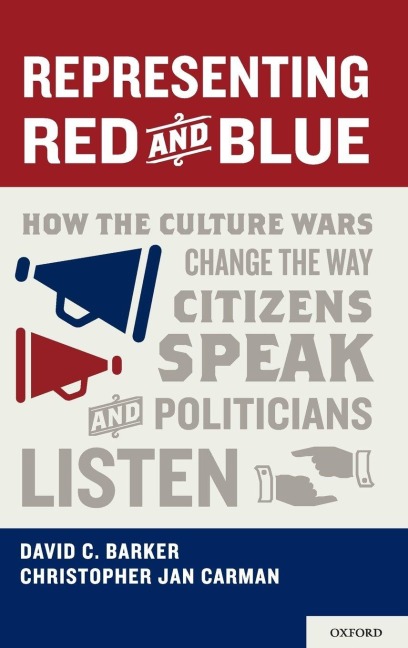
In Representing Red and Blue, Barker and Carman observe that culturally traditionalist Republicans tend to demand -- and get -- less policy responsiveness from their elected representatives than do culturally progressive Democrats. Cultural traditionalists prefer "leaders who lead," while cultural progressives prefer "public servants who listen," creating a dynamic that engenders political inequality.
David C. Barker is Associate Professor of Political Science at the University of Pittsburgh. He received his PhD from the University of Houston in 1998. He is also the author of Rushed to Judgment? Talk Radio, Persuasion, and American Political Behavior (Columbia University Press, 2002). His research interests include American politics, political behavior and psychology, political communication, campaigns and elections, and religion and politics.
Christopher Jan Carman is Senior Research Lecturer in Government at the University of Strathclyde. He received his PhD from the University of Houston in 2000. He is also a co-author of Elections and Voters in Britain, 3rd ed. (Palgrave Macmillan, 2012). He has served as a consultant for the Scottish Parliament and a psephologist for BBC News.
Preface
Chapter 1 Introduction: Saddling the Drunken Mule
Part I: The Demand Side of Political Representation
Chapter 2 How Do We Want to be Represented? How Do We Differ?
Chapter 3 Theory: Cultural Warfare and Styles of Representation in the US
Chapter 4 Mapping the Cultural and Partisan Divide in Representation Preferences
Part II: The Fine Art of Pandering
Chapter 5 Representation Styles, Candidate Cues, and the Voting Booth
Chapter 6 Constituent Perceptions of Representation Styles and Democratic Accountability
Chapter 7 Red Representation, Blue Representation
Chapter 8 Conclusion: Quieting the Stable, Polarizing the Ranch
Appendices