Und dann auf "Zum Home-Bildschirm [+]".

Stöbern
genialokal zum Startbildschirm hinzufügen
Installieren Sie die genialokal App auf Ihrem Startbildschirm für einen schnellen Zugriff und eine komfortable Nutzung.
Installieren Sie die genialokal App auf Ihrem Startbildschirm für einen schnellen Zugriff und eine komfortable Nutzung.
Ihr gewünschter Artikel ist in 0 Buchhandlungen vorrätig - wählen Sie hier eine Buchhandlung in Ihrer Nähe aus:

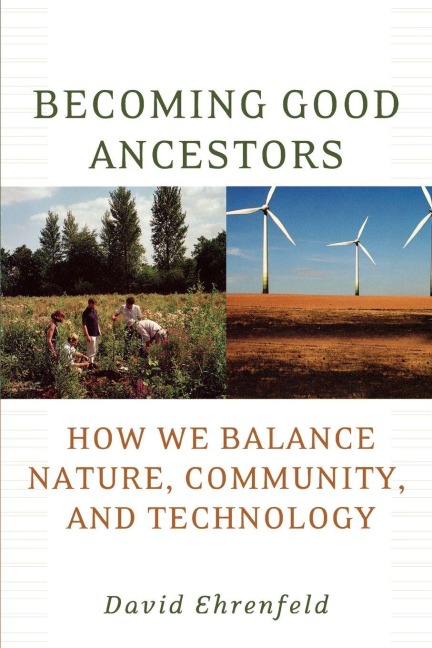
A brilliant writer and gifted "big picture" thinker, David Ehrenfeld is one of America's leading conservation biologists. Becoming Good Ancestors unites in a single, up-to-date framework pieces written over two decades, spanning politics, ecology, and culture, and illuminating the forces in modern society that thwart our efforts to solve today's hard questions about society and the environment.
The book focuses on our present-day retreat from reality, our alienation from nature, our unthinking acceptance of new technology and rejection of the old, the loss of our ability to discriminate between events we can control and those we cannot, the denial of non-economic values, and the decline of local communities. If we are aware of what we are losing and why we are losing it, the author notes, all of these patterns are reversible. Through down-to-earth examples, ranging from a family canoe trip in the wilderness to the novels of Jane Austen to Chinese turtle and tiger farms, Ehrenfeld shows how we can use what we learn to move ourselves and our society towards a more stable, less frantic, and far more satisfying life, a life in which we are no longer compelled to damage ourselves and our environment, in which our children have a future, and in which fewer species are endangered and more rivers run clean. In the final chapter, he offers a dramatic view of the possibilities inherent in a fusion of the best elements of conservatism and liberalism.
Our society has an inherent sense of what is right, says Ehrenfeld, and the creativity and persistence to make good things happen. It is now time to apply our intelligence, guided by our moral judgment, to the very large problems we all face. This book is an important first step.
David Ehrenfeld is Professor of Biology at Rutgers University and holds degrees in history, medicine, and zoology. He is the founding editor of the journal Conservation Biology and the author of The Arrogance of Humanism and Beginning Again.
Preface
Bookmap
Part 1. In Search of Honesty
1: Pretending
2: Brainstorming Has Its Limits
3: Nothing Simple
4: The Comforts of Fantasy
Part 2. Keeping Track of Our Losses
5: Rejecting Gifts
6: The Uses and Risks of Adaptation
7: When Machines Replace People
8: Pseudocommunities
9: Obsolescence
10: Accelerating Social Evolution
11: Writing
Part 3. Towards a Sustainable Economics
12: Affluence and Austerity
13: Energy and Friendly Fire
14: Durable Goods
15: Preserving Our Capital
16: Conservation for Profit
17: Hot Spots and the Globalization of Conservation
18: Putting a Value on Nature
19: The Downside of Corporate Immortality
Part 4. Relating to Nature in a Human-Dominated World
20: Wilderness as Teacher
21: As Opposing View of Nature
22: Death of a Plastic Palm
23: Scientific Discoveries and Nature's Mysteries
24: I Reinvent Agriculture
25: Thinking about Breeds and Species
26: Strangers in Our Own Land
27: Teaching Field Ecology
28: The Ubiquitous Right-of-Way
29: A Walk in the Woods
30: Old Growth
31: Intimacy with Nature
Part 5. Restoring the Community
32: The Utopia Fallacy
33: Traditions
34: Jane Austen and the World of the Community
35: Universities, Schools, and Communities
36: What Do We Owe Our Children?
37: Epilogue: A Call for Fusion and Regeneration
Notes
Index