Und dann auf "Zum Home-Bildschirm [+]".

Stöbern
genialokal zum Startbildschirm hinzufügen
Installieren Sie die genialokal App auf Ihrem Startbildschirm für einen schnellen Zugriff und eine komfortable Nutzung.
Installieren Sie die genialokal App auf Ihrem Startbildschirm für einen schnellen Zugriff und eine komfortable Nutzung.

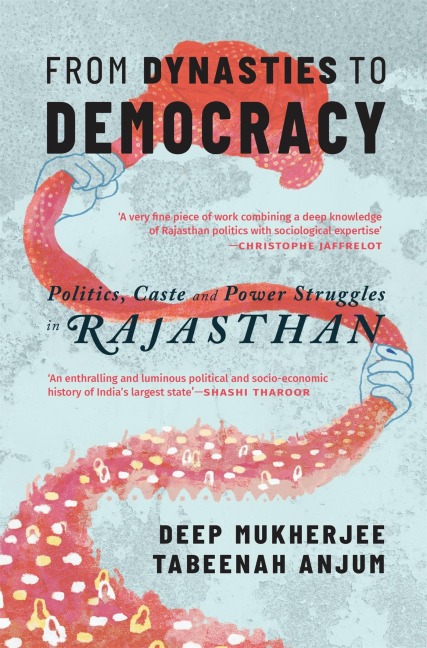

A compelling unveiling of the transformation of Rajasthan from a feudal society into a vibrant democracy Rajasthan, India's largest state, is often imagined as a land of sweeping deserts, majestic forts and colourful traditions. Yet, beneath this picturesque surface lies a complex reality shaped by centuries-old feudal systems, deep-seated social divisions, the lingering influence of royal families and a volatile political landscape. In this insightful narrative, journalists Tabeenah Anjum and Deep Mukherjee offer a comprehensive look at Rajasthan's political evolution from a feudal state ruled by kings and jagirdars to a dynamic electoral democracy. They delve beyond common perceptions to chart Rajasthan's political journey from its formation in 1949 to the 2024 Lok Sabha elections and beyond. They meticulously examine crucial historical moments - the rise of kisan sabhas and praja mandals, caste violence and Dalit agitations, Adivasi self-assertion and episodes of unrest, riots and lynchings. Extensive firsthand reporting and rigorous archival research illuminate the power struggles between the BJP and the Congress, the pervasive influence of the RSS, persistent infighting within political parties and the formidable challenges faced by prominent leaders like Bhairon Singh Shekhawat, Baldev Ram Mirdha, Ashok Gehlot, Sachin Pilot, Vasundhara Raje and others. Scholarly and lucid, this account fills a crucial gap in our understanding of Rajasthan's political history.
Deep Mukherjee is a senior journalist, presently associated with The Wire as an assistant editor. He has long served as the Rajasthan correspondent for The Indian Express and has also worked with Hindustan Times and DNA. He covers issues of national importance, pertaining primarily to politics, human rights, gender, atrocities against marginalized communities, impact of government policies and schemes, labour and farmer suicides. A UNICEF Development Journalism Fellowship awardee, Deep has highlighted the plight of child labourers working in the lac bangle industry in Jaipur and stone quarries of Rajasthan through his investigative reportage. He constantly strives to illuminate those perspectives that usually remain confined to the periphery or get lost in the din of the mainstream, especially oppressed voices and the daily struggles of the underprivileged. His work is aimed at mapping the political and administrative history of various communities through the narrativization and contextualization of individual experiences. Aside from his journalistic endeavours, Deep occasionally writes for literary journals and opinion pieces for news outlets and loves to travel. Tabeenah Anjum is a journalist with over fifteen years of experience across print and multimedia outfits. She reports on politics, gender, human rights, migrant rights and issues impacting marginalized communities from Rajasthan and neighbouring states. Presently, she writes for Outlook magazine and contributes long-form reportage for The Quint, Article 14, Times of India Plus, The Gaon Connection, BBC, Countercurrents, Caravan and Telegraph. She was the bureau incharge of Deccan Herald in Rajasthan until 2020 and continues to write opinion pieces for the newspaper. A passionate photographer, she is the recipient of the National Award in Photography (2015) conferred by the Ministry of Information and Broadcasting, Government of India, and the Maharaja Sawai Ram Singh II Award (2017) for excellence in journalism and photography. Her photographs have been exhibited in India, Nepal and South Australia. She has also published research papers on the media in reputed international journals, including a chapter on 'Journalism of Tolerance: Reporting About Refugees and Immigrants' in Xenophobia in the Media (2024), published by Routledge. She has served as the co-course director of the Basics of Visual Storytelling course at Film and Television Institute of India, Pune, since 2019 and conducts visual storytelling workshops across India and abroad. She has a master's in journalism from University of Rajasthan and has completed her PhD in 2016. Anjum has been teaching as an adjunct professor at Haridev Joshi University of Journalism, Jaipur, since 2022. She also taught at the University of South Australia, Adelaide, in 2019 and the University of Sakarya, Turkey, in 2022. Born and raised in Kashmir, Anjum is currently based in Rajasthan, where her journey in journalism first took root and inspired this book, her non-fiction debut.