Und dann auf "Zum Home-Bildschirm [+]".

Stöbern
genialokal zum Startbildschirm hinzufügen
Installieren Sie die genialokal App auf Ihrem Startbildschirm für einen schnellen Zugriff und eine komfortable Nutzung.
Installieren Sie die genialokal App auf Ihrem Startbildschirm für einen schnellen Zugriff und eine komfortable Nutzung.
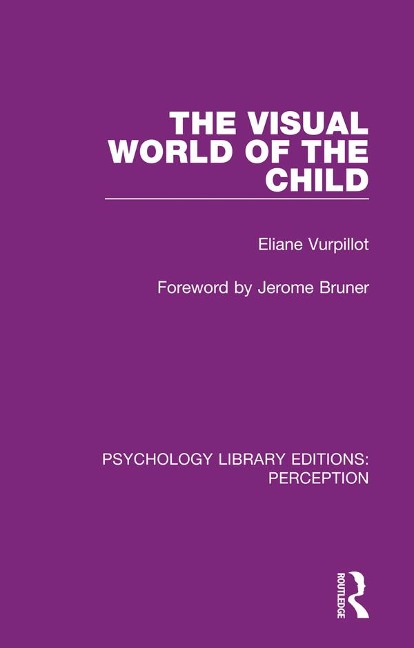
'How do children see the world?' is a question of immense importance which fascinates not only psychologists but also parents and all those concerned with education. In this English translation, first published in 1976, the author, who was Professor of Psychology at the René Descartes University in Paris, provided the most comprehensive review at the time of the development of visual perception in children, a field to which she herself had made a substantial contribution. Her book, which gave the first comprehensive study of the relationship between cognitive development and perceptual activities in small children, explores how they interpret visual information and gradually build up a picture of the world. The author had devoted fifteen years to research on the visual world of the child and possessed an exhaustive knowledge of the experimental literature on the subject in English, French, Russian and other languages. She saw perception as a form of knowledge which the child exploits and adapts in a variety of ways at different stages of development. This is brilliantly demonstrated in her own research on the strategies children use in judging things as 'different' or 'the same' and the way these relate to the structure of their perceptual organisation. This book is essential reading for anyone with a serious interest in developmental and cognitive psychology; it also provides an object lesson in the application of experimental methods. In addition the organisation of the material made it a valuable textbook for advanced undergraduate and post-graduate teaching and will still be of interest in its historical context today.
Eliane Vurpillot
Foreword by Jerome Bruner. Preface to the French Edition by Paul Fraisse. Introduction. Part 1: The Role of Visual Structures in the Organisation of Spatial Relationships 1. The Evolution of Perceptual Structures 2. The Spatial Relationships Between Structures in Three-Dimensional Space 3. The Perception of Form Orientation 4. Intrafigural Spatial Relationships 5. Perceptual Organisation and the Processes of Identification and Differentiation: The Child's 'Syncretism' Part 2: The Analysis of Visual Structures in Terms of their Properties 6. The Role of Verbal Mediators in Discrimination Learning 7. Selective Attention 8. The Emergence of Differentiators Part 3: Strategies of Exploration and Criteria of Judgment 9. An Examination of Some Parameters of Visuo-Motor Exploration 10. The Role of Perceptual Activity in the Genesis of Representational Structures 11. Identity Criteria of Equivalence and Difference. General Conclusions. Bibliography. Index.
Dieses eBook wird im PDF-Format geliefert und ist mit einem Adobe Kopierschutz (DRM) versehen. Sie können dieses eBook mit allen Geräten lesen, die das PDF-Format und den Adobe Kopierschutz (DRM) unterstützen.
Zum Beispiel mit den folgenden Geräten:
• tolino Reader
Laden Sie das eBook direkt über den Reader-Shop auf dem tolino herunter oder übertragen Sie das eBook auf Ihren tolino mit einer kostenlosen Software wie beispielsweise Adobe Digital Editions.
• Sony Reader & andere eBook Reader
Laden Sie das eBook direkt über den Reader-Shop herunter oder übertragen Sie das eBook mit der kostenlosen Software Sony READER FOR PC/Mac oder Adobe Digital Editions auf ein Standard-Lesegeräte mit epub- und Adobe DRM-Unterstützung.
• Tablets & Smartphones
Möchten Sie dieses eBook auf Ihrem Smartphone oder Tablet lesen, finden Sie hier unsere kostenlose Lese-App für iPhone/iPad und Android Smartphone/Tablets.
• PC & Mac
Lesen Sie das eBook direkt nach dem Herunterladen mit einer kostenlosen Lesesoftware, beispielsweise Adobe Digital Editions, Sony READER FOR PC/Mac oder direkt über Ihre eBook-Bibliothek in Ihrem Konto unter „Meine eBooks“ - „online lesen“.
Schalten Sie das eBook mit Ihrer persönlichen Adobe ID auf bis zu sechs Geräten gleichzeitig frei.
Bitte beachten Sie, dass die Kindle-Geräte das Format nicht unterstützen und dieses eBook somit nicht auf Kindle-Geräten lesbar ist.