Und dann auf "Zum Home-Bildschirm [+]".

Stöbern
genialokal zum Startbildschirm hinzufügen
Installieren Sie die genialokal App auf Ihrem Startbildschirm für einen schnellen Zugriff und eine komfortable Nutzung.
Installieren Sie die genialokal App auf Ihrem Startbildschirm für einen schnellen Zugriff und eine komfortable Nutzung.
Ihr gewünschter Artikel ist in 0 Buchhandlungen vorrätig - wählen Sie hier eine Buchhandlung in Ihrer Nähe aus:

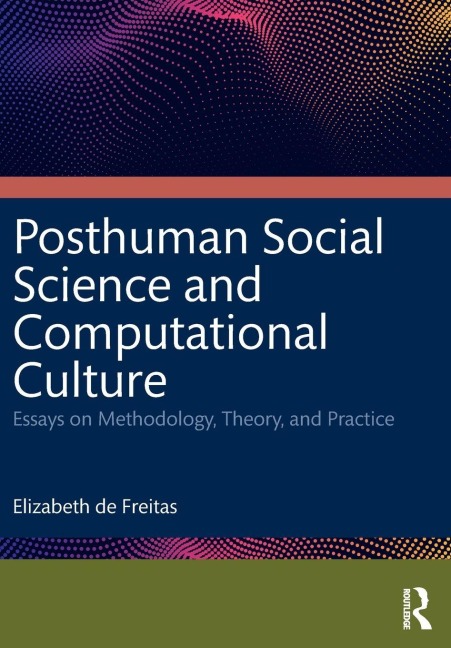
This book offers theoretical and practical insight into posthuman social science research methods, addressing new challenges in computational culture. Philosophy and theory from media studies, software studies, and science and technology studies (STS) are used to make sense of cultural trends and empirical experiments.
Elizabeth de Freitas is Professor and Co-Founder of MIXI, Adelphi University's Manhattan Institute for Studies of STEM and the Imagination, USA. She works across disciplines, developing creative and critical research methodologies for the social sciences, including mapping and other visual methodologies. With expertise in Science and Technology Studies, and the history and philosophy of mathematics, her research explores the power of speculative thought in social inquiry, and the role of algorithmic thinking in control societies. Her work has been funded by the Canada Council for the Arts, the Toronto Arts Council, the Social Sciences and Humanities Research Council of Canada, the US National Science Foundation, the UK Economic and Social Research Council, and the Spencer Foundation.
1. Introduction: Where Lies the Incomputable? 2. The Metamorphic Multiple Earth: Bruno Latour's Anthropocene Science 3. New Empiricisms of the Fractal Fold: Rethinking Monadology in Digital Times 4. Karen Barad's Quantum Ontology and Posthuman Ethics: Queering Relationality 5. Video Data and the Time-image: An-archiving the Body 6. The Biopolitics of the Quantified Self: Sensor Technologies and Worldly Sensibility 7. Eco-Sensory Ethnography and the Surrealist Impulse 8. Atmospheric Data and Software Arts: New Ways of Investigating Learning Environments 9. Re-Animating the Built Environment through Maps and Models 10. New Empiricisms in the Anthropocene: Thinking with Speculative Fiction about Science and Social Inquiry 11. Is there an Outside to Relationality in a Trickster World of Absolute Contingency? 12. Computational Thinking and the Infant Mind: Software Studies between Empiricism and Nativism 13. The Spatial Logic of Epistemic Imaginaries: Guided by Édouard Glissant 14. Fragile Texts and Machine Readers: Trans/In/Dividual Reading Tactics in a Complex Technical Milieu