Und dann auf "Zum Home-Bildschirm [+]".

Stöbern
genialokal zum Startbildschirm hinzufügen
Installieren Sie die genialokal App auf Ihrem Startbildschirm für einen schnellen Zugriff und eine komfortable Nutzung.
Installieren Sie die genialokal App auf Ihrem Startbildschirm für einen schnellen Zugriff und eine komfortable Nutzung.
Ihr gewünschter Artikel ist in 0 Buchhandlungen vorrätig - wählen Sie hier eine Buchhandlung in Ihrer Nähe aus:

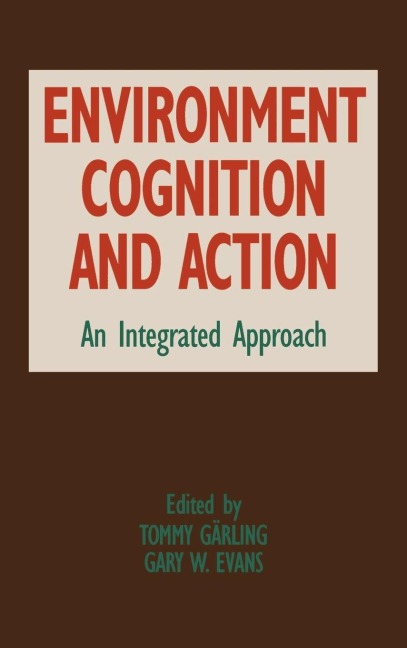
How do people comprehend, evaluate, and utilize the physical environments they inhabit? How are the dimensions of objects, their placement in space, and their organization related to thinking and decision-making? This volume features the contributions of international experts who examine the interconnections between what we know about, feel, and hope to accomplish in real-world environments. The discussion follows three major themes: the impact of the physical environment, psychological processes, and life-span development. A detailed survey of the intuitive and evolving human thought processes which give rise to our "sense of place" shows how this dynamic perception is shaped by elements of aesthetics, inferences of comfort, and visions of ourselves acting within specific environments. Psychologists, planners, architects, and geographers discuss the state of knowledge in spatial cognition, environmental assessment, aesthetics, and choice behavior. They show how this knowledge can be applied to the design and planning of settings - such as buildings and landscapes - better suited to human needs, and in particular, how these needs and perceptions evolve over the human lifespan. Environment, Cognition, and Action also evaluates a research agenda that integrates these processes and provides valuable goals for further work in this fascinating field.
Gary W. Evans & Tommy Garling: Environment, Cognition, and Action; PART I: THE IMPACT OF THE PHYSICAL ENVIRONMENT: Rachel Kaplan: Environmental description and prediction: A conceptual analysis; Reginald G. Golledge: Cognition of physical and built environments; Harry Timmermans: Decision making processes, choice behavior, and environmental design: conceptual issues and problems of application; Craig Zimring and Mark Gross: Searching for the environment in environmental cognition research; Ervin H. Zube: Environmental assessment, cognition, and action: Research applications; PART II: PSYCHOLOGICAL PROCESSES: Rikard Kuller: Environmental assessment from a neurospsychological perspective; Anders Book: Spatial cognition as events; Stephen Kaplan: Beyond rationality: clarity-based descision making; David Canter: Understanding, assessing, and acting in places: is an integrative framework possible?; Gerald D. Weisman: Conceptualization and application: Psychological processes in environmental cognition and assessment; PART III: LIFE-SPAN DEVELOPMENT: Giovanna Axia, Erminielda Mainardi Peron, and Maria Rosa Baroni: Environmental assessment across the life-span; Lynn S. Liben: Environmental cognition through direct and representational experiences: a life-span perspective; Roger A. Hart and Michael K. Conn: Developmental perspectives on action in environments; Christopher Spencer: Life-span changes in activities, and consequent changes in the cognition and assessment of the environment; Gary T. Moore: Life-span development: applications to environmental policy, planning, and design; PART IV: SUMMARY AND CONCLUSION: Tommy Garling, Erik Lindberg, Gunilla Torell and Gary W. Evans: From environmental to ecological cognition.