Und dann auf "Zum Home-Bildschirm [+]".

Stöbern
genialokal zum Startbildschirm hinzufügen
Installieren Sie die genialokal App auf Ihrem Startbildschirm für einen schnellen Zugriff und eine komfortable Nutzung.
Installieren Sie die genialokal App auf Ihrem Startbildschirm für einen schnellen Zugriff und eine komfortable Nutzung.
Ihr gewünschter Artikel ist in 0 Buchhandlungen vorrätig - wählen Sie hier eine Buchhandlung in Ihrer Nähe aus:

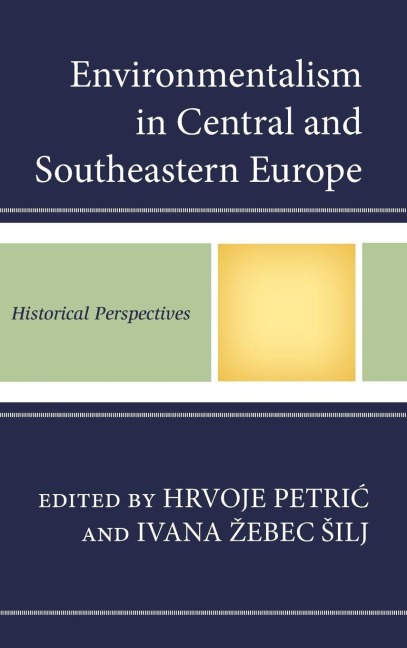
Consisting of 12 chapters, the book presents the rise and development of environmentalism, environmental history as a discipline, and the history of environmental movements in the Central and South Eastern European region from an international point of view.
The chapters—written by scholars from Italy, Austria, Slovenia, Croatia, Slovakia, Romania, Serbia, Greece and Turkey—cover a wide range of topics including the creation of protected areas, increasing environmental consciousness, the evolution of humanity’s relationship toward the environment, and perceptions of environmentalism by different disciplines.
This international approach highlights the region’s complex development from the end of the eighteenth century through the twentieth century, with its unique blend of traditions. Three historically different traditions—the Habsburg, Ottoman and Venetian—converge in Central and South Eastern Europe, and this book emphasizes the subtleties of these sometimes intertwined traditions.
The focus of the book varies according to both the different geographical environments characteristic of the region and the protagonists who actively participated in changing relationships toward the environment. However, what does not vary and is common to all the chapters is the historical approach, since the process has continuity, which the book accentuates.
In geographical terms, the region that is the focus of the book, Central and South Eastern Europe, is the contact zone of the Alps, Danube, Adriatic and partially the North Eastern Mediterranean Sea. Throughout history, it was also the contact zone of the Habsburg, Ottoman and Venetian traditions. Those realities have resulted in a unique blending and intertwining of traditions and, therefore, relationships with and perceptions of the environment.
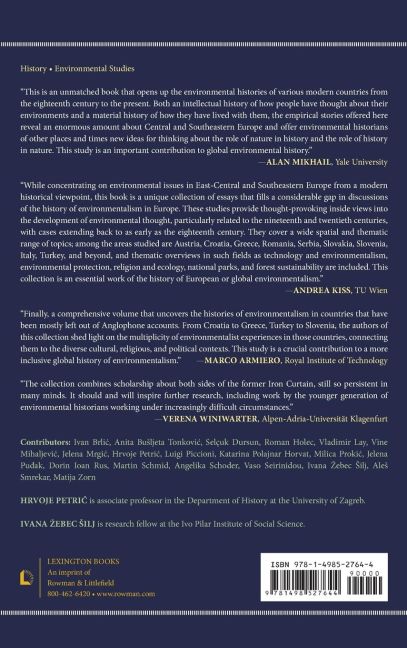
Hrvoje Petric is associate professor in the Department of History at the University of Zagreb. Ivana Zebec Silj is research fellow at the Ivo Pilar Institute of Social Science.
Preface, Ivana Zebec Silj Introduction, Hrvoje Petric and Ivana Zebec Silj Part I: Environmentalism and Environmental Movements Chapter 1: Where Technology and Environmentalism Meet: The Remaking of the Austrian Danube for Hydropower, Angelika Schoder and Martin Schmid Chapter 2: Environmental Thought in Slovenia, Katarina Polajnar Horvat, Ales Smrekar, and Matija Zorn Chapter 3: Civil Society and Environmental Protection NGOs in Croatia, 1989-2014, Vladimir Lay and Jelena Pudak Chapter 4: Religion and Ecology in Croatia, Vine Mihaljevic Chapter 5: Something Old, Something New: Historical Geography and Environmental History Discourse in Serbia, Jelena Mrgic Chapter 6: Environmental Narratives and Sociopolitical Agendas in Greece in the Eighteenth and Nineteenth Centuries, Vaso Seirinidou Chapter 7: The History of Environmental Movements and the Development of Environmental thought in Turkey, 1850-1980, Selçuk Dursun Part II: Nature Protection and Specific Landscapes Chapter 8: Man and Nature in Central Europe during the Long Nineteenth Century from the Slovak Point of View, Roman Holec Chapter 9: Protecting the Alps: Italian-Protected Areas in the Alpine Range, 1911-91, Luigi Piccioni Chapter 10: The Origins and Developmental Course of Plitvice Lakes National Park: From "The Devil's Garden" to the UNESCO World Natural Heritage Register, Ivan Brlic and Anita Tonkovic Busljeta Chapter 11: Contrasting the "Sunny Side": Goli otok and the Islandness of a Political Prison in the Croatian Adriatic Sea, Milica Prokic Chapter 12: The Development of the Concept of Forest Sustainability in Transylvania, the Banat, Bukovina, Moldavia, and Wallachia until 1918, Dorin Ioan Rus