Und dann auf "Zum Home-Bildschirm [+]".

Stöbern
genialokal zum Startbildschirm hinzufügen
Installieren Sie die genialokal App auf Ihrem Startbildschirm für einen schnellen Zugriff und eine komfortable Nutzung.
Installieren Sie die genialokal App auf Ihrem Startbildschirm für einen schnellen Zugriff und eine komfortable Nutzung.
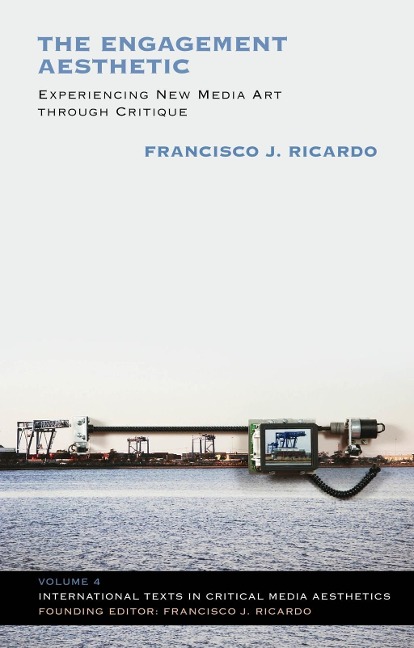
Long after painting, sculpture, photography, and film developed along with their materials - canvas and panel, marble and bronze, and celluloid film - a new generation of art has emerged in which digital, electronic, architectural, and performative materials have offered new forms for creative expression and experience. In much of this new art, the medium - no longer composed of passive materials - now embraces and challenges viewers to work as co-creators of aesthetic experience.
Starting from the impossibility of understanding this new and complex art solely within the framework of contemporary art history and criticism, The Engagement Aesthetic offers new modes of critique for new media works of art, literature, and performance that operate in complex ways. Blending a range of methodologies from phenomenology, art history, linguistics, and statistical analysis, Ricardo explores how a new kinship between individual participation, electronic media, virtual and actual space, and mediated language results in a new aesthetic of mutual engagement.
Francisco J. Ricardo, Ph.D., is an art theorist and filmmaker born in Cuba in 1962. His work focuses on new media art and artists. Formerly affiliated with the University Professors of Boston University, he is co-founder of the Digital Video Research Archive, and has taught digital media theory in the Digital+Media Department at the Rhode Island School of Design, USA.
Preface
1. The Engagement Aesthetic - An Introduction
PART I. IMAGE
2. Engagement as Meta-Reflection -- Andrew Neumann's Industrial Wall Panels
3. Engagement as Transcendence -- The Transmodal Work of Art
4. Engagement Across the Aural/Visual - Marclay's Media Metonymy
5. Engagement as Post-formal Imagery -- Anne Spalter's Scenes from the North Pole of Transcendence
6. Engagement in Virtual and Actual Gallery Space
7. Engagement from Photographic Object to Statement
8. Engagement from Objecthood to Processhood
PART II. SPACE
9. Engagement as Nonlocality -- The Aura of the Distributed Moment
10. Engagement in Projective Dance Performance
11. Engagement as Cathexis -- The Affective Index in Video's Depiction of Desire
12. Engagement as Spatial Chronotope in Electronic Art and the Public Sphere
13. Engagement across Space and Structure in Post-Architecture
14. Engagement as Social Spatiality
15. Engagement as Participation, Mediated and Recursive
PART III. LANGUAGE
16. Engagement as Post-Literary Mechanism, an Historical Argument
17. Engagement as Post-Literary Mechanism, From Exposition to Reflexivity
18. Engagement as Empirical History -- Metaprogramming
19. Engagement as Comparative Communication -- Formalisms of Digital Text
20. Engagement across Shifting Beliefs: Shamanism, Turing, and ELIZA
Dieses eBook wird im PDF-Format geliefert und ist mit einem Adobe Kopierschutz (DRM) versehen. Sie können dieses eBook mit allen Geräten lesen, die das PDF-Format und den Adobe Kopierschutz (DRM) unterstützen.
Zum Beispiel mit den folgenden Geräten:
• tolino Reader
Laden Sie das eBook direkt über den Reader-Shop auf dem tolino herunter oder übertragen Sie das eBook auf Ihren tolino mit einer kostenlosen Software wie beispielsweise Adobe Digital Editions.
• Sony Reader & andere eBook Reader
Laden Sie das eBook direkt über den Reader-Shop herunter oder übertragen Sie das eBook mit der kostenlosen Software Sony READER FOR PC/Mac oder Adobe Digital Editions auf ein Standard-Lesegeräte mit epub- und Adobe DRM-Unterstützung.
• Tablets & Smartphones
Möchten Sie dieses eBook auf Ihrem Smartphone oder Tablet lesen, finden Sie hier unsere kostenlose Lese-App für iPhone/iPad und Android Smartphone/Tablets.
• PC & Mac
Lesen Sie das eBook direkt nach dem Herunterladen mit einer kostenlosen Lesesoftware, beispielsweise Adobe Digital Editions, Sony READER FOR PC/Mac oder direkt über Ihre eBook-Bibliothek in Ihrem Konto unter „Meine eBooks“ - „online lesen“.
Schalten Sie das eBook mit Ihrer persönlichen Adobe ID auf bis zu sechs Geräten gleichzeitig frei.
Bitte beachten Sie, dass die Kindle-Geräte das Format nicht unterstützen und dieses eBook somit nicht auf Kindle-Geräten lesbar ist.