Und dann auf "Zum Home-Bildschirm [+]".

Stöbern
genialokal zum Startbildschirm hinzufügen
Installieren Sie die genialokal App auf Ihrem Startbildschirm für einen schnellen Zugriff und eine komfortable Nutzung.
Installieren Sie die genialokal App auf Ihrem Startbildschirm für einen schnellen Zugriff und eine komfortable Nutzung.
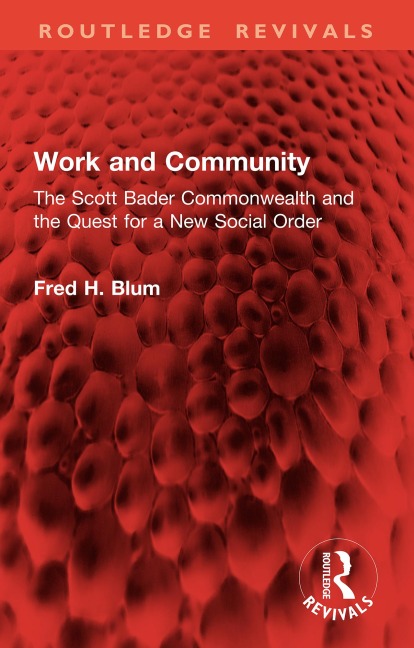
Originally published in 1968, Work and Community asks: can people participate in the decisions affecting their daily work and develop their potentialities for true growth under conditions of a cybernated technology? Can work again become a meaningful part of life? To answer these questions, the author has examined one of the most significant attempts to find a new way in industry - the Scott Bader Commonwealth in Wollaston, a resin manufacturing company owned by those working in it. The work describes how the Commonwealth, inspired by a Christian witness and developing in a highly competitive situation, has built various channels of participation based on the principle of common ownership and the division of tasks according to legislative, executive, judicial and trustee functions. The book is the result of several years of intensive research based on intensive interview-conversations, group work and participant observation. The critical exploration of the significance of the Commonwealth is related to a careful analysis of basic problems of work and its organization. These problems are seen in the perspective of daily life and in terms of such fundamental concepts underlying every organization of work as time, balance and the nature of man. The changes in attitudes and awareness necessary to move from the present towards the realization of Commonwealth ideals in a genuinely human organization of work are indicated. The Scott Bader Commonwealth is still going strong today.
Fred H. Blum (1914-1990) was an American social scientist and the founder of The New Era Centre. He was born in Germany in 1914, emigrated to the US in 1938 where he became an American citizen and came to Britain in 1959 on behalf of the Society of Friends (Quakers) to study new developments in mental health and religion with special reference to the organization of industry. Fred taught economics at Howard University in Washington DC and was a professor of social sciences in Michigan and Minnesota. The US Senate appointed Fred advisor to the Labor and Welfare Committee, and he worked as a consultant for the young Senator John F. Kennedy.
Acknowledgements. Introduction. Part I: Background 1. The Fellowship, the Strike and the Commonwealth 2. Capitalism and the Christian Social Testimony 3. Precursors and Contemporaries of the Commonwealth 4. The People of the Commonwealth Part II: The First Decade of the Commonwealth 1951-1963 5. The Commonwealth Begins to Reorganize Work 6. The Transformation of Wages and Profits 7. Power, Control and Decision Making 8. The Union 9. The Main Advantages of the Commonwealth 10. The Emergence of New Attitudes Part III: The Constitution of 1963 and its Potentialities 11. The Commonwealth is Coming of Age 12. The Constitution of 1963 13. The Body Politic and the Soul of the Commonwealth 14. The Commonwealth Creator of a Human Space Rooted in the Universal 15. The Commonwealth Ideal of Man 16. Growing up to Responsible Participation 17. Participation in a Five-Dimensional Universe Part IV: The Commonwealth and the Meaning of Work 18. Universal Problems of Work 19. The Basic Experience of Work 20. Things, Means and Ends 21. The Product, Use and Exchange Values 22. People and Service to the Community 23. Work and Society 24. Work and Ultimate Reality Part V: Conclusions 25. Potentialities and Realities 26. The New and the Old Consciousness 27. Towards a New Social Order. Epilogue. Appendix: On Method. Note on Comparison of the Quota and Random Sample. Index.