Und dann auf "Zum Home-Bildschirm [+]".

Stöbern
genialokal zum Startbildschirm hinzufügen
Installieren Sie die genialokal App auf Ihrem Startbildschirm für einen schnellen Zugriff und eine komfortable Nutzung.
Installieren Sie die genialokal App auf Ihrem Startbildschirm für einen schnellen Zugriff und eine komfortable Nutzung.
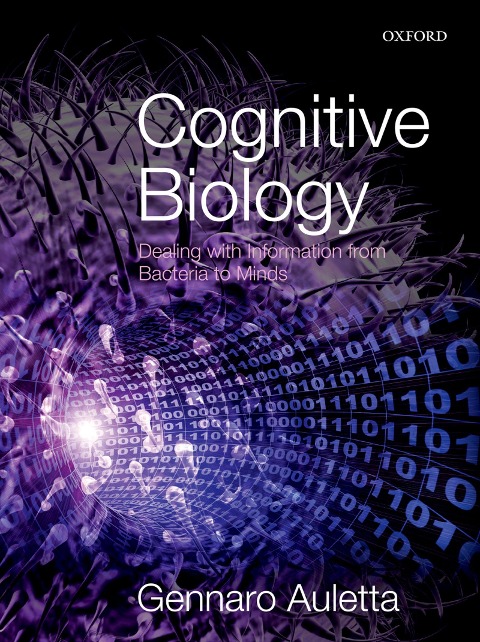
Providing a new conceptual scaffold for further research in biology and cognition, this book introduces the new field of Cognitive Biology: a systems biology approach showing that further progress in this field will depend on a deep recognition of developmental processes, as well as on the consideration of the developed organism as an agent able to modify and control its surrounding environment. The role of cognition, the means through which the organism is able to cope with its environment, cannot be underestimated. In particular, it is shown that this activity is grounded on a theory of information based on Bayesian probabilities. The organism is considered as a cybernetic system able to integrate a processor as a source of variety (the genetic system), a regulator of its own homeostasis (the metabolic system), and a selecting system separating the self from the non-self (the membrane in unicellular organisms). Any organism is a complex system that can survive only if it is able to maintain its internal order against the spontaneous tendency towards disruption. Therefore, it is forced to monitor and control its environment and so to establish feedback circuits resulting in co-adaptation. Cognitive and biological processes are shown to be inseparable.
Gennaro Auletta is Aggregate Professor in the Gregorian University, Researcher in the Cassino University, and Scientific Director of the STOQ Project. He is also visiting professor in the University of Notre Dame, associate of the Faraday Institute of the Cambridge University, and member of the Linnean Society of London. After taking his degree in philosophy at La Sapienza University in Rome he took his Ph.D and his Postdoc in Philosophy at the same university. His philosophical interests are logic, philosophy of nature (with special connections with quantum mechanics and biology), philosophy of mind, and metaphysics. In science, his main interests are in quantum mechanics (quantum information, foundations, interpretation). For the last ten years his research interests have addressed issues in the treatment of information by biological systems (from bacteria to human brain), in cognitive neurosciences.
- 1: Quantum Mechanics as a General Framework - 2: Classical and Quantum Information and Entropy - 3: The Brain: An Outlook - 4: Vision - 5: Dealing with Target's Motion and Our Own Movement - 6: Complexity: A Necessary Condition - 7: General Features of Life - 8: The Organism as a Semiotic and Cybernetic System - 9: Phylogeny - 10: Ontogeny - 11: Epigeny - 12: Representational Semiotics - 13: The Brain as an Information-Control System - 14: Decisional, Emotional and Cognitive Systems - 15: Behavior - 16: Learning - 17: Memory - 18: The Basic Symbolic Systems - 19: What Symbols Are - 20: Intentionality and Conceptualization - 21: Consciousness - 22: Development and Culture - 23: Language - 24: Mind and Brain (Body) - 25: Final Philosophical Remarks
Dieses eBook wird im PDF-Format geliefert und ist mit einem Adobe Kopierschutz (DRM) versehen. Sie können dieses eBook mit allen Geräten lesen, die das PDF-Format und den Adobe Kopierschutz (DRM) unterstützen.
Zum Beispiel mit den folgenden Geräten:
• tolino Reader
Laden Sie das eBook direkt über den Reader-Shop auf dem tolino herunter oder übertragen Sie das eBook auf Ihren tolino mit einer kostenlosen Software wie beispielsweise Adobe Digital Editions.
• Sony Reader & andere eBook Reader
Laden Sie das eBook direkt über den Reader-Shop herunter oder übertragen Sie das eBook mit der kostenlosen Software Sony READER FOR PC/Mac oder Adobe Digital Editions auf ein Standard-Lesegeräte mit epub- und Adobe DRM-Unterstützung.
• Tablets & Smartphones
Möchten Sie dieses eBook auf Ihrem Smartphone oder Tablet lesen, finden Sie hier unsere kostenlose Lese-App für iPhone/iPad und Android Smartphone/Tablets.
• PC & Mac
Lesen Sie das eBook direkt nach dem Herunterladen mit einer kostenlosen Lesesoftware, beispielsweise Adobe Digital Editions, Sony READER FOR PC/Mac oder direkt über Ihre eBook-Bibliothek in Ihrem Konto unter „Meine eBooks“ - „online lesen“.
Schalten Sie das eBook mit Ihrer persönlichen Adobe ID auf bis zu sechs Geräten gleichzeitig frei.
Bitte beachten Sie, dass die Kindle-Geräte das Format nicht unterstützen und dieses eBook somit nicht auf Kindle-Geräten lesbar ist.