Und dann auf "Zum Home-Bildschirm [+]".

Stöbern
genialokal zum Startbildschirm hinzufügen
Installieren Sie die genialokal App auf Ihrem Startbildschirm für einen schnellen Zugriff und eine komfortable Nutzung.
Installieren Sie die genialokal App auf Ihrem Startbildschirm für einen schnellen Zugriff und eine komfortable Nutzung.
Ihr gewünschter Artikel ist in 0 Buchhandlungen vorrätig - wählen Sie hier eine Buchhandlung in Ihrer Nähe aus:

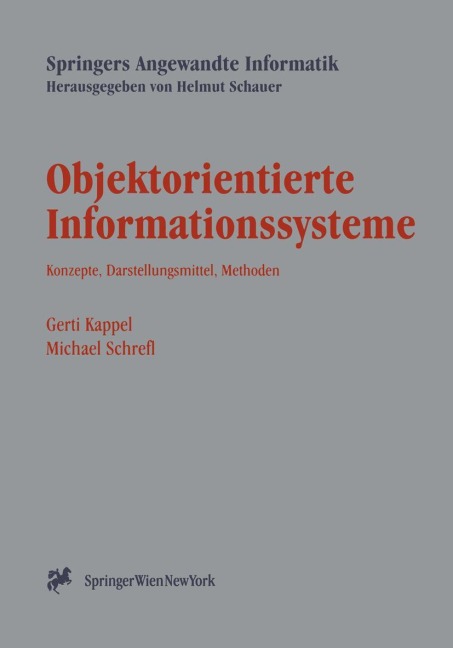

Das Buch gibt einen hochaktuellen Einstieg mit Tiefgang in die objektorientierte Entwicklung von Informationssystemen. Das Schwergewicht liegt auf der methodenunabhängigen Darstellung der Grundlagen, Konzepte und unterschiedlichen Techniken des objektorientierten Modellierens.
Martina Seidl is assistant professor at the Institute for Formal Models and Verification at the Johannes Kepler University Linz and research associate of the Business Informatics Group of the Vienna University of Technology. Her research focuses on formal methods in modeling, model evolution as well as different aspects of automated theorem proving. She has been involved in teaching numerous courses for all stages of the computer science curricula in Vienna and Linz, many of them directly related to her research. Marion Scholz studied computer science at the Vienna University of Technology and at the University of Vienna. Since 2007 she teaches object-oriented modeling to first year bachelor students studying computer science and business informatics. As a senior lecturer, her research interests are new teaching methods with a strong focus on e-learning technologies. One of her main challenges is raising the quality of teaching despite large numbers of students. Christian Huemer is associate professor in the Business Informatics Group of the Vienna University of Technology and serves as vice-dean of academic affairs for business informatics. In addition, he is Scientific Director of the Research Centre Smart Agent Technologies of Research Studios Austria. For ten years he was Chair of the Techniques & Methodologies Group of the United Nations Centre for Trade Facilitation and e-Business (UN / CEFACT). In particular, he has been the project lead of UN / CEFACT Modeling Methodology (UMM) - a UML profile for the specification of inter-organizational business processes.Gerti Kappel is a full professor at the Institute of Software Technology and Interactive Systems at the Vienna University of Technology, chairing the Business Informatics Group. She is head of the Doctoral College "Adaptive Distributed Systems", funded by Vienna University of Technology. Her current research interests include model engineering (model transformation/versioning/evolution, model-driven software development, object-oriented modeling), Web engineering (ubiquitous Web technologies, context awareness, information integration, model-driven development), and process engineering (process modeling, inter-organizational systems, workflow systems).
1 Einleitung und Motivation.- 1.1 Aufbau des Buches.- 1.2 Benutzte Notation und stilistische Konventionen.- 1.3 Begleitende Beispiele.- 2 Grundlagen objektorientierter Informationssysteme.- 2.1 Elementare Konzepte objektorientierter Systeme.- 2.2 Objektorientierte Modellierungskonzepte.- 2.3 Objektorientierte Programmiersprachen.- 2.4 Objektorientierte Datenbanksysteme.- 2.5 Literaturhinweise.- 3 Objektorientierter Entwicklungsprozeß.- 3.1 Einleitung.- 3.2 Von strukturierter zu objektorientierter Entwicklung.- 3.3 Objektorientiertes Lebenszyklusmodell.- 3.4 Verfahren.- 3.5 Zusammenfassung.- 3.6 Literaturhinweise.- 4 Objekt/Verhaltensdiagramme.- 4.1 Strukturmodellierung.- 4.2 Verhaltensmodellierung.- 4.3 Zusammenfassung.- 4.4 Literatur hinweise.- 5 Vererbung von Objekt/Verhaltensdiagrammen.- 5.1 Strukturvererbung.- 5.2 Verhaltens Vererbung.- 6 Lokale referentielle Integrität.- 6.1 Einleitung.- 6.2 Beispiel einer Problemstellung.- 6.3 Objekttypen und lokale Klassen.- 6.4 Subtypen und Subklassen.- 6.5 Zusammenfassung.- 6.6 Literaturhinweise.- 7 Mehrfach polymorphe Operationen.- 7.1 Einleitung.- 7.2 Beispiel einer Problemstellung.- 7.3 Alternative Lösungsansätze.- 7.4 Mehrfach polymorphe Operationen.- 7.5 Zusammenfassung.- 7.6 Literaturhinweise.- 8 Kopplung und Kohäsion.- 8.1 Einleitung.- 8.2 Bausteine eines objektorientierten Systems.- 8.3 Kopplung.- 8.4 Kohäsion.- 8.5 Zusammenfassung.- 8.6 Literaturhinweise.- 9 Ausblick.- A Überblick über objektorientierte Methoden.- A. 6 Analyse- und Entwurfsrichtlinien.- B Definitionen.- B. l Objekt/Verhaltensdiagramme.- B.2 Vererbung in OBD.- B.3 Lokale referentielle Integrität.- C Glossar.- D Verzeichnis der Abkürzungen.- Abbildungs Verzeichnis.- Tabellenverzeichnis.