Und dann auf "Zum Home-Bildschirm [+]".

Stöbern
genialokal zum Startbildschirm hinzufügen
Installieren Sie die genialokal App auf Ihrem Startbildschirm für einen schnellen Zugriff und eine komfortable Nutzung.
Installieren Sie die genialokal App auf Ihrem Startbildschirm für einen schnellen Zugriff und eine komfortable Nutzung.
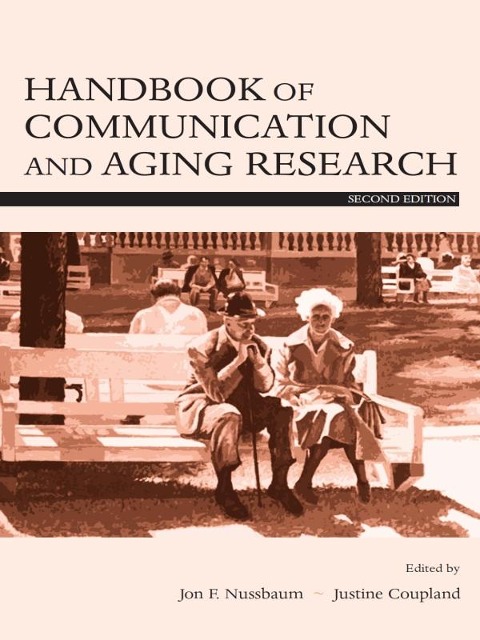
This second edition of the Handbook of Communication and Aging Research captures the ever-changing and expanding domain of aging research. Since it was first recognized that there is more to social aging than demography, gerontology has needed a communication perspective. Like the first edition, this handbook sets out to demonstrate that aging is not only an individual process but an interactive one. The study of communication can lead to an understanding of what it means to grow old. We may age physiologically and chronologically, but our social aging--how we behave as social actors toward others, and even how we align ourselves with or come to understand the signs of difference or change as we age--are phenomena achieved primarily through communication experiences. Synthesizing the vast amount of research that has been published on communication and aging in numerous international outlets over the last three decades, the book's contributors include scholars from North America and the United Kingdom who are active researchers in the perspectives covered in their particular chapter. Many of the chapters work to deny earlier images of aging as involving normative decrement to provide a picture of aging as a process of development involving positive choices and providing new opportunities. A recuring theme in many chapters is that of the heterogeneity of the group of people who are variously categorized as older, aged, elderly, or over 65. The contributors review the literature analytically, in a way that reveals not only current theoretical and methodological approaches to communication and aging research but also sets the future agenda. This handbook will be of great interest to scholars and researchers in gerontology, developmental psychology, and communication, and, in this updated edition, will continue to play a key role in the study of communication and aging.
Jon F. Nussbaum, Justine Coupland
Contents: Preface. Part I: The Experience of Aging.M. Hepworth, Images of Aging. A. O'Hanlon, P. Coleman, Attitudes Towards Aging: Adaptation, Development, and Growth Into Later Years. Part II: Language, Culture, and Social Aging.N. Coupland, Age in Social and Sociolinguistic Theory. M.L. Hummert, T.A. Garstka, E.B. Ryan, J.L. Bonnesen, The Role of Age Stereotypes in Interpersonal Communication. A. Williams, J. Harwood, Intergenerational Communication: Intergroup, Accommodation, and Family Perspectives. V. Barker, H. Giles, J. Harwood, Inter- and Intragroup Perspectives on Intergenerational Communication. L.L. Pecchioni, H. Ota, L. Sparks, Cultural Issues in Communication and Aging. Part III: The Communicative Construction of Relationships in Later Life.K.L. Henwood, Adult Parent-Child Relationships: A View From Feminist and Discursive Social Psychology. M-L. Mares, M.A. Fitzpatrick, Communication in Close Relationships of Older People. V.C. McKay, R.S. Caverly, The Nature of Family Relationships Between and Within Generations: Relations Between Grandparents, Grandchildren, and Siblings in Later Life. W.K. Rawlins, Friendships in Later Life. Part IV: Organizational Communication.M.J. Bergstrom, M.E. Holmes, Organizational Communication and Aging: Age-Related Processes in Organizations. A.L. Balazs, Marketing to the Older Adults. M. Bernard, C. Phillipson, Retirement and Leisure. Part V: Political and Mass Communication.S.J. Holladay, W.T. Coombs, The Political Power of Seniors. L.L. Kaid, J. Garner, The Portrayal of Older Adults in Political Advertising. J.D. Robinson, T. Skill, J.W. Turner, Media Usage Patterns and Portrayals of Seniors. Part VI: Health Communication.T.L. Thompson, J.D. Robinson, A.E. Beisecker, The Older Patient-Physician Interaction. K. Grainger, Communication and the Institutionalized Elderly. K.B. Wright, J.L. Query, Online Support and Older Adults: A Theoretical Examination of Benefits and Limitations of Computer-Mediated Support Networks for Older Adults and Possible Health Outcomes. Part VII: Senior Adult Education.F. Glendenning, Education for Older Adults: Lifelong Learning, Empowerment, and Social Change. D.K. Baringer, A.L. Kundrat, J.F. Nussbaum, Instructional Communication and Older Adults.
Dieses eBook wird im PDF-Format geliefert und ist mit einem Adobe Kopierschutz (DRM) versehen. Sie können dieses eBook mit allen Geräten lesen, die das PDF-Format und den Adobe Kopierschutz (DRM) unterstützen.
Zum Beispiel mit den folgenden Geräten:
• tolino Reader
Laden Sie das eBook direkt über den Reader-Shop auf dem tolino herunter oder übertragen Sie das eBook auf Ihren tolino mit einer kostenlosen Software wie beispielsweise Adobe Digital Editions.
• Sony Reader & andere eBook Reader
Laden Sie das eBook direkt über den Reader-Shop herunter oder übertragen Sie das eBook mit der kostenlosen Software Sony READER FOR PC/Mac oder Adobe Digital Editions auf ein Standard-Lesegeräte mit epub- und Adobe DRM-Unterstützung.
• Tablets & Smartphones
Möchten Sie dieses eBook auf Ihrem Smartphone oder Tablet lesen, finden Sie hier unsere kostenlose Lese-App für iPhone/iPad und Android Smartphone/Tablets.
• PC & Mac
Lesen Sie das eBook direkt nach dem Herunterladen mit einer kostenlosen Lesesoftware, beispielsweise Adobe Digital Editions, Sony READER FOR PC/Mac oder direkt über Ihre eBook-Bibliothek in Ihrem Konto unter „Meine eBooks“ - „online lesen“.
Schalten Sie das eBook mit Ihrer persönlichen Adobe ID auf bis zu sechs Geräten gleichzeitig frei.
Bitte beachten Sie, dass die Kindle-Geräte das Format nicht unterstützen und dieses eBook somit nicht auf Kindle-Geräten lesbar ist.