Und dann auf "Zum Home-Bildschirm [+]".

Stöbern
genialokal zum Startbildschirm hinzufügen
Installieren Sie die genialokal App auf Ihrem Startbildschirm für einen schnellen Zugriff und eine komfortable Nutzung.
Installieren Sie die genialokal App auf Ihrem Startbildschirm für einen schnellen Zugriff und eine komfortable Nutzung.
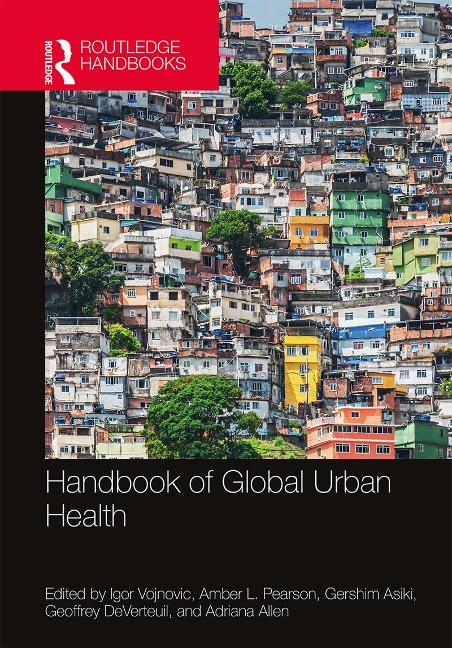
Through interdisciplinary and multidisciplinary perspectives, and with an emphasis on exploring patterns as well as distinct and unique conditions across the globe, this collection examines advanced and cutting-edge theoretical and methodological approaches to the study of the health of urban populations. Despite the growing interest in global urban health, there are limited resources available that provide an extensive and advanced exploration into the health of urban populations in a transnational context. This volume offers a high-quality and comprehensive examination of global urban health issues by leading urban health scholars from around the world. The book brings together a multi-disciplinary perspective on urban health, with chapter contributions emphasizing disciplines in the social sciences, construction sciences and medical sciences. The co-editors of the collection come from a number of different disciplinary backgrounds that have been at the forefront of urban health research, including public health, epidemiology, geography, city planning and urban design. The book is intended to be a reference in global urban health for research libraries and faculty collections. It will also be appropriate as a text for university class adoption in upper-division under-graduate courses and above. The proposed volume is extensive and offers enough breadth and depth to enable it to be used for courses emphasizing a U.S., or wider Western perspective, as well as courses on urban health emphasizing a global context.
Igor Vojnovic is Professor and Interim Director of the Global Urban Studies Program at Michigan State University. His main area of research focuses on urban (re)development processes and the study of resulting socio-economic, physical, environmental and health impacts. He holds appointments in the Department of Geography, Environment and Spatial Sciences, the School of Planning, Design, and Construction and the Global Urban Studies Program. He is also the Editor-in-Chief of the Journal of Urban Affairs. Amber L. Pearson is an Assistant Professor at Michigan State University in the Department of Geography, Environment and Spatial Sciences and an Honorary Fellow at the University of Otago, Department of Public Health. She is a health geographer with a focus on social justice. She employs spatial and epidemiological methods to understand processes that lead to or exacerbate health inequalities globally. In her research she aims to explore aspects of the built, physical and social environment which can bolster equitable health. Gershim Asiki is a medical doctor with a PhD in Epidemiology, and an Associate Research Scientist at the African Population and Health Research Center (APHRC) in Nairobi, Kenya. His research focuses on generating evidence to drive stronger and more resilient systems for improved health of vulnerable populations. He has worked as a frontline physician (2001-2005) in a district hospital in Uganda, as a research scientist at the British Medical Research Council Unit in Uganda (2008-2015) and as a Technical Advisor with Columbia University (ICAP project) in Uganda, Cameroon and Namibia (2015-2017) leading country-wide population based HIV impact assessments. He currently leads research on chronic diseases, testing models for strengthening health systems' response to epidemiological trends of non-communicable diseases to influence policy and transform lives of vulnerable populations across Africa. Geoffrey DeVerteuil is a Senior Lecturer of social geography, urban geography and health geography at the School of Geography and Planning at Cardiff University. His work focuses on the geographies of social problems in cities-homelessness, mental health, substance abuse-as well responses to them, in terms of concepts such as poverty management, service hubs and social/spatial resilience. His recent work underlines the important role of the voluntary sector in both managing extreme poverty and creating particular perspectives on what it means to help the vulnerable. Adriana Allen is Professor of Development Planning and Urban Sustainability at the Development Planning Unit (DPU), University College London (UCL), where she is actively engaged in various initiatives promoting trans-local learning and enhanced research capacity, both within UCL and internationally.She has over 30 years' research experience in over 20 countries in Asia, Africa and Latin America. Adopting a political ecology perspective, her work focuses on investigating the scope for transformative links between socio-environmental change, justice and sustainability in urban and peri-urban contexts.
Handbook of Global Urban Health
Dieses eBook wird im PDF-Format geliefert und ist mit einem Adobe Kopierschutz (DRM) versehen. Sie können dieses eBook mit allen Geräten lesen, die das PDF-Format und den Adobe Kopierschutz (DRM) unterstützen.
Zum Beispiel mit den folgenden Geräten:
• tolino Reader
Laden Sie das eBook direkt über den Reader-Shop auf dem tolino herunter oder übertragen Sie das eBook auf Ihren tolino mit einer kostenlosen Software wie beispielsweise Adobe Digital Editions.
• Sony Reader & andere eBook Reader
Laden Sie das eBook direkt über den Reader-Shop herunter oder übertragen Sie das eBook mit der kostenlosen Software Sony READER FOR PC/Mac oder Adobe Digital Editions auf ein Standard-Lesegeräte mit epub- und Adobe DRM-Unterstützung.
• Tablets & Smartphones
Möchten Sie dieses eBook auf Ihrem Smartphone oder Tablet lesen, finden Sie hier unsere kostenlose Lese-App für iPhone/iPad und Android Smartphone/Tablets.
• PC & Mac
Lesen Sie das eBook direkt nach dem Herunterladen mit einer kostenlosen Lesesoftware, beispielsweise Adobe Digital Editions, Sony READER FOR PC/Mac oder direkt über Ihre eBook-Bibliothek in Ihrem Konto unter „Meine eBooks“ - „online lesen“.
Schalten Sie das eBook mit Ihrer persönlichen Adobe ID auf bis zu sechs Geräten gleichzeitig frei.
Bitte beachten Sie, dass die Kindle-Geräte das Format nicht unterstützen und dieses eBook somit nicht auf Kindle-Geräten lesbar ist.