Und dann auf "Zum Home-Bildschirm [+]".

Stöbern
genialokal zum Startbildschirm hinzufügen
Installieren Sie die genialokal App auf Ihrem Startbildschirm für einen schnellen Zugriff und eine komfortable Nutzung.
Installieren Sie die genialokal App auf Ihrem Startbildschirm für einen schnellen Zugriff und eine komfortable Nutzung.
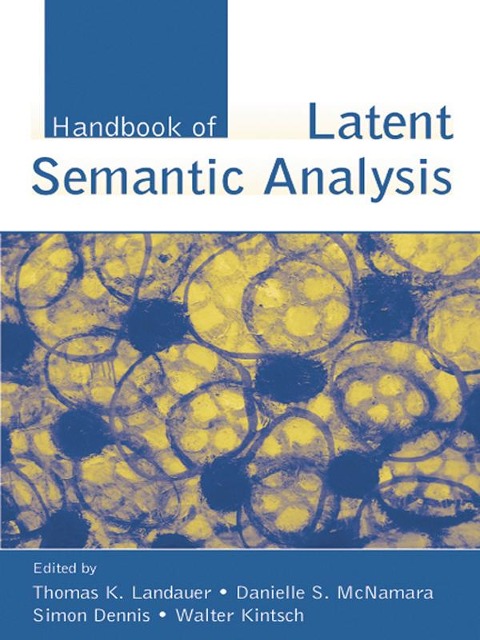
The Handbook of Latent Semantic Analysis is the authoritative reference for the theory behind Latent Semantic Analysis (LSA), a burgeoning mathematical method used to analyze how words make meaning, with the desired outcome to program machines to understand human commands via natural language rather than strict programming protocols. The first book
Thomas K. Landauer, Danielle S. McNamara, Simon Dennis, Walter Kintsch
Contents: Part I: Introduction to LSA: Theory and Methods. T.K. Landauer, LSA as a Theory of Meaning. D. Martin, M. Berry, Mathematical Foundations Behind Latent Semantic Analysis. S. Dennis, How to Use the LSA Website. J. Quesada, Creating Your Own LSA Spaces. Part II: LSA in Cognitive Theory. W. Kintsch , Meaning in Context. M. Louwerse, Symbolic or Embodied Representations: A Case for Symbol Interdependency. M.W. Howard, K. Addis, B. Jing, M.K. Kahana, Semantic Structure and Episodic Memory. G. Denhisre, B. Lemaire, C. Bellissens, S. Jhean-Larose, A Semantic Space for Modeling Children's Semantic Memory. P. Foltz, Discourse Coherence and LSA. J. Quesada, Spaces for Problem Solving. Part III: LSA in Educational Applications. K. Millis, J. Magliano, K. Wiemer-Hastings, S. Todaro, D.S. McNamara, Assessing and Improving Comprehension With Latent Semantic Analysis. D.S. McNamara, C. Boonthum, I. Levinstein, K. Millis, Evaluating Self-Explanations in iSTART: Comparing Word-Based and LSA Algorithms. A. Graesser, P. Penumatsa, M. Ventura, Z. Cai, X. Hu, Using LSA in AutoTutor: Learning Through Mixed-Initiative Dialog in Natural Language. E. Kintsch, D. Caccamise, M. Franzke, N. Johnson, S. Dooley, Summary Streetr: Computer-Guided Summary Writing. L. Streeter, K. Lochbaum, N. LaVoie, J.E. Psotka, Automated Tools for Collaborative Learning Environments. Part IV: Information Retrieval and HCI Applications of LSA. S.T. Dumais, LSA and Information Retrieval: Getting Back to Basics. P.K. Foltz, T.K. Landauer, Helping People Find and Learn From Documents: Exploiting Synergies Between Human and Computer Retrieval With SuperManual. M.H. Blackmon, M. Kitajima, D.R. Mandalia, P.G. Polson, Automating Usability Evaluation Cognitive Walkthrough for the Web Puts LSA to Work on Real-World HCI Design Problems. Part V: Extensions to LSA. D.S. McNamara, Z. Cai, M.M. Louwerse, Optimizing LSA Measures of Cohesion. X. Hu, Z. Cai, P. Wiemer-Hastings, A.C. Graesser, D.S. McNamara, Strength, Weakness, and Extensions of LSA. M. Steyvers, T. Griffiths, Probabilistic Topic Models. S. Dennis, Introducing Word Order: Within the LSA Framework. Part VI: Conclusion. W. Kintsch, D.S. McNamara, S. Dennis, T.K. Landauer, LSA and Meaning: In Theory and Application.
Dieses eBook wird im PDF-Format geliefert und ist mit einem Adobe Kopierschutz (DRM) versehen. Sie können dieses eBook mit allen Geräten lesen, die das PDF-Format und den Adobe Kopierschutz (DRM) unterstützen.
Zum Beispiel mit den folgenden Geräten:
• tolino Reader
Laden Sie das eBook direkt über den Reader-Shop auf dem tolino herunter oder übertragen Sie das eBook auf Ihren tolino mit einer kostenlosen Software wie beispielsweise Adobe Digital Editions.
• Sony Reader & andere eBook Reader
Laden Sie das eBook direkt über den Reader-Shop herunter oder übertragen Sie das eBook mit der kostenlosen Software Sony READER FOR PC/Mac oder Adobe Digital Editions auf ein Standard-Lesegeräte mit epub- und Adobe DRM-Unterstützung.
• Tablets & Smartphones
Möchten Sie dieses eBook auf Ihrem Smartphone oder Tablet lesen, finden Sie hier unsere kostenlose Lese-App für iPhone/iPad und Android Smartphone/Tablets.
• PC & Mac
Lesen Sie das eBook direkt nach dem Herunterladen mit einer kostenlosen Lesesoftware, beispielsweise Adobe Digital Editions, Sony READER FOR PC/Mac oder direkt über Ihre eBook-Bibliothek in Ihrem Konto unter „Meine eBooks“ - „online lesen“.
Schalten Sie das eBook mit Ihrer persönlichen Adobe ID auf bis zu sechs Geräten gleichzeitig frei.
Bitte beachten Sie, dass die Kindle-Geräte das Format nicht unterstützen und dieses eBook somit nicht auf Kindle-Geräten lesbar ist.